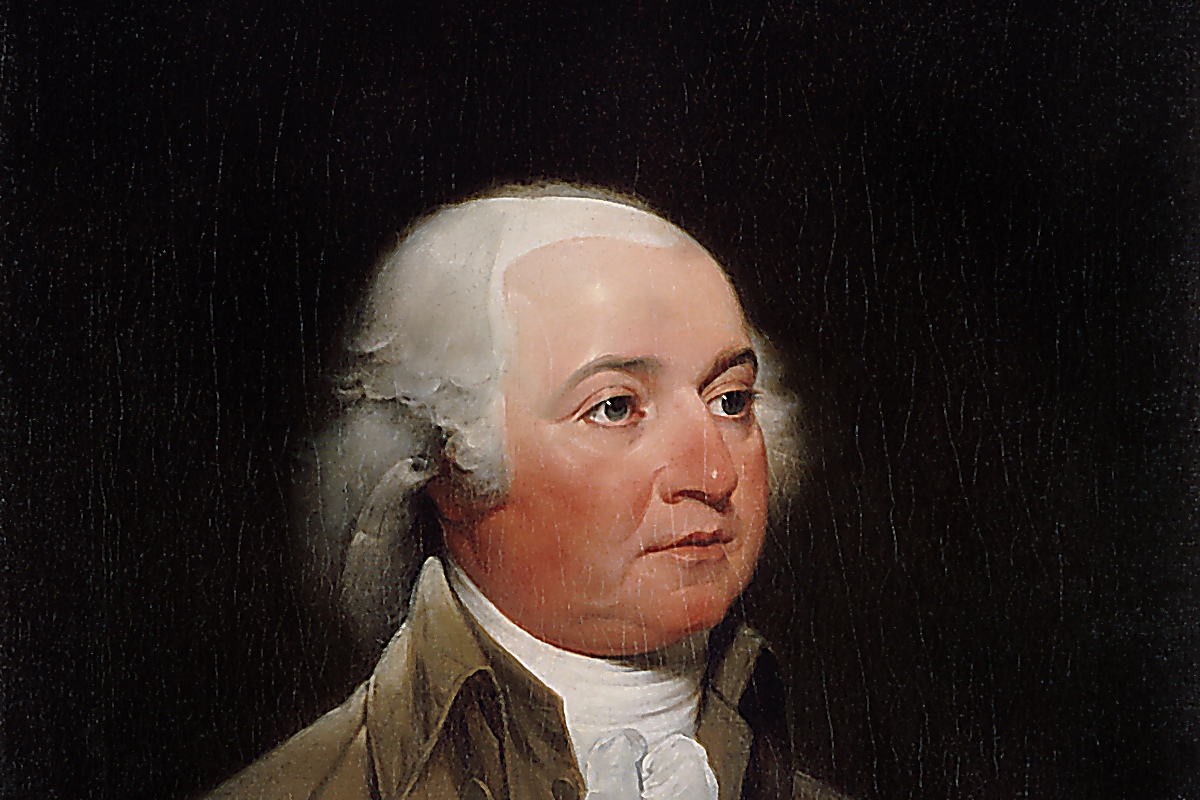
On July 11, 1798, President John Adams signed a short act of Congress with an unremarkable name: "An Act for the establishing and organizing a Marine Corps." Six sections. A few hundred words. No ceremony recorded, no speech to accompany it.
It is the law that created the Marine Corps that has existed, continuously, ever since.
Most people assume the Marine Corps has existed, unbroken, since the Revolution. It hasn't. For fifteen years, there was no Marine Corps at all.
The Document on the Table
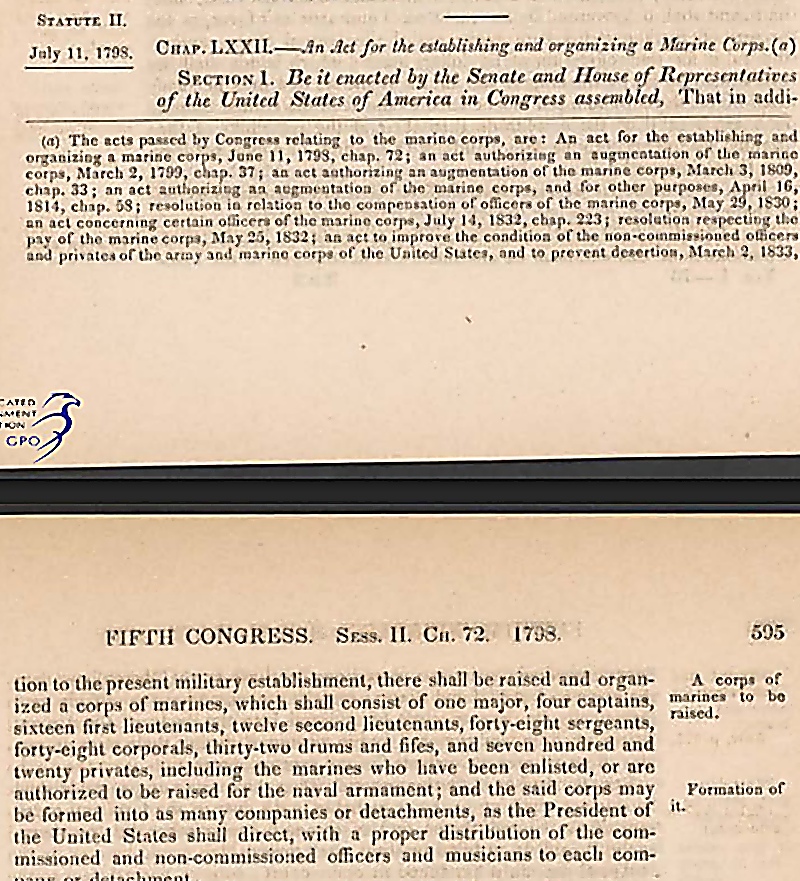
The page above comes from the U.S. Statutes at Large, Fifth Congress, Session II, Chapter LXXII, digitized and authenticated by the Government Publishing Office. The header is plain: "Statute II. July 11, 1798." No preamble explaining why the corps was needed. No mention of the Revolution, or of the fact that a Marine Corps had once existed and had been allowed to disappear.
Section 1 simply states that "in addition to the present military establishment, there shall be raised and organized a corps of marines" — one major, four captains, sixteen first lieutenants, twelve second lieutenants, forty-eight sergeants, forty-eight corporals, thirty-two drums and fifes, and seven hundred twenty privates.
Section 2 sets the pay: fifty dollars a month and four rations a day for a major, down to twenty-five dollars a month and two rations a day for a second lieutenant. Enlistments ran three years.
Section 6 is the sentence that matters most, and the one almost nobody quotes. It states that this new marine corps "shall, at any time, be liable to do duty in the forts and garrisons of the United States, on the sea-coast, or any other duty on shore, as the President, at his discretion, shall direct."
That clause established, from the outset, that Marines were not confined to shipboard service. It gave the President standing authority to put Marines to work on land, at his discretion, whenever he judged it necessary — authority written directly into the Corps' founding statute.
Fifteen Years That Officially Didn't Exist
The Continental Marines were raised by Congress on November 10, 1775, to serve aboard Continental Navy ships during the Revolution. They fought at the raid on Nassau in 1776, alongside Washington's army at Princeton in January 1777, and in scattered actions at sea through the end of the war.
When the Treaty of Paris ended the Revolution in 1783, the young republic was deeply in debt. Congress disposed of the remaining Continental Navy to save money, and the Marines — who existed to serve aboard Navy ships — disappeared along with it. For the next decade and a half, the United States had no standing navy and no Marine Corps. Small detachments of Marines served aboard some of the new frigates authorized by the Naval Act of 1794, but Congress had not yet created a separate, standing Marine Corps to organize and command them.
By 1798, that gap had become a liability. France, angered by American neutrality and the Jay Treaty with Britain, had begun seizing American merchant ships in what became known as the Quasi-War. Congress responded that year with a burst of legislation: an act creating a standalone Department of the Navy, an act authorizing new naval armament, and — on July 11 — the act reestablishing the Marine Corps as a separate military service.
The document doesn't editorialize about any of this. It doesn't mention France. It doesn't mention the fifteen-year gap it was quietly closing. It just raises a corps and tells Congress what it will cost.
Which Birthday Is the Real One
Ask the Marine Corps when it was founded, and the official answer is November 10, 1775 — the date of the original Continental Congress resolution. That date is celebrated every year as the Marine Corps birthday, complete with cake-cutting ceremonies and a reading of Commandant John A. Lejeune's 1921 order establishing the tradition.
But Lejeune's order was written in 1921, retroactively choosing 1775 as the symbolic birthday — 123 years after the actual legal recreation of the Corps in 1798, and 146 years after the original 1775 resolution. Before Lejeune's 1921 order, July 11 — the anniversary of the 1798 act — was observed within the Marine Corps as "Marine Corps Day." There's little record of ceremony behind it in those years; it doesn't appear to have involved parades or birthday balls the way November 10 does now. But it was the date on the calendar.
The 1775 Continental Marines and the modern United States Marine Corps are not, strictly speaking, the same organization. One was disbanded and ceased to exist. The other was created by a new act of Congress that never once mentions its predecessor. The Marine Corps ultimately chose to emphasize its lineage from the Continental Marines rather than the legal break represented by the 1798 act — a common enough move for a military institution tracing its history through a disbanded predecessor, but one that quietly overwrote the anniversary its own veterans had marked before 1921.
A Small Error in the Government's Own Record
There is one more detail worth noting, because it says something about how these documents get handled over time. A footnote printed on the same page as the Act, listing every law Congress ever passed concerning the Marine Corps, dates this same act to "June 11, 1798" — a month off from the "July 11, 1798" printed twice on the very same page, in the chapter heading and the "Approved" line.
It's almost certainly a printing or transcription error made more than two centuries ago and never corrected. But it's a useful reminder: even the government's own authenticated record of its own laws isn't immune to a simple mistake sitting in plain sight, uncorrected, for over 225 years.
The Marine Corps you know — the one with the birthday in November, the Eagle, Globe, and Anchor, the recruiting posters — legally began with six paragraphs signed by John Adams on July 11, 1798. Everything before that date belonged to the Continental Marines — an earlier organization that had been dissolved after the Revolutionary War, not the Corps that carries its name today.