On June 2, 1997, a federal jury in Denver, Colorado returned a unanimous verdict that would echo across American history. After deliberating for just 23 hours, jurors found Timothy James McVeigh guilty on all 11 counts against him — including conspiracy to use a weapon of mass destruction and the first-degree murder of eight federal law enforcement officers. Two months later, he was sentenced to death. It was the legal closing of the chapter on what remained, until September 11, 2001, the deadliest terrorist attack ever carried out on American soil.
The conviction was the culmination of the largest criminal investigation in the nation's history — code-named OKBOMB — involving 28,000 FBI interviews, more than 7,100 pounds of physical evidence, and nearly one billion pieces of collected information. The task force overseeing the case numbered 900 federal, state, and local law enforcement personnel and was deemed the most complex criminal case since the assassination of John F. Kennedy.
Who Was Timothy McVeigh?
Timothy James McVeigh was born on April 23, 1968, in Lockport, New York — a quiet kid from a small upstate town, the son of a General Motors worker. What distinguished him, early on, was an intense interest in firearms, a growing distrust of government, and a ferocious attachment to the idea that individual liberty was under siege.
In 1988, McVeigh enlisted in the U.S. Army, where he served as a decorated soldier through the Gulf War, earning a Bronze Star. It was in the Army that he met Terry Nichols and Michael Fortier — the men who would eventually become his co-conspirators. The three shared deep interests in survivalism, anti-government literature, and the conviction that the federal government was becoming a tyrannical force.
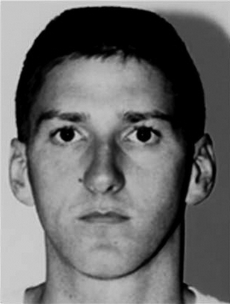 McVeigh's FBI booking photograph, taken April 21, 1995 — two days after the bombing. He was 26 years old. Federal Bureau of Investigation / Public Domain (PD-USGov-FBI).
McVeigh's radicalization accelerated through the early 1990s, driven by two federal actions that became rallying points for the American militia movement: the 1992 Ruby Ridge standoff, where an FBI sniper killed the wife and son of Randy Weaver, and the 1993 Waco siege, in which a 51-day standoff with the Branch Davidian religious community ended in fire, killing David Koresh and 76 others. McVeigh did not follow Waco from a distance. According to FBI records, he traveled to the site during the standoff and again after it ended, handing out anti-government literature.
He also found ideological fuel in fiction. As he drove toward downtown Oklahoma City on the morning of April 19, 1995, he carried pages from The Turner Diaries — a novel depicting white supremacists who blow up FBI headquarters with a truck bomb. He wore a T-shirt printed with Sic semper tyrannis — "Thus always to tyrants" — the phrase attributed to John Wilkes Booth at the moment he shot Abraham Lincoln.
"Think about the people as if they were storm troopers in Star Wars. They may be individually innocent, but they are guilty because they work for the Evil Empire." — Timothy McVeigh, on the victims of the bombing
The Plan and the Bomb
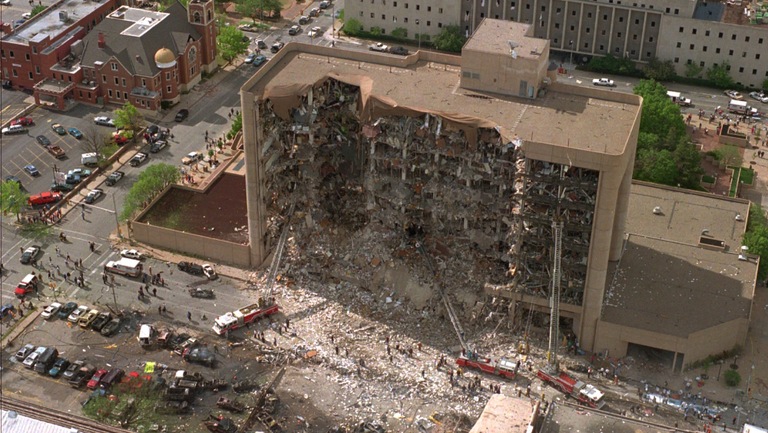
McVeigh chose the Alfred P. Murrah Federal Building in Oklahoma City with deliberation. The nine-story structure, built in 1977, housed 14 federal agencies — including the DEA, the ATF, and the Secret Service — satisfying McVeigh's self-imposed criterion that a target must contain at least two federal law enforcement agencies. He also noted that its glass facade would shatter under blast pressure, and that the open parking lot beside it would offer what he coldly described as better photo opportunities for propaganda purposes.
He timed the attack for April 19, 1995 — the second anniversary of the end of the Waco siege, and the 220th anniversary of the Battles of Lexington and Concord, the opening engagements of the American Revolutionary War. The symbolism was intentional and layered.
Over the preceding months, McVeigh and Nichols assembled their materials across multiple states — buying and stealing ammonium nitrate fertilizer, nitromethane, and blasting caps. They mixed the chemicals at Geary Lake State Park in Kansas, loading 13 barrels into the cargo bay of a rented Ryder truck. The bomb cost approximately $5,000 to construct. Its explosive force, when detonated, would be equivalent to more than 5,000 pounds of TNT.
9:02 a.m. — The Bombing
McVeigh entered Oklahoma City at 8:50 a.m. on April 19, 1995. At 8:57, a security camera captured the Ryder truck moving toward the Murrah Building. At that same moment, McVeigh lit the five-minute fuse. Three minutes later, still a block away, he lit the two-minute fuse. He parked the truck directly beneath the building's day-care center, locked the door, and walked away.
At 9:02 a.m., the bomb detonated.
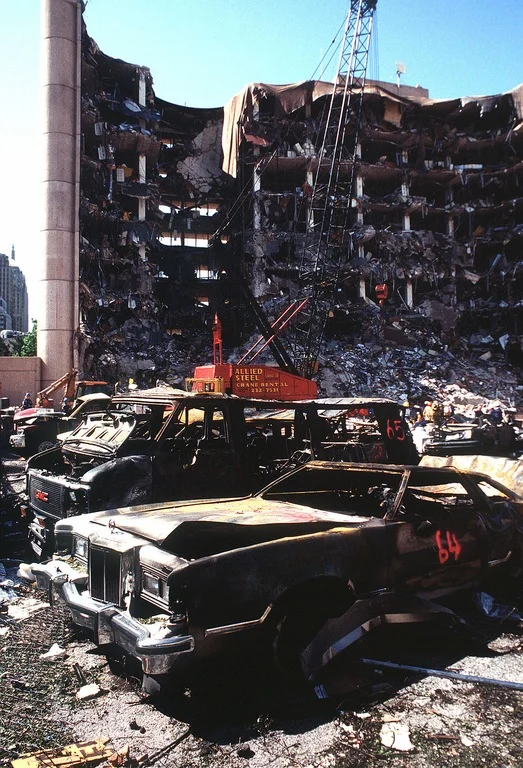 Ground-level view of the Murrah Federal Building in the days following the blast. Dozens of vehicles were incinerated; the building's north face was reduced to rubble. Rescue workers operated around the clock for two weeks. U.S. Government / Public Domain.
The explosion collapsed the northern half of the nine-story building in roughly seven seconds. The shockwave forced lower floors upward before they pancaked down, triggering a progressive structural collapse. One-third of the structure was obliterated. The blast shattered glass in 258 surrounding buildings, destroyed or damaged 324 structures within a four-block radius, and incinerated 86 vehicles. The concussion was felt and heard up to 55 miles away. Seismometers recorded the blast at approximately 3.0 on the Richter scale.
The Victims
The human toll was staggering. An estimated 650 people were inside the Murrah Building when the bomb detonated. 168 people were killed. 684 were injured.
The victims ranged in age from three months to 73 years and included three pregnant women. Of the 168 killed, 108 were federal government employees — Social Security Administration workers, HUD staff, DEA agents, Secret Service officers. Six were active military personnel. And 19 were children, 15 of them enrolled in the America's Kids Day Care Center on the building's second floor.
The youngest victim was four months old.
Nurse Rebecca Anderson, a volunteer rescue worker, became the 168th fatality when falling debris struck her head during the search and recovery operation. She is counted among the dead, though not in the direct blast toll.
Over 12,000 people participated in rescue and recovery efforts in the days that followed. FEMA deployed 665 rescue workers. The last survivor — a 15-year-old girl found under the base of the collapsed building — was pulled free at approximately 7 p.m. on the day of the bombing. Recovery efforts concluded on May 5, 1995. The building was demolished on May 23.
The photograph that came to define the tragedy was taken by bank employee Charles H. Porter IV: firefighter Chris Fields emerging from the rubble carrying one-year-old Baylee Almon, fatally injured in the blast. It won the 1996 Pulitzer Prize for Spot News Photography. Baylee's mother later said her daughter had been reduced to a symbol when she was, in fact, a real person who got left behind.
The Arrest — Caught by a Traffic Stop
Within 90 minutes of the explosion, McVeigh was already in handcuffs — not because of any investigative breakthrough, but because of a missing license plate. Oklahoma Highway Patrol Trooper Charlie Hanger stopped McVeigh's yellow 1977 Mercury Marquis on Interstate 35 near Perry, Oklahoma, for driving without a front plate. During the stop, Hanger discovered McVeigh was carrying a concealed Glock 21. He arrested him on the spot.
When Hanger booked McVeigh into the Noble County Jail, he found a business card hidden on McVeigh's person, bearing the handwritten note: "TNT at $5 a stick. Need more." That card became a critical piece of trial evidence.
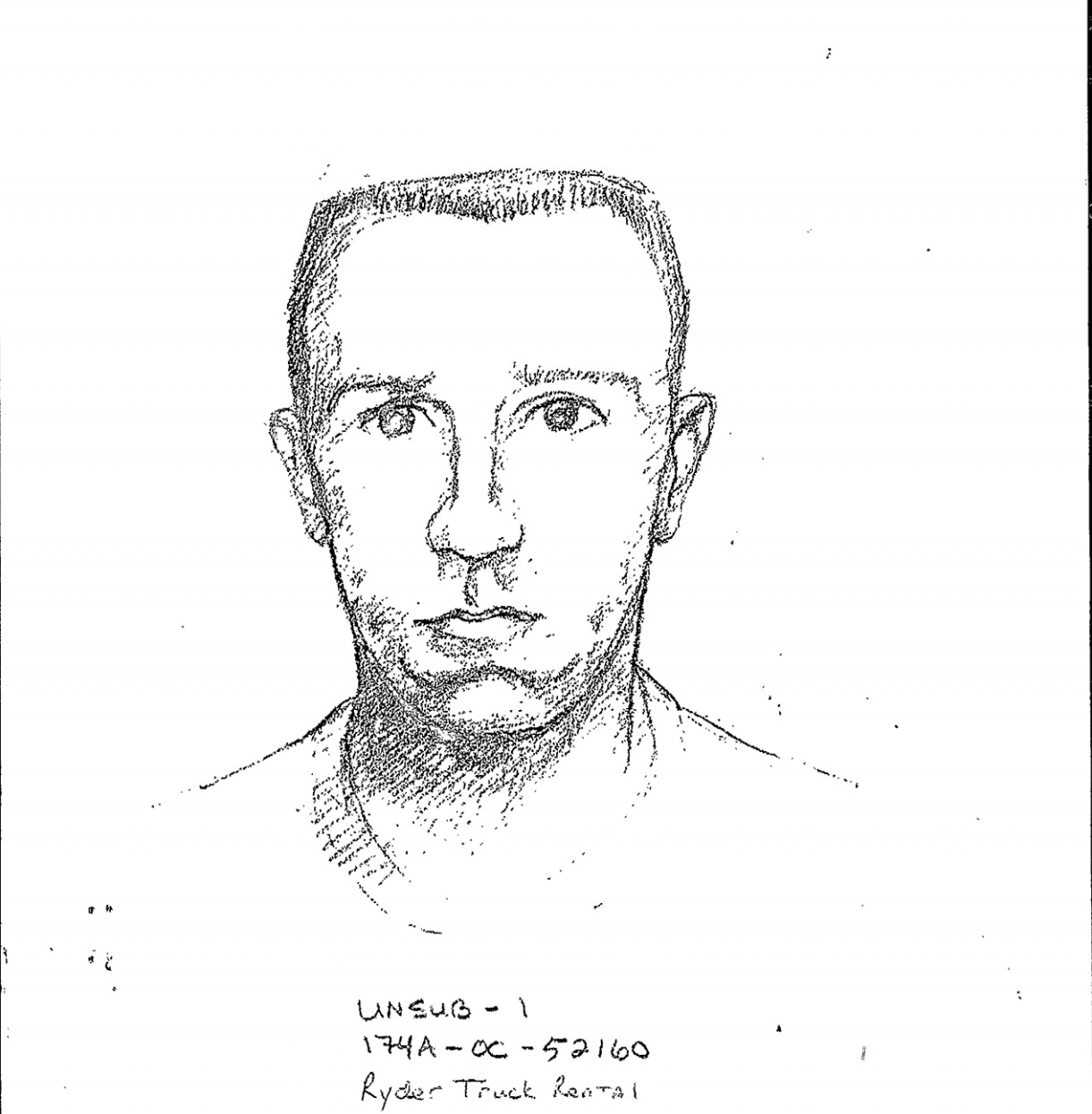
Meanwhile, investigators working the bomb site recovered a rear axle from the Ryder truck. The vehicle identification number traced to a rental agency in Junction City, Kansas — exactly 250 miles from Oklahoma City. Agency owner Eldon Elliott worked with agents to produce the now-famous composite sketch labeled UNSUB-1, case number 174A-OC-52160. It was transmitted to FBI field offices across the country within 24 hours of the bombing.
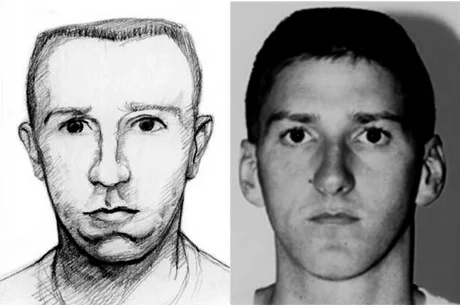 The FBI composite sketch (left), drawn with the help of Junction City rental agency owner Eldon Elliott, alongside McVeigh's actual booking photo (right). The resemblance was striking and became key trial evidence. FBI / Public Domain.
Local hotel employees in Junction City recognized the sketch and gave McVeigh's name. He had signed the Dreamland Motel register under his real name — a momentary lapse investigators believe was muscle memory breaking through his cover story. He was formally charged in connection with the bombing on April 21, 1995, while still sitting in the Noble County Jail on the weapons charge.
The original UNSUB-1 composite sketch distributed by the FBI, labeled 174A-OC-52160 — Ryder Truck Rental. Transmitted from Army CID at Fort Riley to FBI Oklahoma City on April 20, 1995 — just one day after the bombing. From the declassified FBI FOIA file obtained for this article. FBI / Public Domain (FOIA Release).
The FBI files also reveal a second composite sketch — UNSUB-2 — circulated simultaneously, depicting a possible second suspect seen with McVeigh at the rental agency. Despite intense early focus on a mysterious "John Doe No. 2," no second bomber was ever charged. McVeigh himself was characteristically blunt: "You can't handle the truth! Because the truth is, I blew up the Murrah Building — and isn't it kind of scary that one man could wreak this kind of hell?"
The Trial and Conviction
Federal judge Richard Paul Matsch ordered the trial moved from Oklahoma City to Denver, ruling that McVeigh could not receive a fair trial in a community still raw with grief. Opening statements began April 24, 1997. The prosecution, led by Joseph Hartzler, called 137 witnesses and built a methodical portrait of McVeigh's ideology, planning, and execution. Michael and Lori Fortier testified. So did McVeigh's own sister Jennifer — in exchange for immunity.
McVeigh's defense team, led by Stephen Jones, attempted to sow reasonable doubt — arguing the bombing could not have been carried out by two men alone, and that no one had placed McVeigh at the scene. The jury was unpersuaded. After 23 hours of deliberation, the verdict came on June 2, 1997: guilty on all 11 counts. Two months later, McVeigh was sentenced to death by lethal injection.
The Execution
McVeigh's appeals were exhausted by 1999. The Tenth Circuit upheld his conviction; the Supreme Court refused to hear his case. In December 2000, he ended all further appeals himself and asked that an execution date be set. He described what he wanted as "state-assisted suicide."
His execution was briefly delayed in May 2001 when the Justice Department acknowledged the FBI had failed to turn over more than 3,000 documents to the defense during discovery. A federal judge reviewed them and determined they would not have changed the outcome. The execution proceeded.
On the evening of June 10, McVeigh had his last meal: two pints of chocolate chip mint ice cream. The next morning, dressed in a white T-shirt and khaki pants, he was led to the execution chamber at USP Terre Haute, Indiana. Curtains parted for 30 direct witnesses, while 300 victims' relatives watched via closed-circuit television in Oklahoma City.
McVeigh made no final verbal statement. He left a handwritten copy of the Victorian poem Invictus by William Ernest Henley — ending with the lines: "I am the master of my fate / I am the captain of my soul."
He was pronounced dead at 8:14 a.m. on June 11, 2001. He was 33 years old. His execution was the first federal execution carried out in the United States in 38 years. Three months later to the day, the September 11 attacks occurred — and Oklahoma City ceded its grim distinction as the worst terrorist attack in American history.
Domestic Terrorism — Then and Now
The Oklahoma City bombing did not emerge from a vacuum. The declassified FBI files obtained for this article reveal how deeply embedded McVeigh's ideology was in a broader ecosystem of anti-government extremism flourishing in the early 1990s. Documents detail FBI surveillance of a Michigan paramilitary group whose members expressed anti-Semitic views, conducted armed war games, and believed the federal government was plotting to place citizens in concentration camps. A separate intelligence report from February 1995 — just two months before the bombing — documents an Oklahoma Militia meeting at a public library in Moore, Oklahoma, where members discussed fears of a UN takeover, FEMA-imposed martial law, and moving from, in their own words, "Ballots to Bullets."
McVeigh was not a lone aberration. He was the most violent product of a movement. In the wake of the bombing, the Southern Poverty Law Center tracked another 60 domestic terrorism plots between 1995 and 2005. At its peak in 1996, investigators counted approximately 858 active militia and anti-government groups in the United States.
The government's response was legislative and structural. Congress passed the Antiterrorism and Effective Death Penalty Act of 1996. New construction standards required federal buildings to include truck-resistant barriers and setbacks from public streets. The FBI hired 500 additional agents specifically to monitor domestic threats. A 2005 FBI report acknowledged that the bombing had, for the first time, brought right-wing domestic terrorism to the center of American law enforcement attention.
That awakening proved short-lived. The September 11 attacks redirected the national security apparatus toward foreign threats, and the domestic extremism McVeigh represented was treated for years as secondary. The FBI's 2021 threat assessment identified domestic violent extremism — driven by anti-government and racially motivated ideologies — as one of the two most lethal terrorism threats facing the United States. The same ideological roots that produced McVeigh remain alive in American life.
The Oklahoma City National Memorial now stands on the site of the Murrah Federal Building. A field of 168 bronze and stone chairs — one for each victim — faces a reflecting pool flanked by two gates inscribed with 9:01 and 9:03: the minute before, and the minute after. The chairs of the 19 children are smaller than the rest. They are empty. They are permanent. And they are a reminder that the deadliest act of domestic terrorism in American history was carried out not by a foreign power, but by a decorated American veteran, radicalized by ideas that had grown unchecked in the American interior — ideas that, in one form or another, are still growing today.
Primary sources: FBI FOIA Release — Timothy McVeigh File, Part 01 of 01, FOI/PA# 1275292-0, 101 pages, partially declassified. U.S. Army CID and FBI Oklahoma City inter-agency faxes, April 20 and 21, 1995. U.S. Department of Justice press releases, May and June 2001. FBI Famous Cases: Oklahoma City Bombing. Images: Federal Bureau of Investigation, public domain (PD-USGov-FBI) and U.S. Government.