Every schoolkid who gets a Civil War unit hears the line. "Damn the torpedoes, full speed ahead." Bold, defiant, exactly the kind of thing you'd want your admiral to say while sailing straight into a minefield.
There's a good chance he never said it that way.
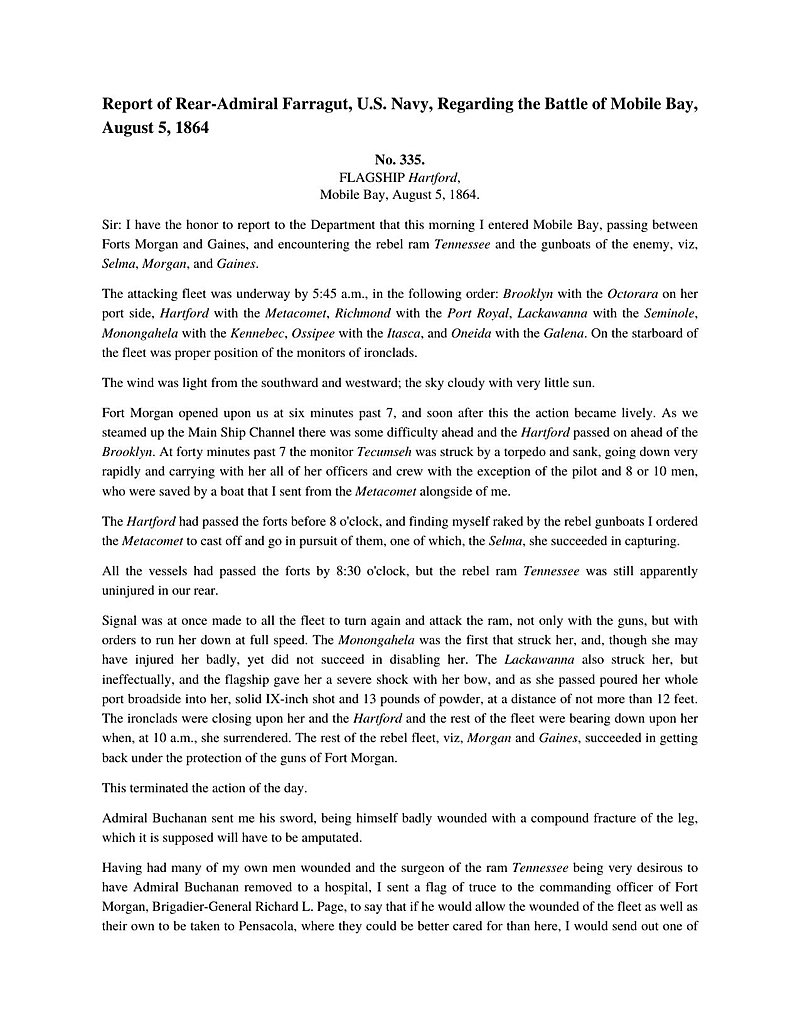
Farragut's own report to the Navy Department, filed the evening of August 5, 1864, doesn't contain the phrase at all. Neither does his longer, more detailed follow-up report a week later. The line doesn't show up in print until years afterward, and the men who were standing near him that morning gave conflicting accounts of what he actually shouted, if he shouted anything coherent over the noise of the guns at all. The most plausible version, pieced together from officers who were there, has him saying something closer to "Damn the torpedoes. Four bells, Captain Drayton," followed by an order to the gunboat Metacomet to go ahead at full speed. Practical, not poetic. There is no contemporary eyewitness account that confirms the famous wording word for word. It got sanded down into a slogan somewhere between the battle and the history books.
That's not really the interesting part, though. The interesting part is what actually happened that morning, and who got left out of the story that got built around one maybe-apocryphal sentence.
A Minefield With One Deliberate Gap
By the summer of 1864, Mobile was the last major Confederate port left open on the Gulf of Mexico. New Orleans had fallen two years earlier. Everything else worth having was already in Union hands or under blockade. Mobile Bay was still funneling supplies in from Havana through blockade runners, and Grant and the Lincoln administration wanted the port closed.
The Confederates had spent the intervening time preparing. Fort Morgan and Fort Gaines guarded the entrance to the bay, backed by a smaller work called Fort Powell. Below the surface, Confederate torpedo crews had planted roughly five dozen naval mines across the channel, marked by a line of buoys, with a narrow gap left open on the eastern side so blockade runners could still get in and out. Farragut knew about the gap. He'd been told about the minefield by refugees and deserters, and his own flag lieutenant had scouted the buoys on several nighttime reconnaissance runs without finding the mines themselves.
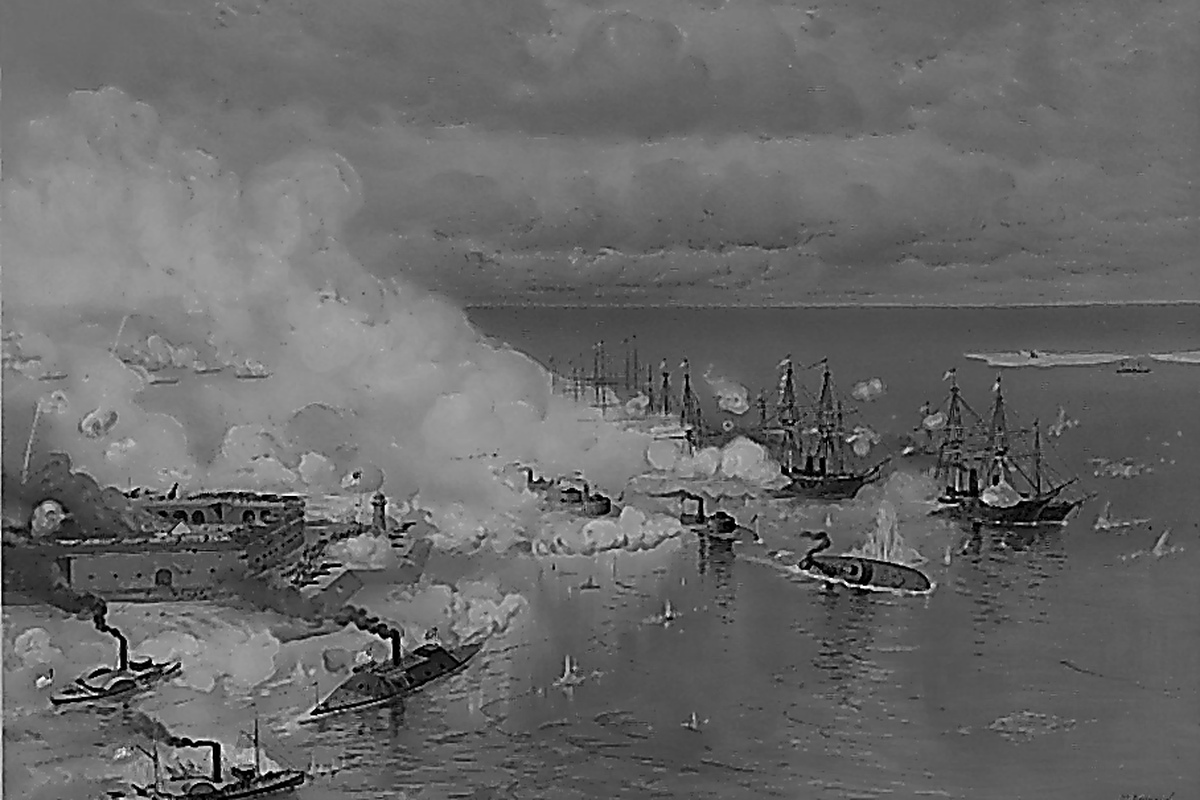
At dawn on August 5, Farragut sent his fleet in anyway, fourteen wooden ships lashed together in pairs, with four new ironclad monitors running ahead of them along the fort's side to shield the wooden hulls from Fort Morgan's guns.
It went wrong almost immediately. The lead monitor, USS Tecumseh, drifted west of the marked safe channel, whether from a targeting decision or simple bad steering is still debated, and struck a mine. She went down in two or three minutes, taking all but 21 of her 114-man crew with her. Right behind her, the wooden ship Brooklyn stopped dead in the channel, uncertain whether to press through the same water that had just swallowed an ironclad.
Farragut, watching from the rigging of his flagship Hartford where he'd been secured with a line near the mainmast for a better view of the action, made the call that actually mattered: pass Brooklyn, take the lead himself, and keep the fleet moving. Whatever he said in that moment, the decision itself, not the wording, is what got thirteen more ships through a minefield that had just proven it worked.
The Fight After the Minefield
Once inside the bay, the smaller Confederate gunboats scattered. Selma was run down and captured. Gaines took enough damage that her crew beached and burned her. Morgan slipped past the anchored Union fleet that night and escaped upriver to Mobile.
That left the CSS Tennessee, an ironclad ram commanded by Admiral Franklin Buchanan, the Confederacy's first admiral and the same man who had commanded the CSS Virginia in her famous duel with the Monitor two years earlier. Buchanan chose not to retreat under the fort's guns. He turned Tennessee around and attacked the entire Union fleet alone.
It did not go well for him. Farragut's ships rammed her repeatedly, and while the collisions did more damage to the attacking vessels than to Tennessee's armor, the accumulated fire eventually shot away her smokestack, wrecked her steering chains, and jammed several of her gun port shutters. Buchanan himself was wounded, a compound fracture of the leg, according to Farragut's own report, and Tennessee surrendered a little after 10 a.m. Farragut's first dispatch to Washington, written that same evening, put Union losses at 41 killed and 88 wounded "as far as yet ascertained." That phrase turned out to matter. As the full toll came in over the following days, the number climbed substantially, and most later accounts of the battle put Union dead closer to 150, with wounded well over 170. Casualty counts from any 1864 battle should be read as estimates that firmed up over time rather than numbers fixed on the day, and Mobile Bay is a clear example of exactly that.
The Part That Gets Cut
Here's what rarely makes it into the popular version. 115 Medals of Honor were awarded for actions during the Battle of Mobile Bay, making it the second most decorated battle in American military history. Among the recipients were four Black sailors: William H. Brown, Wilson Brown, John Henry Lawson, and James Mifflin.
That detail almost never survives the retelling. The "damn the torpedoes" version of the story has room for one dramatic sentence and one admiral tied to a mast. It has much less room for the fact that Black sailors, serving in one of the few integrated fighting forces in the United States at the time, even as discrimination in pay, promotion, and assignments remained common, fought through the same minefield and the same three-hour brawl with Tennessee and came out of it among the most decorated participants in the entire engagement.
Fort Morgan held out under siege for another three weeks before its garrison surrendered on August 23. The city of Mobile itself stayed in Confederate hands until nearly the end of the war, not falling until April 1865. But the port was closed, the last one of any size left on the Gulf, and the psychological effect back home was immediate. Coming just weeks before Sherman's capture of Atlanta, Mobile Bay became the first half of what historian James McPherson called a "lethal one-two punch" that transformed Northern morale before the 1864 election.
It was also Farragut's last battle. He never commanded in combat again.
The line people remember him for might not even be the line he said. What actually happened that morning, a calculated gamble through a live minefield, a wounded admiral surrendering his ironclad, and one of the most decorated battles in American military history, needs no embellishment at all.