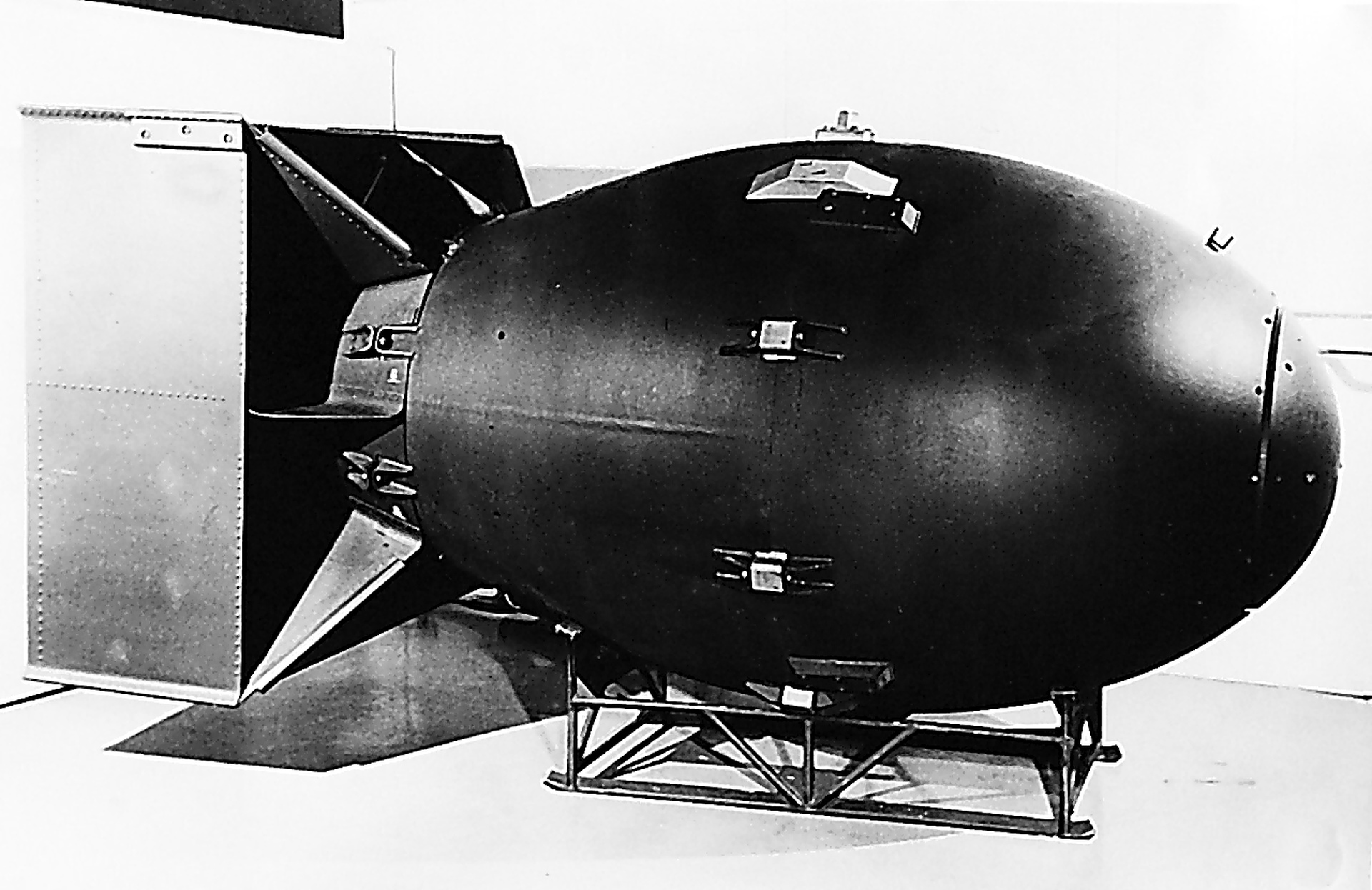
At 3:47 a.m. on August 9, 1945, a B-29 lifted off from Tinian Island carrying a plutonium bomb called Fat Man. The primary target listed in its mission orders was not Nagasaki. It was Kokura, home to one of Japan's largest military arsenals.
Nagasaki was the fallback. And for most of that morning, it looked like the mission would never even get that far.
An Order Written Two Weeks Earlier
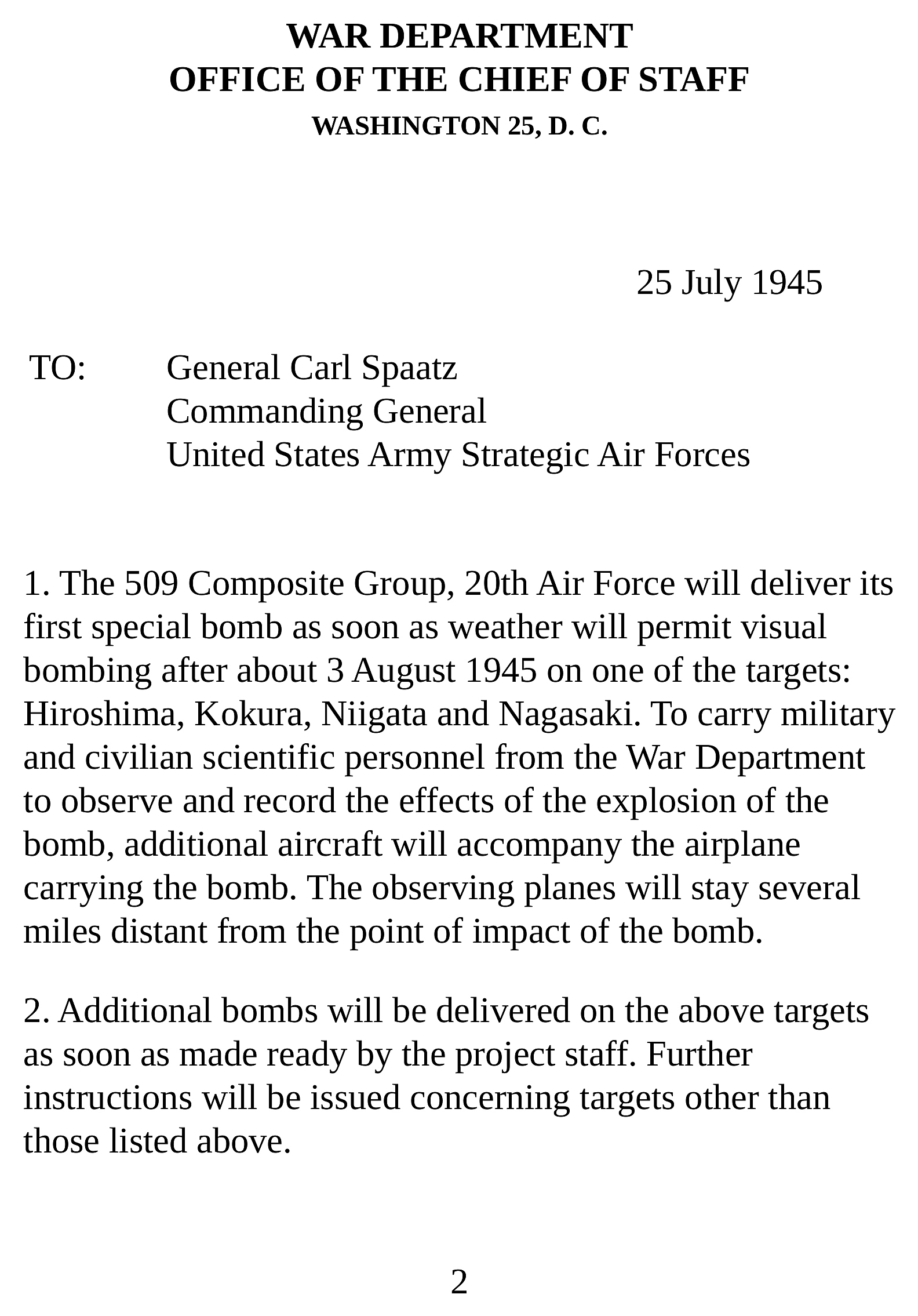
The authority to drop the bomb did not come from a decision made that morning. It came from a single typed page, four paragraphs long, signed on July 25 by General Thomas T. Handy, the acting Army chief of staff, and addressed to General Carl Spaatz, commander of the U.S. Army Strategic Air Forces. Handy signed it because Army Chief of Staff George Marshall was with Truman at the Potsdam Conference at the time.
The order named four cities the 509th Composite Group was cleared to bomb "as soon as weather will permit visual bombing after about 3 August 1945": Hiroshima, Kokura, Niigata, and Nagasaki. It also stated that "additional bombs will be delivered on the above targets as soon as made ready by the project staff." No further presidential authorization was required. When Bockscar took off on August 9, it was still operating under the same order that had sent the Enola Gay to Hiroshima three days earlier.
Nagasaki's presence on that list was recent. Through most of the spring, the fifth name under consideration by the Army's Target Committee had been Kyoto, Japan's ancient capital and a major industrial center in its own right. Secretary of War Henry Stimson had visited Kyoto years earlier and argued repeatedly that destroying Japan's ancient cultural capital would be needlessly cruel and damage postwar relations. General Leslie Groves, who ran the Manhattan Project, pushed to keep Kyoto on the list as late as July. Stimson brought the matter directly to Truman, who sided with him. On July 25, the same day Handy signed the bombing order, Nagasaki replaced Kyoto.
Kokura's Lucky Smoke
Bockscar's commander that day was Major Charles W. Sweeney, and the aircraft itself was not even his regular plane. Sweeney normally flew The Great Artiste, but that aircraft had been fitted with the sensitive instruments needed to measure the blast, so Sweeney and his crew swapped planes with Captain Frederick C. Bock, whose aircraft they took instead. Bock flew The Great Artiste on the instrumentation run while Sweeney flew what history would remember as Bockscar.
Trouble started early. Ten minutes after takeoff, Sweeney ordered the bomb armed so the aircraft could climb above the lightning and storms building over the Pacific. A flight engineer then discovered a fuel transfer pump was not working, which meant roughly 640 gallons of reserve fuel carried in a tail tank would be along for the entire flight but never usable. Replacing the pump or moving the live bomb to another aircraft would have cost hours neither the mission nor the weather allowed, so Sweeney continued on, expecting the reserve would not be needed.
He was wrong. Over the rendezvous point off the coast of Japan, one of his two escort aircraft, carrying the British observers Group Captain Leonard Cheshire and William Penney, never showed up. Sweeney circled for nearly forty minutes, well past his ordered limit, before proceeding toward Kokura alone with The Great Artiste.
What greeted them over Kokura was smoke. The city of Yahata, next door, had been hit by 224 B-29s in a firebombing raid the previous day, and the fires were still burning. Some accounts suggest the Yahata Steel Works had also deliberately burned coal tar to generate black smoke as a defensive measure. Combined with haze, roughly 70 percent of the target area was obscured. Bockscar made three separate runs over Kokura, burning fuel and time while antiaircraft fire increased and Japanese fighters were reported nearby. Crewman Jacob Beser later described the conditions over the target as getting "a little hairy." No bombardier could sight the aiming point. Sweeney gave up on Kokura.
The city's residents, who had taken shelter during an earlier air raid warning that morning, heard the all-clear and went back to their routines. Most never learned how close they had come.
The near miss entered Japanese memory as "Kokura no Un," or "Kokura's luck," a phrase still used today to describe someone who escapes disaster through sheer chance.
What Was Left When the Fuel Ran Low
With reserve fuel unreachable and the clock working against them, Bockscar turned toward its secondary target, Nagasaki, now uncertain it could even make it back to Allied territory afterward. Sweeney and the bomb's commander, Navy Captain Frederick Ashworth, discussed dumping Fat Man in the ocean if Nagasaki was also obscured and diverting straight to Okinawa. Ashworth agreed instead to allow a radar-guided drop if visual bombing proved impossible.
Nagasaki was clouded over too. At 11:01 a.m., with the aircraft already committed to its bomb run, a gap opened in the clouds. Bombardier Captain Kermit Beahan caught sight of the city below and released the bomb visually rather than by radar. Fat Man detonated one minute later, at 11:02 a.m., at an altitude of roughly 1,650 feet.
Even that final moment did not go according to any plan drawn up in Washington. The bomb detonated about 1.5 to 2 miles northwest of its planned aiming point, the Mitsubishi Steel and Arms Works, landing instead between two Mitsubishi armaments plants in the Urakami Valley, a district north of Nagasaki's commercial center. The surrounding hills helped contain the blast to that valley. Had the bomb exploded closer to its intended aiming point in the more densely developed southern part of the city, casualties would likely have been even higher.
As it was, the destruction was severe. Nearly everything within half a mile of the blast was destroyed outright, including reinforced concrete buildings that had withstood comparable damage at Hiroshima. Estimates of the dead vary by source and by the point in time being measured, ranging from roughly 40,000 killed on the day itself to a modern Radiation Effects Research Foundation estimate of 60,000 to 80,000 dead by the end of 1945, out of a city population of roughly 250,000 to 270,000. Tens of thousands more died in the years that followed from burns, radiation sickness, and related illness.
Bockscar, critically low on fuel, could not reach its planned emergency field on Iwo Jima. Sweeney diverted to Okinawa, firing every flare aboard the aircraft to signal an emergency landing after repeated attempts to reach the control tower went unanswered. The plane touched down at nearly 140 miles per hour, well above normal landing speed, with one engine already dead from fuel starvation. A second engine quit from fuel exhaustion before the aircraft finally rolled to a stop. Where the Enola Gay's crew had returned to a runway lined with cheering officers and an unexpected medal ceremony three days earlier, nobody was waiting for Bockscar. Nobody had known it was coming.
During the early hours of August 10, with Japan's Supreme War Council deadlocked, Hirohito broke the tie by making what officials called his "sacred decision" to accept the Allied surrender terms. Japan's formal surrender came five days later, and the instrument of surrender was signed on September 2, 1945, ending the war.
The Document
The order shown above is what actually authorized the mission, not a decision made in the cockpit or even in Tinian. Read closely, it lists four possible targets and none of them is singled out as more important than the others. It does not mention Kyoto, already removed from consideration weeks before it was signed. It does not mention weather, smoke, or fuel pumps. Those variables, rather than any new decision by Truman or his commanders, determined which city on the list would ultimately be struck.