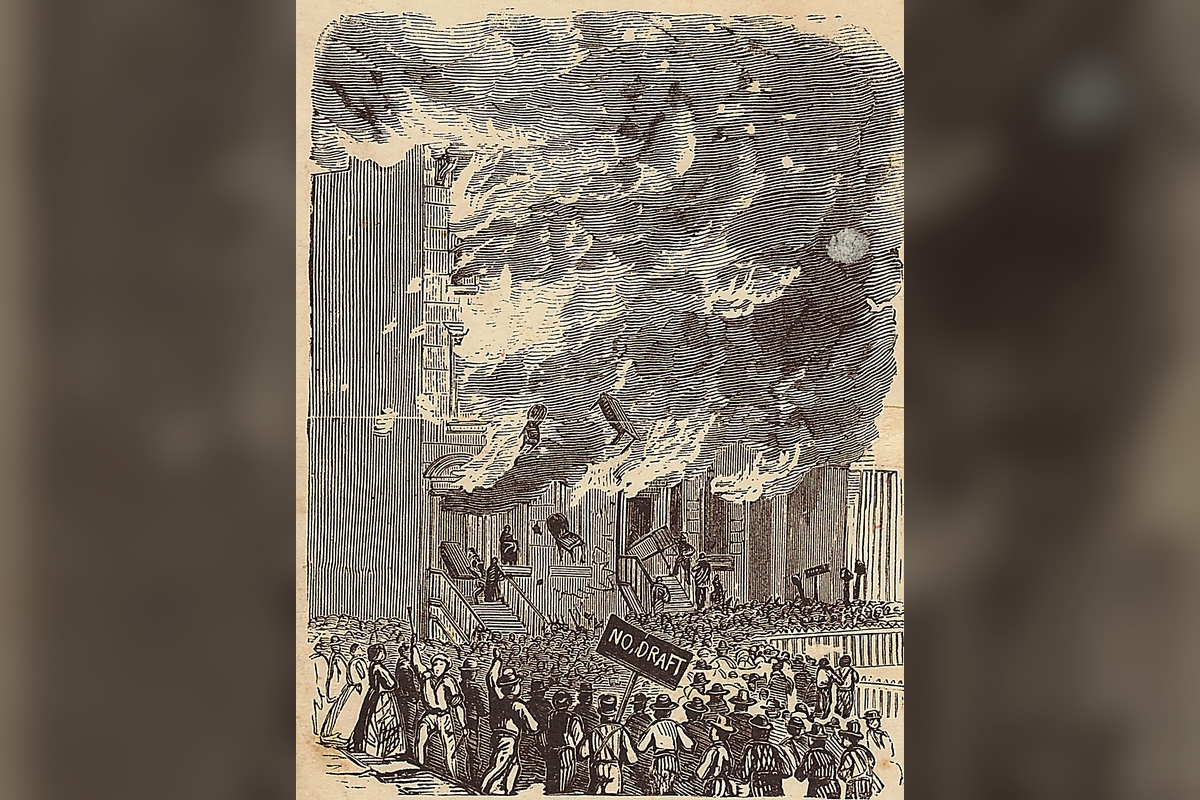
On the morning of July 13, 1863, a crowd of about 500 people gathered outside a provost marshal's office at Third Avenue and 47th Street in Manhattan, where the second drawing under the nation's first federal conscription law was underway. Many of them were volunteer firemen angered by the morning's proceedings. Within minutes they had thrown paving stones through the windows, forced the doors, and set the building on fire.
By the time federal troops finally restored order four days later, the city had absorbed the culmination of two years of buried resentment over class, race, and who got to decide who fought a war. Estimates of the dead run from about 120 to several times that number, depending on whose count you trust. At least eleven Black men were lynched in the streets. A children's orphanage was burned to the ground. And a group of New York merchants, horrified by what their city had just done, spent the following weeks compiling a written record of exactly who had suffered and how.
The Document on the Table
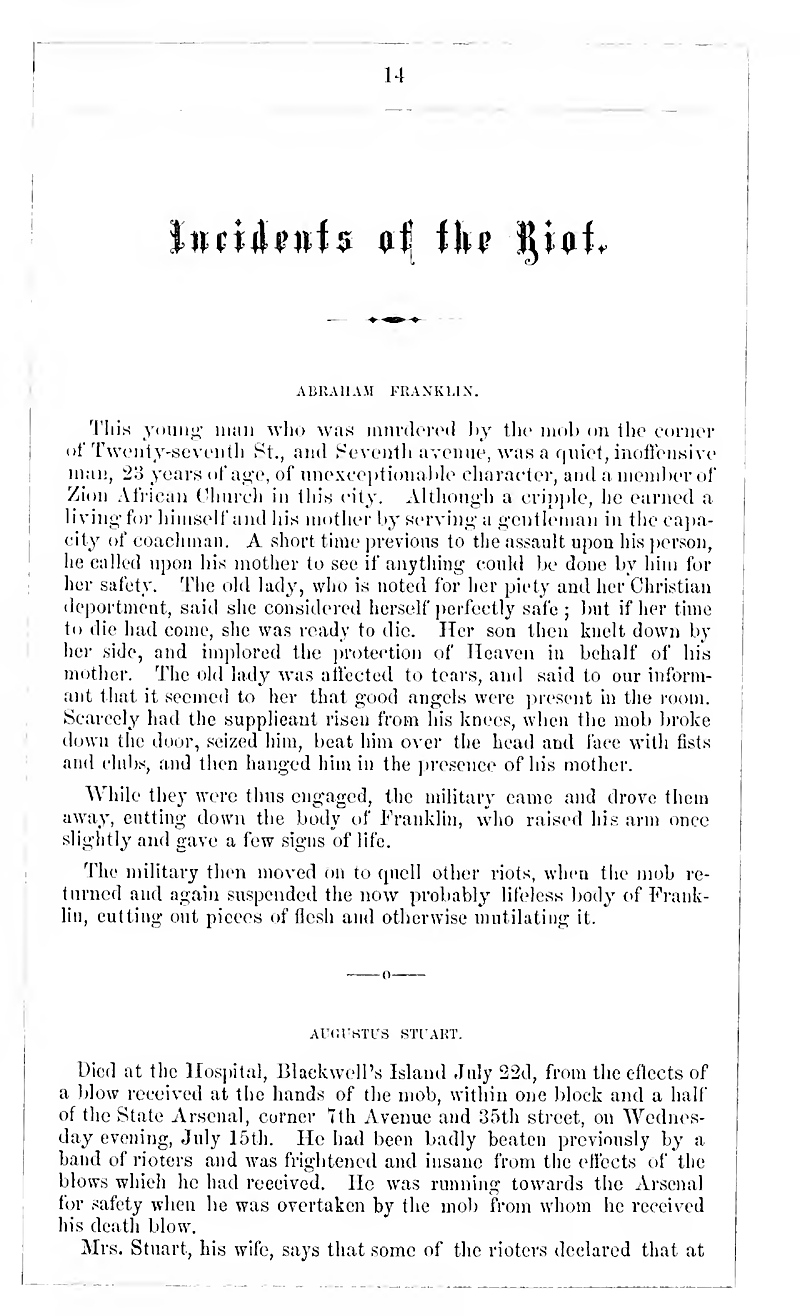
The document you see above is page 14 of a 48 page pamphlet titled Report of the Committee of Merchants for the Relief of Colored People, Suffering from the Late Riots in the City of New York. It was printed that same year, 1863, by a group of New York merchants who had raised more than $40,000 for riot victims and wanted their donors to understand exactly where the money had gone.
The page opens a section the committee called "Incidents of the Riot." The first name in it is Abraham Franklin, a 23 year old coachman described as "a quiet, inoffensive man... of unexceptionable character." Franklin was disabled and supported his mother by working for a local family. According to the committee's own interview with witnesses, he had just knelt at his mother's side to pray for her safety when the mob broke down their door. They beat him, then hanged him in front of her. Soldiers cut his body down and briefly dispersed the crowd. The mob returned once the troops moved on and mutilated what was left of him.
That is not a secondhand retelling. It is close to the committee's own words, taken from testimony they collected within weeks of the killing. The report continues with case after case in the same register: names, addresses, occupations, and what happened to each person, compiled by a group of merchants who wanted a plain accounting rather than a sermon.
Saturday Was Quiet
The draft itself came from the Enrollment Act, signed by President Lincoln on March 3, 1863, the first true national conscription law in American history. It required the enrollment of nearly every male citizen and immigrant who had filed for citizenship between the ages of 20 and 45. A drafted man could avoid service by paying a $300 commutation fee, roughly a year's wages for a laborer, or by hiring a substitute. Black men were generally excluded from the draft, since they were not yet broadly recognized as citizens under federal law.
New York City's first lottery drawing, on Saturday, July 11, passed without incident. The second drawing was scheduled for Monday, July 13, ten days after the Union's costly victory at Gettysburg, a battle that had pulled much of the militia and volunteer force that would ordinarily have kept order in New York down to Pennsylvania. The city's Metropolitan Police, alone and heavily outnumbered, were left to face whatever came next.
What came next spread quickly beyond the draft office. Rioters cut telegraph lines, destroyed streetcars, and attacked Police Superintendent John Kennedy so severely that, by later count, he had suffered more than seventy separate wounds. He recognized several of his attackers. He never fully regained his previous health, and resigned from the force a few years later.
Although opposition to the draft had sparked the violence, much of the mob's fury turned quickly toward the city's Black residents, who many white working-class rioters blamed both for the war itself and for competition over jobs.
The Colored Orphan Asylum
By that afternoon, the crowd's target had shifted. The Colored Orphan Asylum stood on Fifth Avenue near 43rd Street, a four story brick building that housed roughly 230 Black children, some as young as four years old. According to the merchants' report, several hundred rioters entered the building, carried off its furniture and supplies, and set it on fire. The asylum's matron and superintendent got every child out through the back yard before the flames took hold. They did not lose a single life that day, though the building itself was destroyed along with most of the grounds.
The riots did not spare adults who tried to defend themselves, either. James Costello, a shoemaker, was chased down by an armed man and, in self defense, shot his pursuer. The crowd killed Costello anyway. William Jones was hanged from a lamppost simply for being a Black man walking home from a bakery with a loaf of bread under his arm. Historian Leslie Harris has written that a white laborer named George Glass pulled Franklin from his home before the mob hanged him, and that a teenage bystander later dragged what remained of his body through the street. None of that cruelty was hidden. Newspapers at the time described it in similarly plain terms, and the committee's report treats it the same way: as fact to be recorded, not sensation to be dwelt on.
By some estimates, eleven Black men were lynched over the four days of rioting. The official death toll across all causes was later placed at 119 or 120, though historian Adrian Cook, who studied the riots in depth, put the combined number of killed and wounded closer to 1,000, with most of those casualties occurring among the rioters. Property damage ran to roughly $1 to $1.5 million, worth tens of millions of dollars today, though even that figure is disputed among historians who have tried to reconstruct it from surviving claims.
Four Days, Not One
Violence continued through Tuesday and Wednesday. Governor Horatio Seymour arrived and, in a speech at City Hall that would follow him the rest of his career, addressed the crowd as "my friends" while telling them the draft was unconstitutional. Major General John E. Wool, in command of the city's defenses, wrote to his superiors that "martial law ought to be proclaimed, but I have not a sufficient force to enforce it." Reinforcements did not arrive in real numbers until federal troops, pulled directly from the pursuit of Robert E. Lee's retreating army after Gettysburg, reached the city on July 16. Rioting continued in isolated pockets into July 17 before the city was finally under control.
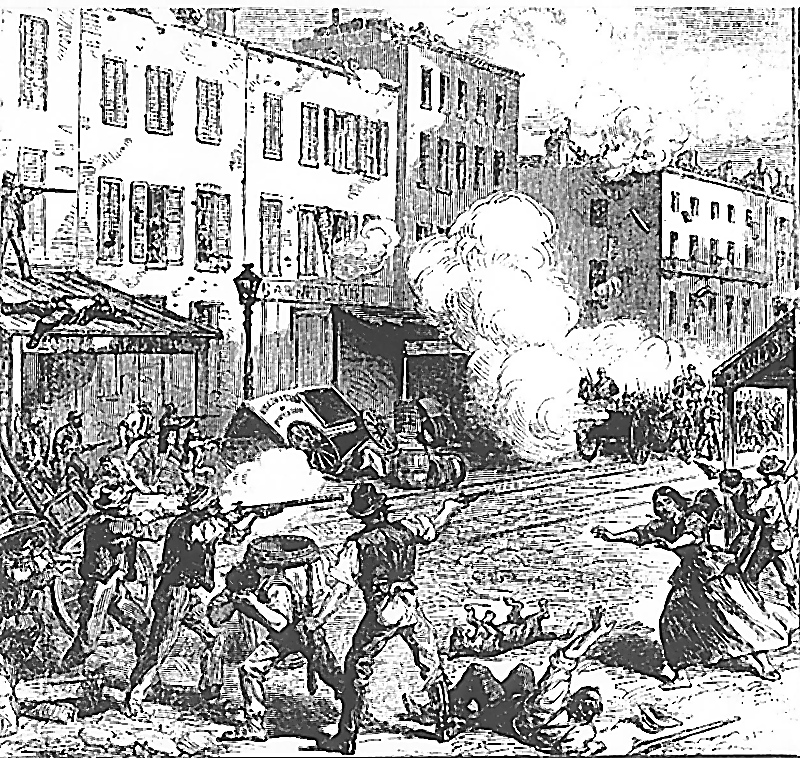 Street fighting during the New York City draft riots, July 1863. Harper's Weekly. Public domain, via Wikimedia Commons.
The draft itself, suspended during the violence, resumed on August 19 and was completed within ten days without further incident.
What the Merchants Did Next
A week after the worst of it, a group of New York merchants met at a sales room on Front Street to decide what, if anything, they owed the city's Black residents. Jonathan Sturges, who chaired the meeting, put it directly to the room: the city's Black population had been "deprived of their homes and their little property, by a mob," and the merchants intended to do something about it. Within days they had raised more than $40,000, appointed Vincent Colyer as secretary of a relief office at 350 Fourth Street, and begun processing claims.
By the time the office closed that September, the committee had provided relief to more than 12,000 people and helped file damage claims worth over $145,000 against the city on behalf of more than 2,000 claimants. The report documents all of it in painstaking detail, down to the occupations of the people they helped: laborers, longshoremen, whitewashers, waiters, cooks, seamstresses, a physician, a teacher, a farmer.
The riots permanently changed who lived in Manhattan. Thousands of Black residents left the city for Brooklyn, New Jersey, and elsewhere in the aftermath, and by 1865 the city's Black population had fallen below 11,000 for the first time in over four decades, according to most historians' estimates. Some who fled never returned.
Eight months later, in March 1864, a very different crowd gathered along the same New York streets. More than a thousand Black soldiers of a newly raised Union regiment marched to the Hudson River docks to ship south, escorted by police and members of the city's Union League Club. An estimated 100,000 New Yorkers, Black and white, turned out to watch. It did not undo what had happened the previous July. But it was, in its own way, an answer to it.