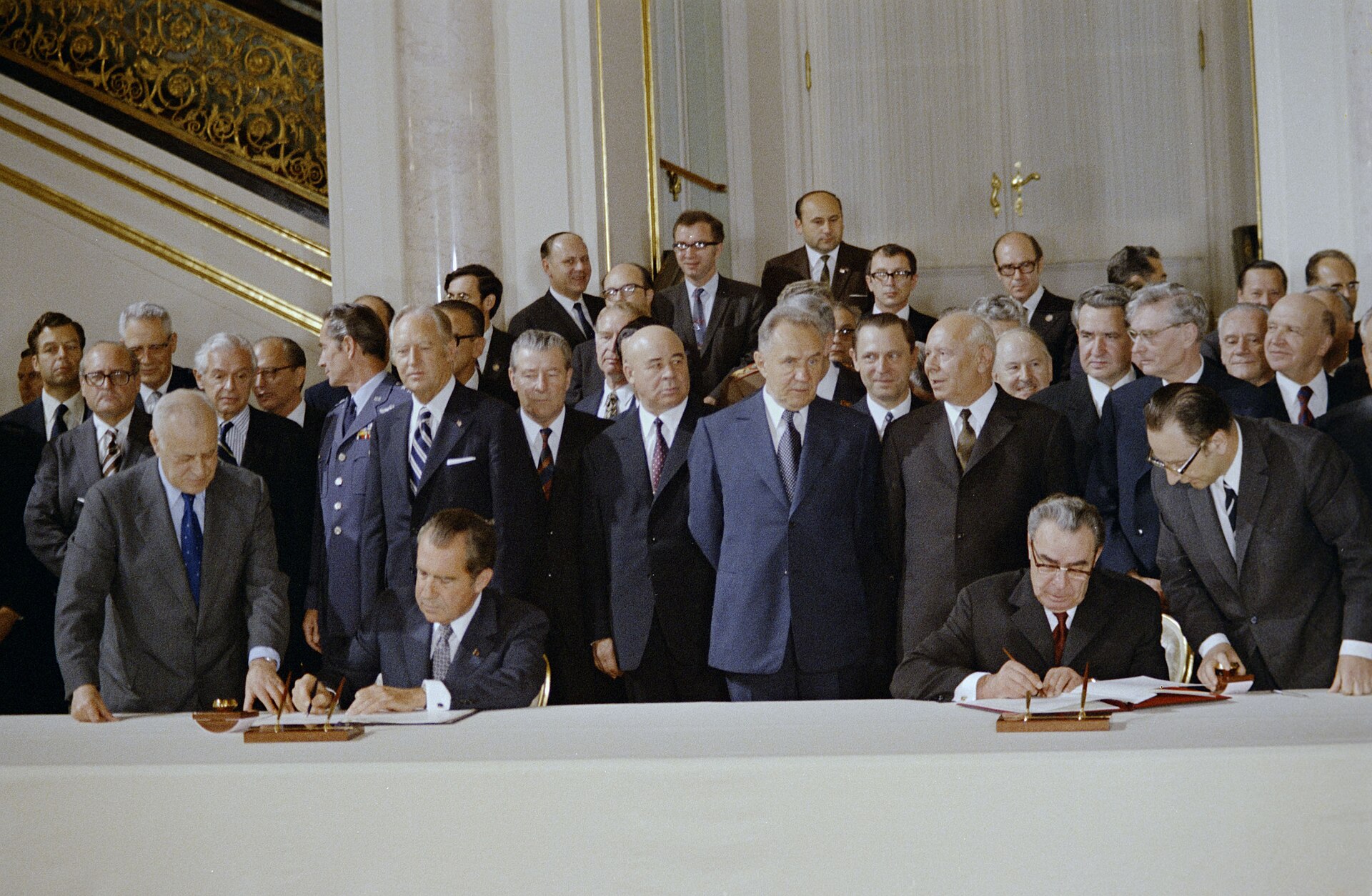
Just after eleven o'clock on the night of May 26, 1972, two of the most feared men on earth sat down together in St. Vladimir Hall at the Grand Kremlin Palace and picked up their pens.
Richard Nixon. Leonid Brezhnev. An American president who had built his entire career warning the world about the dangers of communist expansion. A Soviet general secretary who had ordered tanks into Czechoslovakia four years earlier. By any reasonable measure, they were the last two men anyone expected to sign a peace agreement.
And yet there they were.
The Strategic Arms Limitation Talks agreement, known as SALT I, was declared a triumph. The most far-reaching nuclear arms control agreement in the history of the world. A turning point in the Cold War. The beginning of détente. It was also, in ways that would take years to fully understand, a deal that changed almost nothing.
Two Cold Warriors, One Room
Neither man came to Moscow in 1972 out of idealism.
Nixon needed a headline. He had promised to end the Vietnam War in 1968. Nearly four years later, American soldiers were still dying in Southeast Asia and the American public was furious. A historic summit in Moscow, the first visit by a sitting U.S. president to the Soviet Union since Yalta in 1945, was exactly the kind of dramatic foreign policy moment that could reframe his presidency.
Brezhnev had his own problems. The Soviet relationship with communist China had collapsed into open hostility. Border skirmishes between Soviet and Chinese troops had erupted along the Ussuri River in 1969. A warming relationship with Washington gave Moscow leverage and breathing room against Beijing.
Both men wanted the deal. Neither fully trusted the other. White House Chief of Staff H.R. Haldeman wrote in his diary that night that the signing had been rushed. Nixon had been pushed through a dinner at the U.S. Embassy as fast as possible, getting back just in time for the ceremony a few minutes after eleven. Haldeman noted that everybody got a great feeling of the historic nature of the occasion.
The feeling was real. Whether what they built would last was another matter entirely.
What They Actually Signed
SALT I was not one agreement. It was two.
The Anti-Ballistic Missile Treaty limited each side to deploying missile defense systems at just two sites, later reduced to one. The logic was deliberately counterintuitive. If neither side could defend itself from a nuclear strike, neither side would ever rationally launch one. Mutual assured destruction required that both sides remain permanently vulnerable. Defense, paradoxically, made the world more dangerous.
The Interim Agreement on Strategic Offensive Arms froze the number of strategic ballistic missile launchers at their existing levels. No new land-based ICBM launchers could be constructed after July 1, 1972. New submarine-launched ballistic missile launchers could only be added if an equivalent number of older launchers were dismantled first. The protocol spelled out the caps precisely. The United States was limited to 710 submarine-launched ballistic missile launchers and 44 modern submarines. The Soviet Union was permitted 950 launchers and 62 submarines.
The numbers were not equal. They were never meant to be. Soviet missiles were larger and more numerous. American missiles carried MIRVs, which stands for multiple independently targetable reentry vehicles. A single MIRVed missile could deliver warheads to several different targets simultaneously. The Nixon administration argued that this qualitative advantage more than offset the Soviet numerical edge.
Both sides agreed to verify compliance through their own satellite and intelligence capabilities, without interference from the other party. A Standing Consultative Commission would be established to handle any disputes. The agreement would last five years, after which both sides committed to negotiating a permanent replacement.
They shook hands. The cameras rolled. The world exhaled.
The Loophole That Swallowed the Treaty
There was one thing SALT I did not limit.
MIRVs.
Multiple independently targetable reentry vehicles were, at the time of signing, almost exclusively an American technology. The United States had been deploying MIRVed missiles since 1970. The Soviets had not yet developed the capability. And SALT I placed no restrictions on them whatsoever.
This was not an oversight. It was a deliberate choice.
Henry Kissinger, Nixon's national security advisor, had actively resisted any ban on MIRV testing or deployment throughout the negotiations. His reasoning was strategic. American MIRVs were the counterweight to Soviet numerical superiority in raw missile counts. Agree to limit them, and the numerical disparity written into the treaty would look indefensible to Congress and the public.
What the agreement never adequately accounted for was that the Soviets would eventually develop their own MIRVs. And when they did, they would place them on their heavy missiles, which were already larger and more powerful than anything in the American arsenal.
By the late 1970s, that is exactly what happened. The Soviet SS-18 intercontinental ballistic missile, which NATO designated the Satan, began carrying ten MIRVed warheads. The Soviet Union had signed an agreement freezing its missile launcher count. It had multiplied its actual deliverable warhead count many times over without violating a single word of the treaty.
SALT I had frozen the number of launchers. It said nothing about what those launchers could carry.
The arms race did not end on May 26, 1972. It changed shape.
Kissinger's Shadow Negotiation
The public story of SALT I was that it emerged from years of painstaking diplomatic work by Gerard Smith, the director of the Arms Control and Disarmament Agency, who led the official American delegation through more than two years of sessions alternating between Helsinki and Vienna.
The private story was considerably different.
Throughout the negotiations, Kissinger ran a parallel backchannel directly with Soviet Ambassador Anatoly Dobrynin and later with Soviet leadership in Moscow itself, operating entirely outside the official process. In April 1972, just weeks before the summit, Kissinger flew secretly to Moscow to settle final details with Soviet leaders. He continued negotiating even after Nixon had arrived in the Soviet Union.
Smith and his delegation were not always informed of what had been agreed in the backchannel. When discrepancies emerged between what the official delegation believed had been decided and what Kissinger had privately committed to, the results were confusion, contradictions and what critics called avoidable mistakes.
The failure to address MIRVs was, in the view of many arms control experts, a direct consequence of this fragmented and secretive process. Details mattered enormously in a treaty of this complexity. The White House, managing a sweeping foreign policy agenda while simultaneously running a secret negotiation, was not positioned to get every detail right.
What the backchannel produced was a deal that could be signed by the deadline, in time for the summit, in front of the cameras. Whether it was the best possible deal was a question that got answered slowly over the following decade.
The Critics
Not everyone applauded.
Senator Henry Jackson of Washington, a Democrat, became the most prominent and persistent critic of SALT I. Jackson argued that the treaty locked in Soviet numerical superiority and that any future agreement must require strict numerical equality. He pushed what became known as the Jackson Amendment through Congress, requiring exactly that as a condition of any future SALT ratification.
The Joint Chiefs of Staff had their own reservations. Internal Pentagon documents show ongoing friction between the Defense Department, which wanted to preserve American nuclear advantages, and the White House, which was willing to trade them for the political achievement of a signed agreement.
Contradictions were baked into the agreement itself. The United States issued a unilateral statement warning that if more complete strategic limitations were not achieved within five years, it might be justified in withdrawing from the ABM Treaty to protect its national interests. The Soviets, meanwhile, claimed the right to increase their submarine count if NATO submarines exceeded certain levels. The United States explicitly rejected that interpretation at the time of signing. The two sides had agreed on paper. They had not agreed on what the paper meant.
What It Actually Accomplished
None of this means SALT I was worthless.
The ABM Treaty held for thirty years. It created a genuine strategic framework in which both sides accepted mutual vulnerability as the price of stability. That framework shaped every nuclear calculation of the Cold War's remaining decades.
The Interim Agreement established something equally important. It proved that the United States and Soviet Union could negotiate, could verify and could comply. The Standing Consultative Commission met regularly. Satellites monitored missile silos. Neither side cheated in ways that destroyed the agreement. The infrastructure of arms control, however imperfect, got built.
The talks continued. SALT II followed in 1979. START I came in 1991. New START was ratified in 2011. The chain that runs from St. Vladimir Hall in 1972 to every nuclear arms negotiation that followed is unbroken.
Nixon was right that it was historic. He was simply unwilling to say out loud that the hardest part was still ahead.
The Cadillac and the Hydrofoil
There is one more detail worth noting.
The Soviet government gave Nixon a hydrofoil for Key Biscayne as a personal gift. In return, Brezhnev, who maintained a personal collection of luxury Western automobiles, received a Cadillac. Nixon called it a damn good car.
Two men who had spent their careers preparing for nuclear war exchanged gifts like neighbors. They ate dinner together at the U.S. Embassy. They drank toasts. They talked about China, which both of them quietly feared more than they feared each other.
The arms race continued. The warhead counts climbed. The missiles grew smarter and more numerous. But for one night in Moscow, in front of the cameras and the history books, two cold warriors put down their pens and called it peace.
It was the most they could manage. And for a world that had spent twenty-five years staring at the possibility of nuclear annihilation, it was not nothing.
The SALT I Interim Agreement remained in effect for five years, expiring in 1977 without a permanent replacement. SALT II was signed in 1979 but never ratified by the U.S. Senate. The ABM Treaty remained in force until 2002, when the United States withdrew under President George W. Bush.