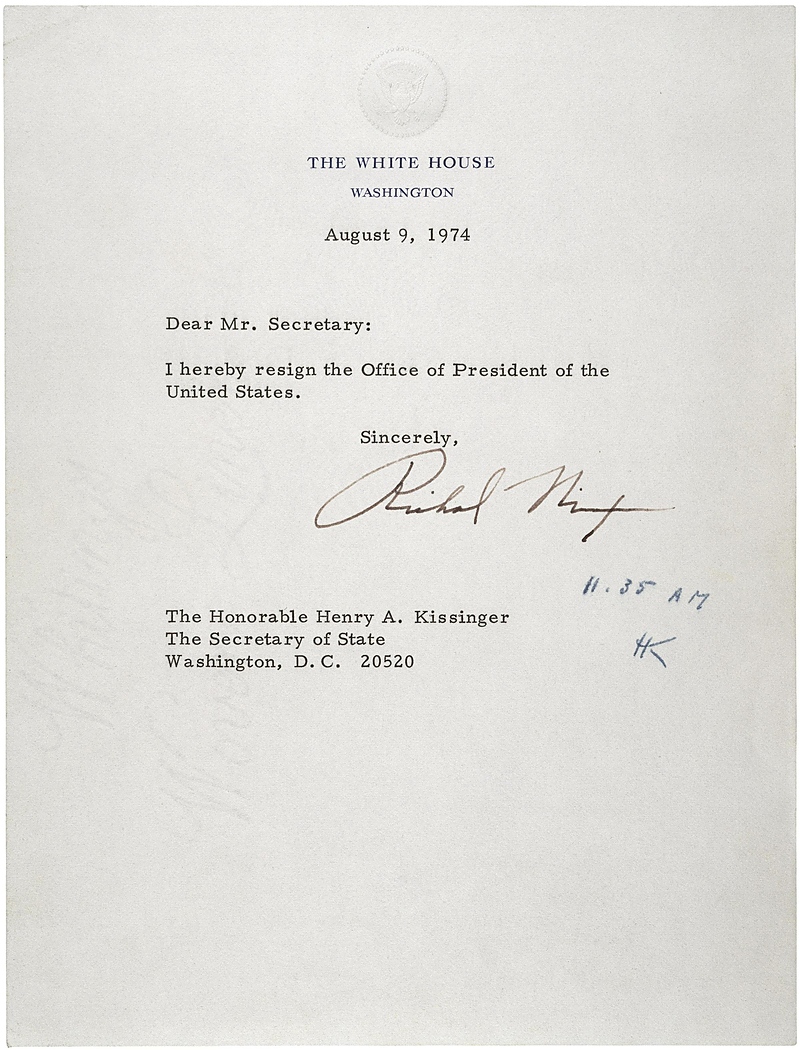
Most people who can tell you Richard Nixon resigned over Watergate could not tell you the mechanism that actually did it. It wasn't a vote in Congress. It wasn't a ruling from the Supreme Court. It was a single typed sentence on White House stationery, addressed not to the American people but to his Secretary of State, because of a 1792 law that established how presidential vacancies were formally communicated.
On the evening of August 8, 1974, Nixon sat behind the Oval Office desk and spoke to the country for the thirty-seventh time from that room. The speech ran sixteen minutes. He never said the word impeachment. He told viewers that he had concluded he no longer had enough support in Congress to keep governing effectively, and that he would resign the presidency effective at noon the next day.
That part is well known. What gets lost is what happened in the eighteen hours between the speech and the actual resignation.
Nixon's announcement on the 8th was a statement of intent, not a legal act. The Constitution says almost nothing about how a president resigns, so the country was operating under a 1792 statute that established the Secretary of State as the official recipient of notice when a presidential vacancy occurred. On the morning of August 9, White House Chief of Staff Alexander Haig brought Nixon a one paragraph letter to sign. It read, in full: "Dear Mr. Secretary: I hereby resign the Office of President of the United States. Sincerely, Richard Nixon." It was delivered to Secretary of State Henry Kissinger, who initialed it at 11:35 a.m. to acknowledge receipt. A resignation does not require anyone's acceptance, but the law required that notice of one reach that office. The delivery of that letter, not the speech the night before, is the moment Nixon's presidency legally ended. Gerald Ford was sworn in roughly thirty minutes later.
The letter itself gives away nothing. No mention of Watergate, no admission of wrongdoing, no acknowledgment of the three articles of impeachment the House Judiciary Committee had approved less than two weeks earlier. Compare that to the televised speech, where Nixon came closest to contrition when he said he regretted "any injuries that may have been done in the course of the events that led to this decision." Even that stopped short of admitting the injuries were his doing.
By the time Nixon spoke, the outcome was not really in doubt. Three days earlier, on August 5, he had released transcripts of a taped conversation from days after the Watergate break in, showing he had approved an effort to use the CIA to limit the FBI's investigation. That recording became known as the smoking gun. It cost Nixon the last of his support among Republican leaders. Barry Goldwater, Hugh Scott, and John Rhodes, three prominent Republican allies in Congress, met with him privately on August 7 and told him plainly that he would lose an impeachment trial in the Senate. Nixon made his decision to resign that same night.
There is a strange echo buried in the calendar here. On August 8, 1863, more than a century earlier, Robert E. Lee wrote a letter offering to resign his command of the Army of Northern Virginia to Jefferson Davis after the defeat at Gettysburg. Davis refused it. Lee stayed. Nixon had no equivalent option. There was no one above him who could refuse his letter, only a procedure established by law that determined where it had to be delivered.
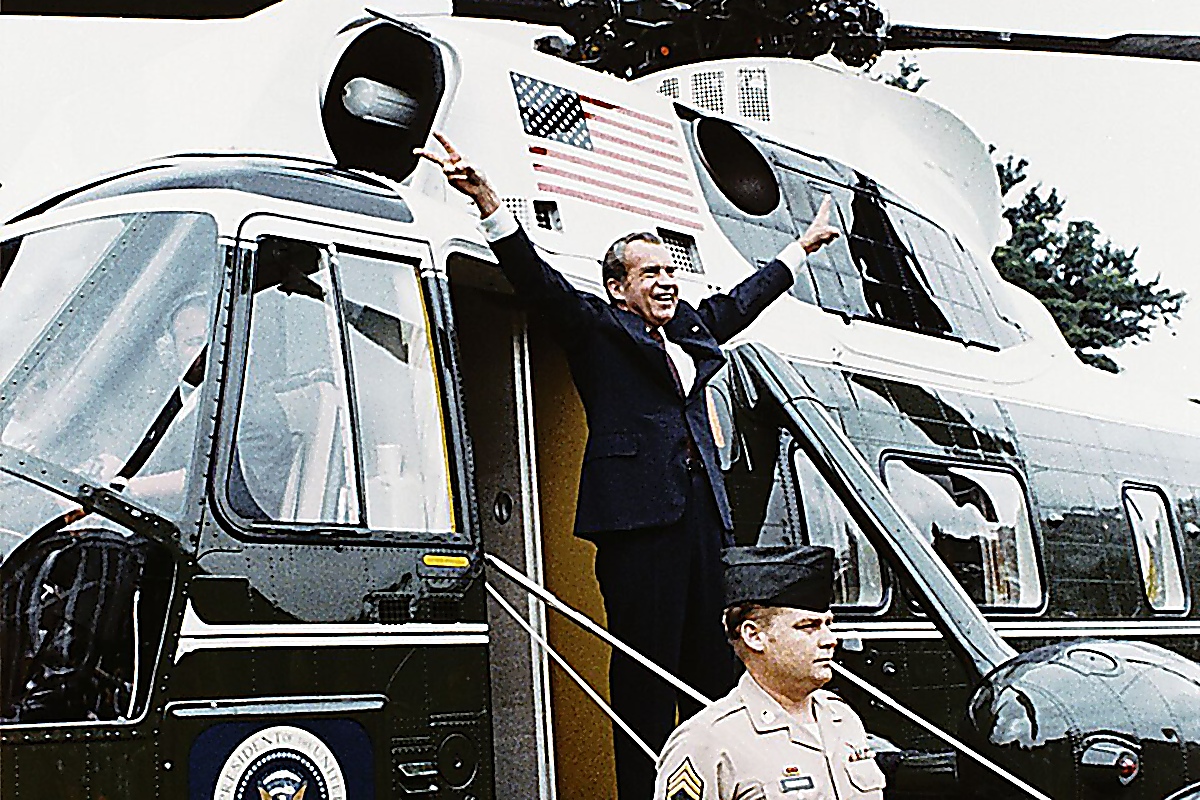
Nixon left the White House the next afternoon by helicopter, pausing at the top of the stairs to raise both arms in his trademark double V gesture, the defining image of the day. A little over a month later, on September 8, 1974, Ford granted him a full pardon for any crimes he might have committed as president, a decision Ford always insisted was not part of any deal, though the suspicion followed him for the rest of his political career.
Nixon remains the only U.S. president to resign the office. The speech is what people remember. The letter is what actually did it.