Ask most people when NORAD was created and you will get 1958, if you get an answer at all. Ask NORAD's own public affairs office and their current fact sheet says "September 1957." Neither one mentions August 1.
But pull the actual treaty, the exchange of diplomatic notes that formally established the agreement, and it opens with a very specific sentence. Canadian Ambassador N. A. Robertson, writing to Secretary of State John Foster Dulles, refers to "the joint announcement of August 1, 1957," not once but twice in the same paragraph. That announcement, made jointly by Canada's Minister of National Defence and the United States Secretary of Defense, is what the treaty itself points to as the beginning. Everything that followed, the headquarters at Ent Air Force Base, the formal signing nine months later, the eventual move into Cheyenne Mountain, traces back to that one August afternoon.
So why does almost nobody, including NORAD, lead with it?
Part of the answer is that the announcement was the easy part. The hard part happened in the months before and after.
In late 1956, Canadian and American military officials had already agreed in principle that the air defense of North America needed a single, integrated command rather than two national defense plans loosely coordinated with each other. The United States Joint Chiefs of Staff signed off in February 1957. Then Canadian politics got in the way. A federal election that spring replaced Louis St. Laurent's Liberal government with John Diefenbaker's Conservatives, and the new prime minister was not eager to look like he was simply extending American military reach into Canadian territory.
What happened next is the part that rarely makes it into the official retellings. Diefenbaker's defense minister, George Pearkes, lobbied him hard, and within weeks of taking office, Diefenbaker personally approved the plan before a full cabinet debate could occur. He moved so quickly that his own Department of External Affairs, the people responsible for actually negotiating the agreement, were caught off guard. The opposition Liberals criticized the government for moving too quickly on a decision affecting Canadian sovereignty.
That is the political mess sitting underneath the tidy joint announcement of August 1, 1957. The public got a clean statement that two allied governments had agreed to integrate their air defenses. What they did not get, at least not right away, was a clear picture of how limited the internal debate had been in Ottawa before that statement went out.
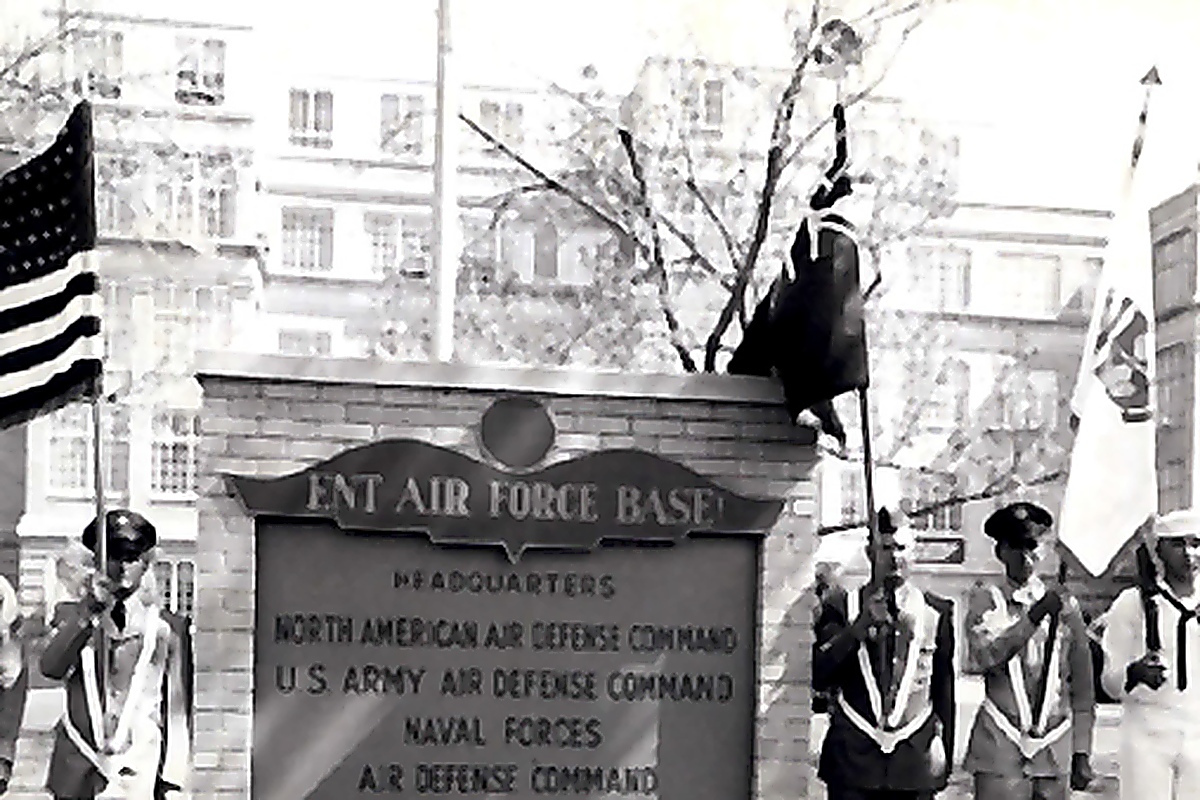
The command stood up on an interim basis a little over a month later, on September 12, 1957, at a 1954-era blockhouse on Ent Air Force Base in Colorado Springs. It would operate that way, informally, for another eight months while diplomats worked out the actual terms. The formal agreement, the one with the eleven governing principles and the ten-year renewal clause, was not signed until May 12, 1958, in an exchange of notes between Robertson and Dulles's office. That is the date most reference works cite as NORAD's founding, because it is the date with a signed piece of paper attached to it.
But the paper itself says otherwise. It says the studies and negotiations "led to the joint announcement of August 1, 1957," and that everything from Colorado Springs onward happened "pursuant to" that announcement. The agreement itself traces NORAD's origins to that August 1 announcement, even though the agreement's own signature is nine months later.
There is something fitting about a Cold War alliance built to detect incoming threats having a founding date that nobody can quite agree on. NORAD spent the next several decades refining its ability to separate real signals from false ones, most famously during a string of false alarms in 1979 and 1980 when equipment failures briefly made it look like a Soviet attack was underway. It is a little ironic that the command's own birthday has never been fully sorted out.
For what it is worth, the primary source makes clear that the governments themselves viewed the August 1, 1957 announcement as the starting point from which the command was implemented. Everything else, the interim headquarters, the formal signing, the eventual move underground into Cheyenne Mountain, followed from that one announcement.