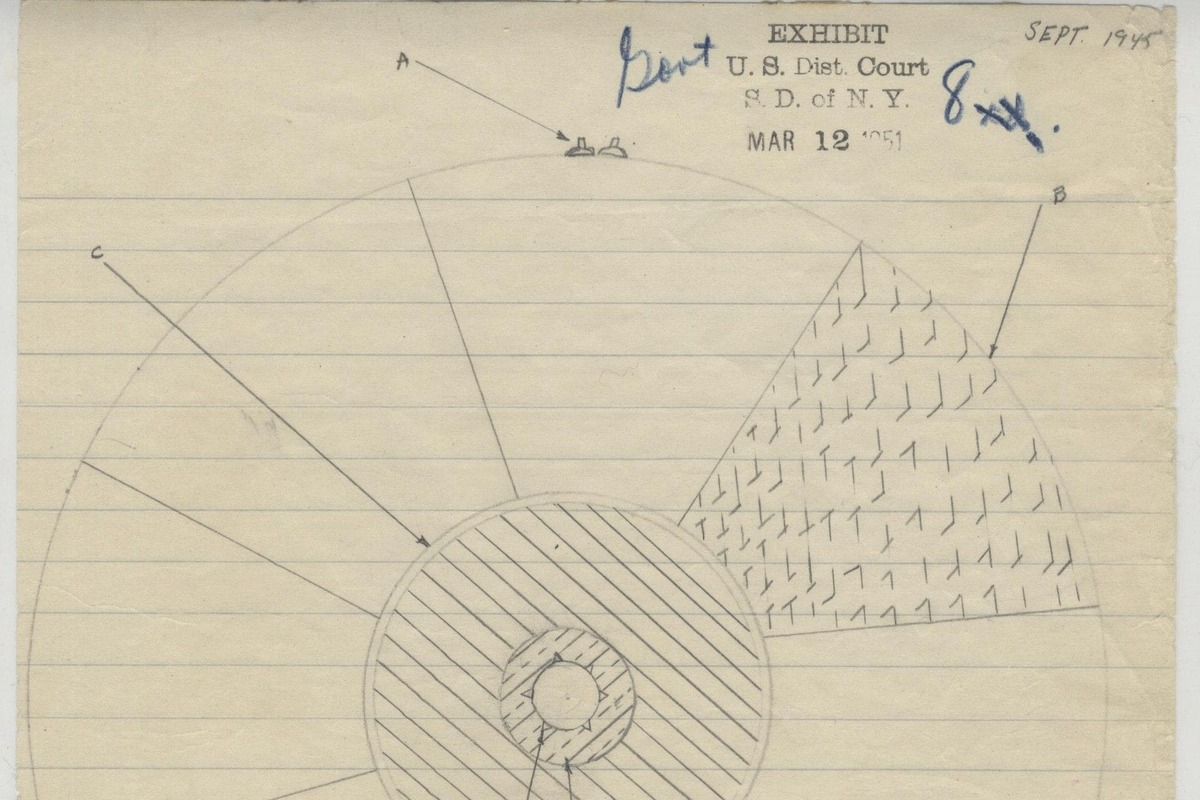
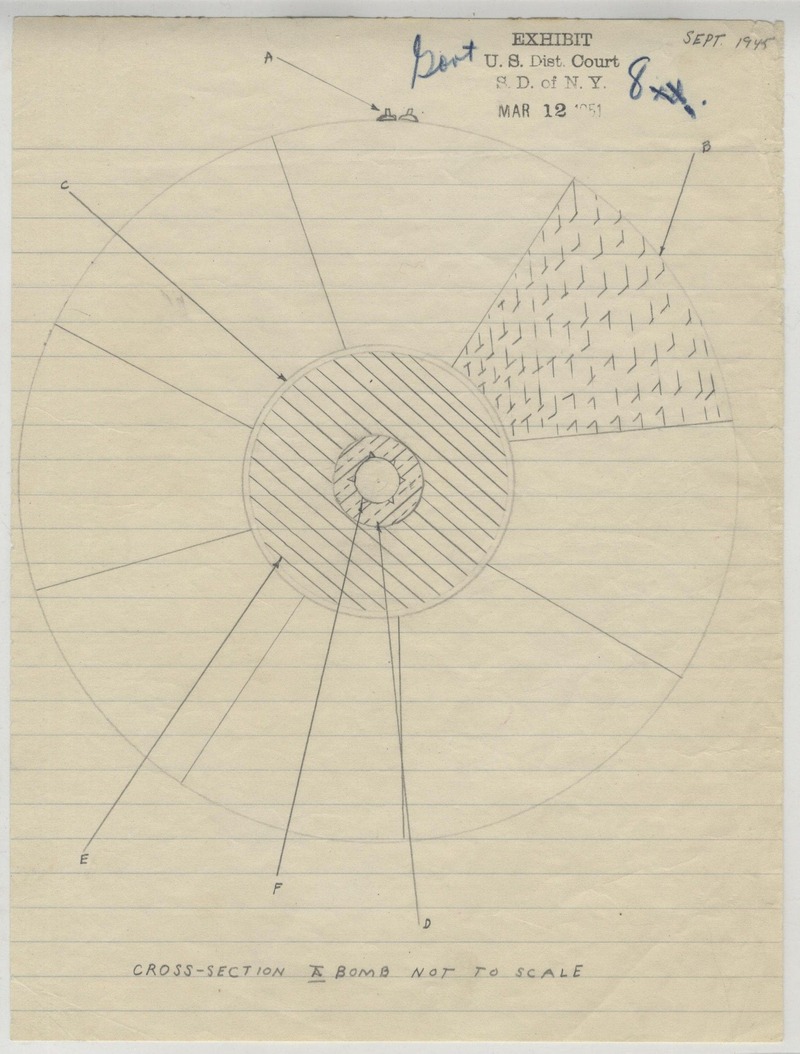
On June 19, 1953, Julius and Ethel Rosenberg were executed in the electric chair at Sing Sing Prison, convicted of conspiracy to commit espionage. A central piece of the government's atomic espionage case against Julius came down to a single piece of evidence: a pencil drawing of an atomic bomb's cross-section, sketched from memory by Ethel's brother, David Greenglass, for a jury in 1951, six years after he says the original changed hands. Beneath the title, in Greenglass's own handwriting, are three words that sit oddly next to a capital crime: not to scale.
Ethel's conviction rested on separate testimony, the claim that she typed up Greenglass's notes, which her brother himself walked back decades later. The sketch belongs to Julius's side of the case, not Ethel's, and even there it's only one part of a broader espionage charge. But it's also the clearest window into how thin the technical case actually was, and how strangely the government handled the one document everyone agreed mattered most.
Greenglass was not a physicist. He had briefly studied mechanical engineering before the war and worked at Los Alamos as an Army machinist, building parts to specifications he often didn't fully understand. He testified that in January 1945 he gave Julius sketches of the high explosive lens molds used in implosion-type weapons, and that in September 1945 he handed over a cross-section sketch of the "Fat Man" design, the bomb later dropped on Nagasaki. Neither original was ever recovered. What the jury saw, marked Government Exhibits 7 and 8, were reconstructions Greenglass drew at the prosecution's request for trial.
A document too sensitive to show, and too useful to leave out
The moment the cross-section sketch was introduced, Julius's own lawyer asked the court to seal it from public view, arguing that displaying it openly would itself endanger national security. Judge Irving Kaufman agreed, restricting it to the court, the jury, the defendants, and the attorneys, noting that since the defense had requested the restriction, they would have no grounds to complain about it later on appeal.
That single ruling captures the strange status this sketch held throughout the case. It was dangerous enough to keep from the public in the courtroom, yet the government had gone out of its way, before the trial even started, to make sure it could be discussed in open court at all. Greenglass had already told the FBI that his contribution amounted to little more than describing a barometric triggering mechanism and a rough physical layout, not the kind of thing that supports a death sentence on its own, as one of the prosecutors later acknowledged under oath. To strengthen the case, Assistant Attorney General Myles Lane worked with Atomic Energy Commission chairman Gordon Dean to get congressional buy-in for declassifying Greenglass's bomb testimony specifically so it could be used at trial. Prosecutor Irving Saypol said as much for the record: the AEC had declassified the material under the Atomic Energy Act, with the explicit understanding that it would be reclassified the moment the trial ended.
So the most damaging piece of evidence against Julius Rosenberg was secret until the government needed it to convict him, sealed from public view for the length of the trial itself, then secret again as soon as the verdict came in.
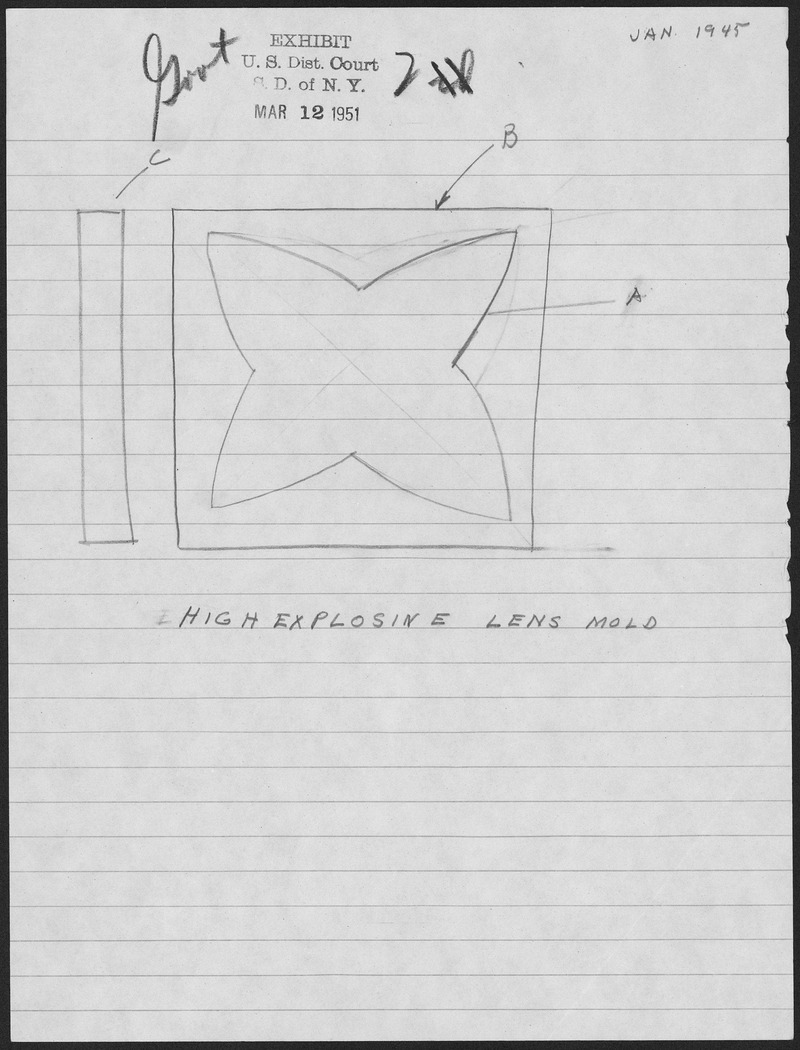 Government Exhibit 7, dated January 1945: the lens mold sketch Greenglass testified he reproduced for the prosecution.
Translating a machinist's memory into a capital crime
Because Greenglass's own testimony couldn't establish how dangerous the sketches actually were, prosecutors called Walter Koski, an Atomic Energy Commission physical chemist who had worked on lens mold research at Los Alamos, to walk the jury through what an expert could glean from them. Koski didn't claim the sketches amounted to a working bomb design. He testified, more carefully, that someone already expert in the field could use them to confirm the general direction American research had taken.
Judge Kaufman built his sentencing on that inference, then went well beyond what the testimony itself supported. He called the Rosenbergs' crime worse than murder, told them their actions had put the bomb into the hands of the Russians years ahead of schedule, and held them responsible for the more than fifty thousand American casualties of the Korean War. Nothing in the trial record claimed the sketches had accelerated Soviet research by any specific number of years, let alone tied them to a war on the other side of the world. That framing came from the bench, not the evidence, and it's the version of the story most people still carry around.
What the government's own experts thought, and kept quiet
Three years later, at the 1954 hearing that stripped Robert Oppenheimer of his security clearance, General Leslie Groves, who had run the Manhattan Project, was asked privately about the Rosenberg case. He said the information that went out was, in his judgment, of minor value, and that he had always felt the effects were greatly exaggerated. He asked that his comment be kept quiet, by his own account because he still believed the Rosenbergs deserved to die regardless of what the sketches were actually worth. The transcript took him at his word: that section of his testimony was redacted from the public 1954 record and stayed classified until 2014, sixty years after he said it.
Accounts from the Soviet side have run in a similar direction, though they carry their own motives for downplaying the haul. Alexander Feklisov, who served as Julius Rosenberg's actual KGB handler, said decades later that Julius didn't understand anything about the atomic bomb and couldn't help on that front. Boris Brokhovich, the engineer who ran the Soviet Union's plutonium production plant at Chelyabinsk-40, was characteristically blunt about it: in his telling, the Rosenbergs went to the chair for information that gave the Soviet program essentially nothing.
That isn't the only word on the subject, and it shouldn't be treated as the final one. Senator Daniel Patrick Moynihan, citing physicist Hans Bethe's wartime estimate that the Soviets would need roughly five years to build a bomb without outside help, argued that espionage, atomic spying broadly, not the Greenglass sketches specifically, helped them do it in four. Historians still disagree about how much of that one year, if any of it, traces back to anything Greenglass actually handed over. The sketches' real value was disputed before the trial transcript was even bound, and it remains disputed now.
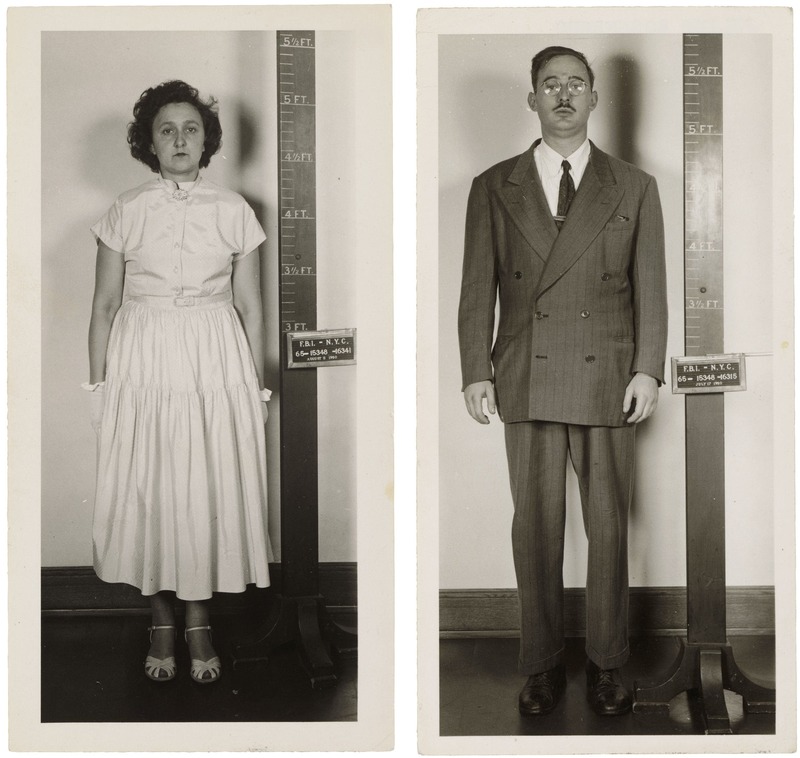 Ethel and Julius Rosenberg's FBI booking photographs, taken five weeks apart in the summer of 1950.
A document that outlived its own secrecy rules
When the National Security Agency declassified the Venona intercepts in 1995, the decoded Soviet cables confirmed Julius operated under the codenames Antenna and later Liberal, and that he was a real and active Soviet asset. What the cables describe most clearly, though, is military and industrial espionage: radar, jet propulsion designs, naval ordnance, the kind of material that moved through Julius from contacts like Morton Sobell. The cables say comparatively little about atomic weapons specifically, and at least one reading of the traffic has suggested Julius may not have fully grasped what his brother in law was actually giving him.
None of this settles the broader question of the Rosenbergs' guilt, which historians, including their own sons, have continued to debate using evidence well beyond the bomb sketches alone. What the sketches do settle is narrower, and in its way stranger: the single document treated as serious enough to help send a man to the electric chair carried its own handwritten admission that it wasn't drawn to scale, and one of the government's most senior wartime officials privately said its significance had been greatly exaggerated, a judgment kept classified for sixty years.