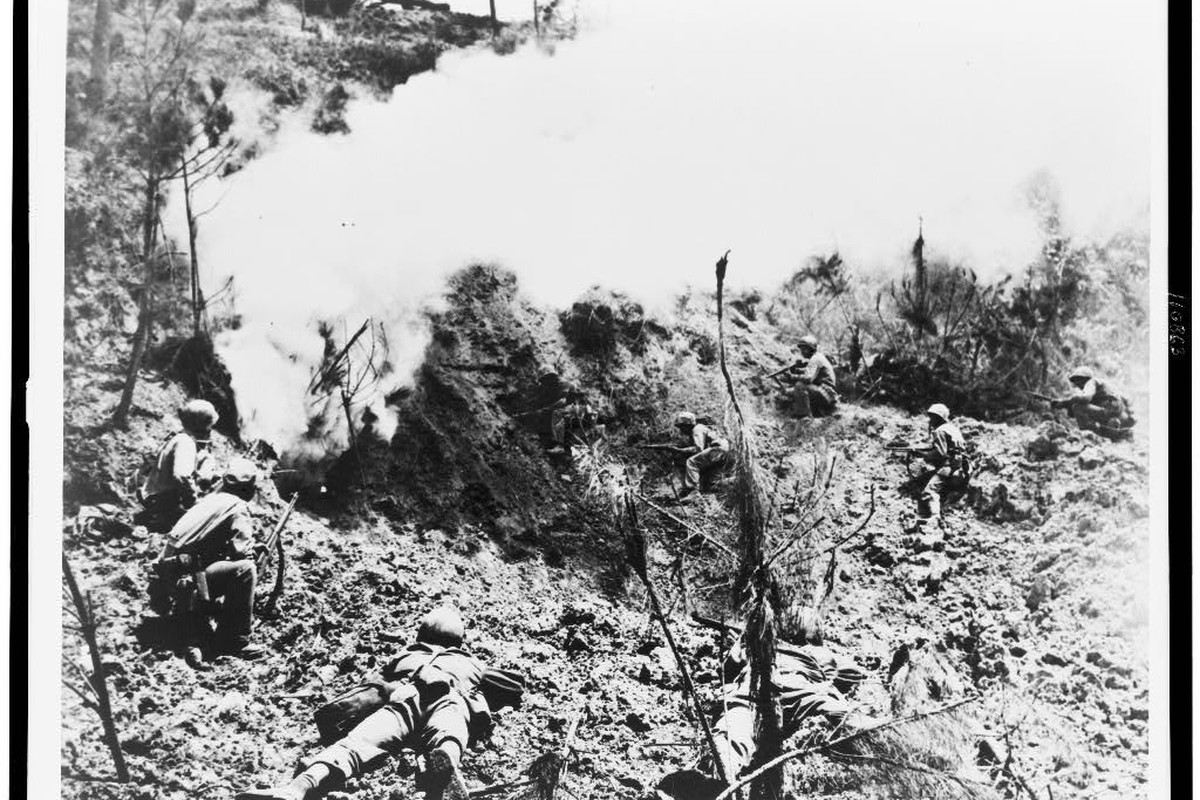
By June 22, 1945, the island of Okinawa had been fought over for eighty two days. American troops had crossed beaches, climbed ridges, dug Japanese soldiers out of caves with flamethrowers, and buried their own dead in mud that the monsoon rains never let dry. That morning, the commander of Japan's defending army, Lieutenant General Mitsuru Ushijima, knelt in a cave on a hillside above the southern coast and ended his own life rather than surrender. His chief of staff, Lieutenant General Isamu Cho, did the same beside him. The Tenth Army raised its colors over its headquarters and declared organized resistance over.
It is one of the most common stories told about the battle that followed: that Okinawa's bloodshed was so severe it convinced Washington an invasion of Japan would cost a million American lives, and that this number is the reason two atomic bombs fell six weeks later. The number gets repeated often enough that it reads like settled fact.
The declassified minutes of the meeting where Harry Truman's military leadership actually discussed the invasion of Japan tell a quieter story. No one in that room said a million. The number on the table was 31,000.
The Meeting Four Days Before the End
On the afternoon of June 18, 1945, four days before Ushijima's death, Truman convened his top military leadership at the White House. Fleet Admiral William Leahy was there, along with General of the Army George Marshall, Fleet Admiral Ernest King, the Secretary of War Henry Stimson, the Secretary of the Navy James Forrestal, and Assistant Secretary of War John McCloy. The minutes were stamped Top Secret and stored at the Pentagon. They would stay classified for decades.
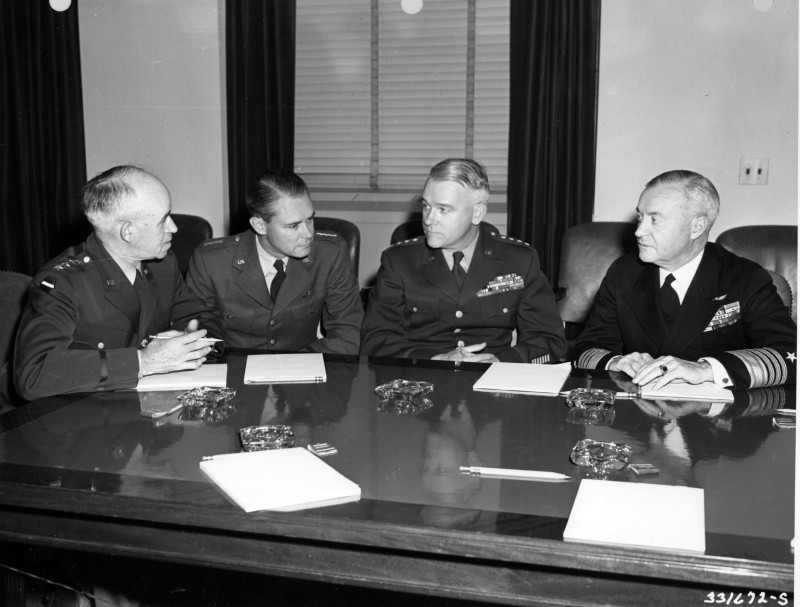 Members of the Joint Chiefs of Staff in conference, circa 1945. The June 18 meeting brought together the Army, Navy, and civilian leadership to weigh the cost of invading Japan.
Truman told the room he had called the meeting to understand exactly what an invasion of Japan would cost. Marshall did most of the talking. He laid out the plan: a landing on the southern Japanese island of Kyushu, codenamed Operation Olympic, targeted for November 1, 1945. Air power and naval blockade alone, he argued, would not be enough. Germany had shown that bombing alone did not force a modern industrial nation to surrender. Japan, he believed, would require the same thing Europe had required: troops on the ground.
Then came the casualties.
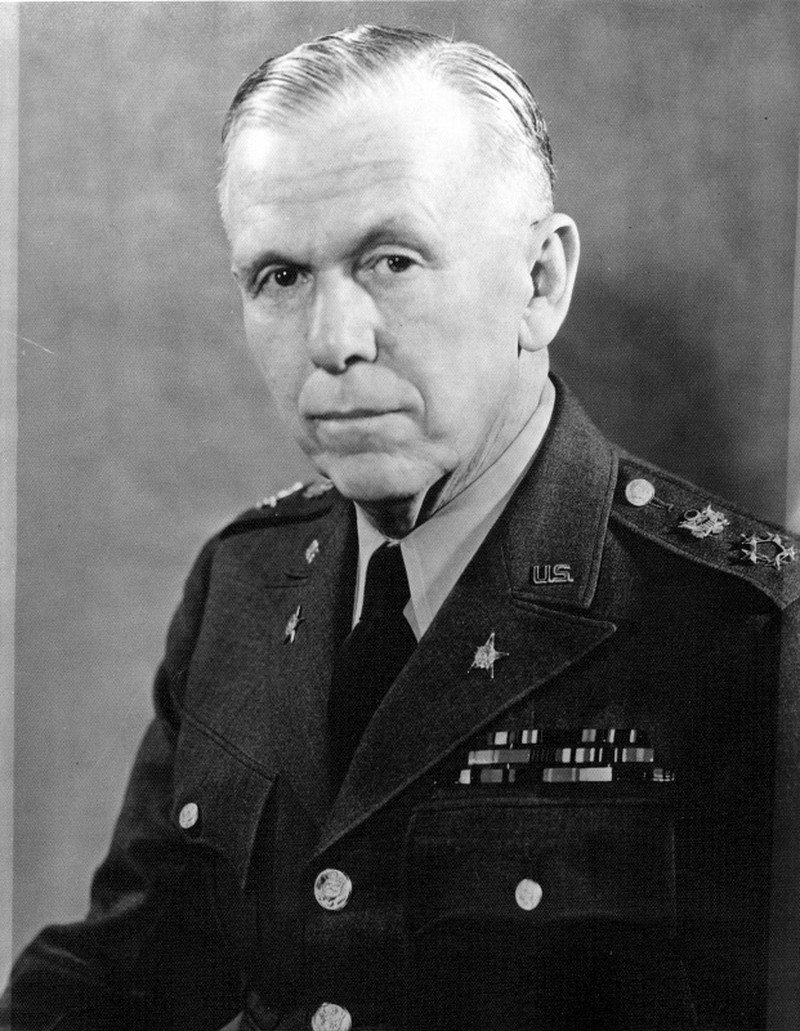 General of the Army George C. Marshall, Army Chief of Staff. Marshall led the June 18 briefing and presented the invasion casualty estimates Truman used to weigh Operation Olympic.
What the Document Actually Shows
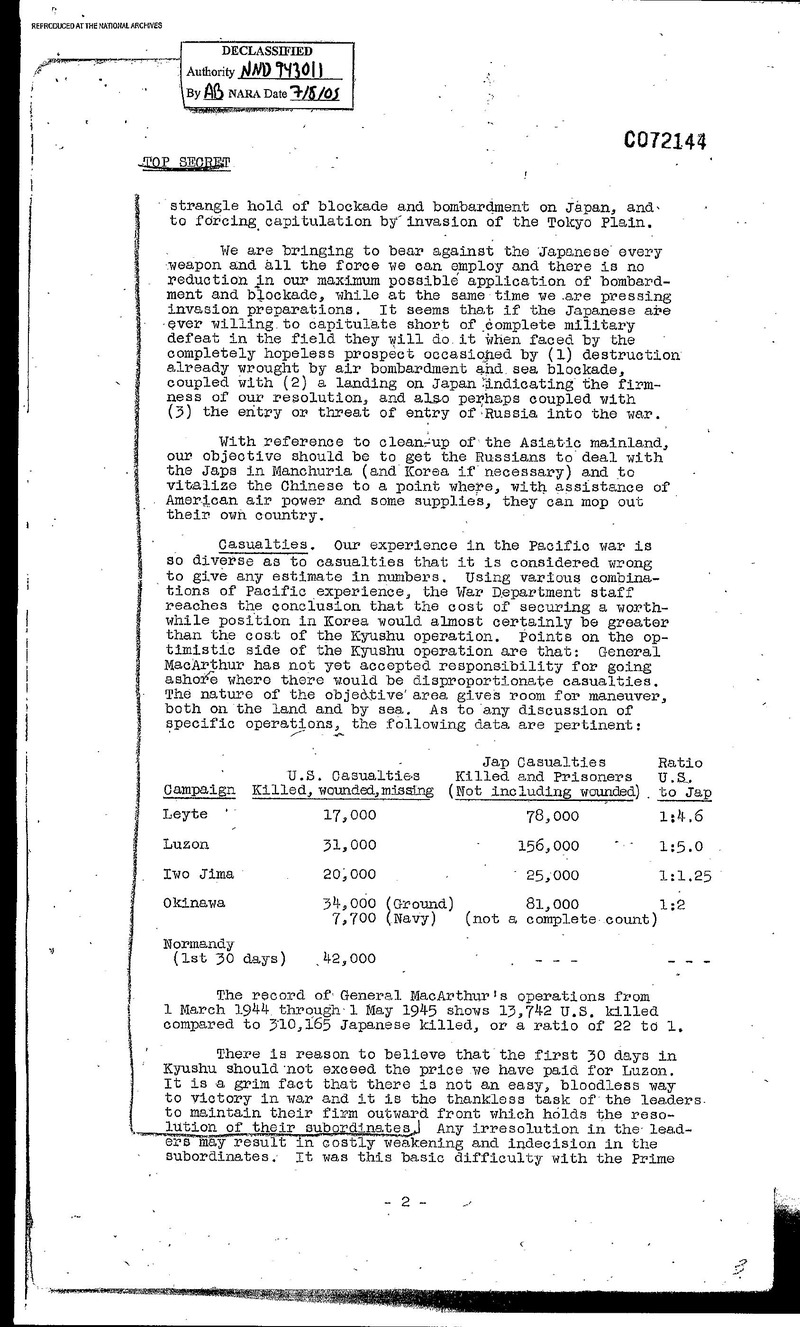
Page three of the minutes contains a table, typed on War Department letterhead, comparing American losses across recent Pacific campaigns. It reads, in full, as the document recorded it:
| Campaign | U.S. Casualties (killed, wounded, missing) | Japanese Casualties (killed and prisoners) |
|---|---|---|
| Leyte | 17,000 | 78,000 |
| Luzon | 31,000 | 156,000 |
| Iwo Jima | 20,000 | 25,000 |
| Okinawa | 34,000 (ground) + 7,700 (Navy) | 81,000 (not a complete count) |
| Normandy, first 30 days | 42,000 | not applicable |
The casualty comparison table from the declassified June 18 minutes — the single typed page Marshall used to anchor his estimate of 31,000 for the first thirty days of the Kyushu invasion.
Marshall's conclusion, based on this table, was that the first thirty days of the Kyushu invasion should not exceed what the United States had already paid to take Luzon, a single Philippine island: 31,000 men. Admiral Leahy pushed back gently. He noted that Okinawa's casualty rate had run to 35 percent of the troops engaged, and if that rate held for the larger force planned for Kyushu, the true cost could run higher than Marshall's estimate. Admiral King split the difference, suggesting the real number would land somewhere between the Luzon and Okinawa rates.
Nowhere in the room does anyone say a million. Nowhere does anyone say half a million. The working number, debated and argued over by the men who would actually have to plan the invasion, was 31,000, with Leahy's caution that it might run higher.
It is worth being precise about what this document does and does not prove. The minutes record a planning meeting about invading Japan. They do not record a decision to use the atomic bomb. The bomb is mentioned only obliquely, in a single line noting that Truman and the Chiefs of Staff "discussed certain other matters" after the main business concluded. No transcript of that part of the conversation survives. What happened in that final, unrecorded stretch of the meeting has been pieced together since only through the postwar recollections of men who were in the room, recollections that do not always agree with each other.
A Battle Still Being Counted
There is something else worth sitting with in that casualty table. When Marshall's staff typed "34,000 (ground) plus 7,700 (Navy)" for Okinawa, the battle was not over. Ushijima would not commit suicide for four more days. The fighting in the island's southernmost pocket, the worst of it, was still ahead.
By the time the guns actually fell silent on June 22, the real toll had climbed past what the document recorded. The accepted modern tally puts American casualties at roughly 49,000, with more than 12,000 killed, a meaningfully higher figure than the snapshot Marshall presented that afternoon. Among the dead was the man commanding the entire invasion. Lieutenant General Simon Bolivar Buckner Jr., killed by Japanese artillery on June 18, the very day this meeting was taking place in Washington, was the highest ranking American officer killed by enemy fire in the entire war. Japanese military deaths are estimated above 100,000. Okinawan civilian deaths, the population caught in between, are estimated at well over 100,000 more, some killed in the crossfire, some forced into mass suicide by their own army, some never fully counted at all.
None of those final numbers were available to the men in the White House on June 18. They were working from the best information they had at the time, and the best information understated what was actually happening on the ground.
What Came After
The Kyushu invasion that Marshall, King, and Leahy debated that afternoon never happened. Six weeks after Ushijima's death, the United States dropped atomic bombs on Hiroshima and Nagasaki. Japan surrendered. Operation Olympic was never launched, and the 31,000 figure Marshall offered Truman was never tested against reality.
In the years after the war, the casualty estimates attached to a hypothetical invasion of Japan grew. Truman's own public accounting, in speeches and writings after 1945, cited figures far above what his military staff had given him in June, sometimes as high as a quarter million American lives saved by the bomb. Historians have spent decades since trying to trace where those larger numbers came from and how much they reflect genuine military planning versus a postwar need to justify an extraordinary decision. The debate over the size of the real invasion estimate, and how much it actually weighed on the choice to use the bomb, remains active among historians today.
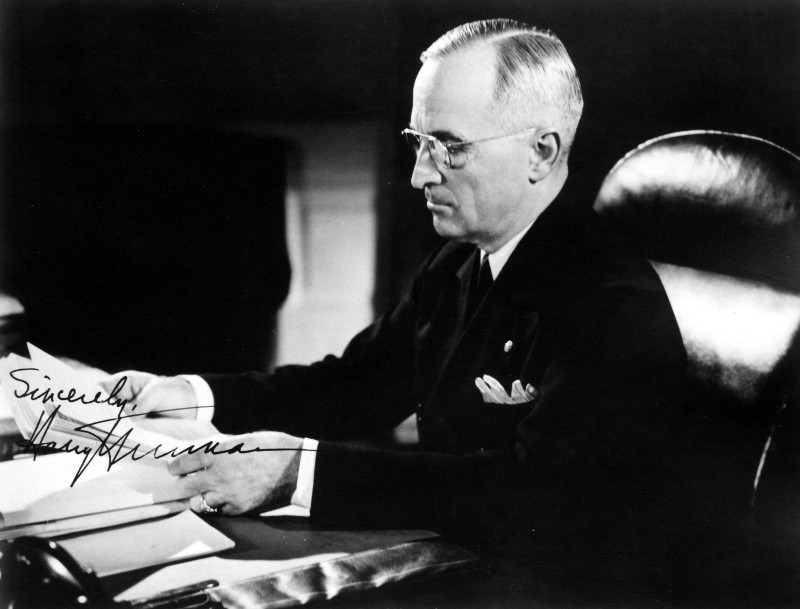 President Harry S. Truman. In public statements and memoirs after 1945, Truman cited casualty figures for a hypothetical Japan invasion that were far larger than the estimates his military staff had given him at the June 18 meeting.
What the document shows is narrower and, in its way, more interesting than the popular version of the story. It shows five tired, serious men in a room four days before Okinawa ended, working from a single typed page of numbers that did not yet include the worst of what was still to come, trying to decide how many more young Americans an invasion of Japan was going to cost. The number they wrote down was 31,000. History would remember it as a million.
If you're interested in primary sources from the final months of the Pacific War, the full nine page minutes of the June 18 meeting, declassified and held by the National Archives, are linked above.