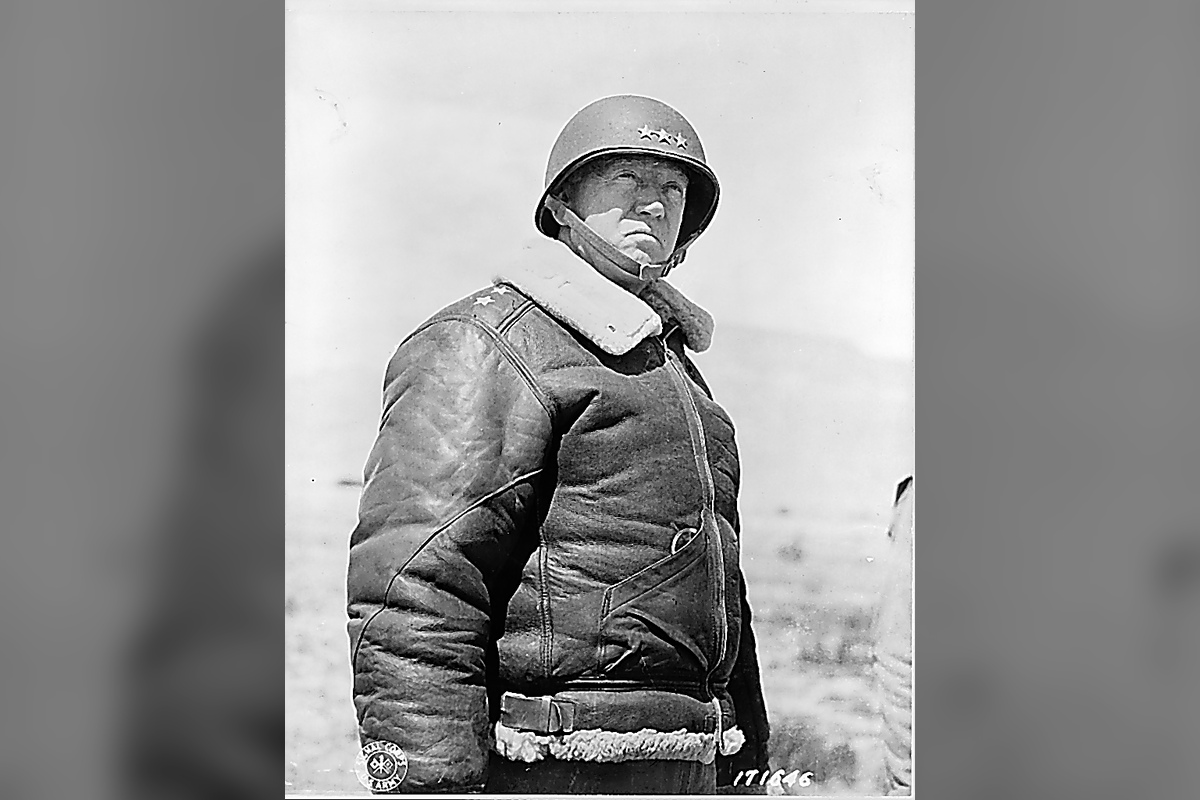
If you've seen the 1970 movie, you know the line. George C. Scott, playing Patton in front of a giant American flag, growls that there's no such thing as battle fatigue and he's not going to subsidize cowardice.
It's a great scene. There's no documented record Patton ever said it.
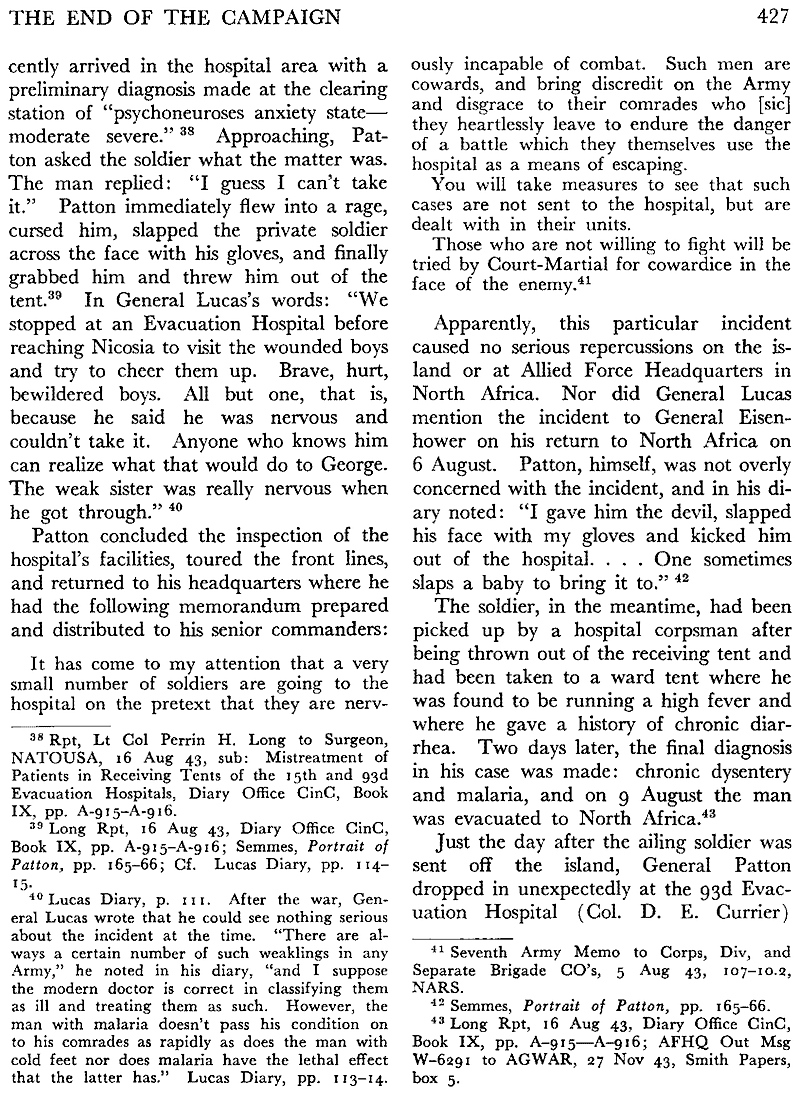
What he actually did, on the afternoon of August 3, 1943, was walk into a receiving tent at the 15th Evacuation Hospital near Nicosia, Sicily, and slap a private he'd decided was lying to him. The private was suffering from malaria.
Patton was touring the hospital as part of his usual rounds through II Corps, the way he'd done dozens of times that summer. He worked down the line of cots, shaking hands, asking men where they'd been hit, praising men with obvious combat wounds. Then he reached Private Charles H. Kuhl, twenty-seven years old, Company L, 26th Infantry, sitting on a stool with no visible injury. Patton asked what was wrong with him.
Kuhl told him he was nervous. "I guess I can't take it," he said.
According to multiple witnesses in the tent, Patton went from calm to furious in the space of a sentence. He slapped Kuhl across the face with his gloves, grabbed him by the collar, and kicked him out of the tent, shouting for the staff not to admit him. That night he wrote in his diary that he'd met the only coward he'd ever seen in his army, and that men like him should be tried and shot.
Kuhl was carrying a fever of 102 degrees. He was later diagnosed with malarial parasites. He'd already been through the hospital twice in ten days with the same complaint, which is presumably why Patton didn't believe him this time. There is no evidence he was malingering. He was genuinely sick, on top of whatever else three weeks of combat in Sicily's heat had done to him.
This is the part most retellings skip, because the story people actually remember is a composite. A week later, on August 10, Patton did it again at a different hospital, to a different soldier, Private Paul Bennett, and that second incident is the one with the pulled pistol and the threat of a firing squad. The two get folded into a single "slap" in popular memory. They weren't the same event, the same soldier, or even quite the same Patton. The first incident reads as more deliberate than explosive. He didn't lose his temper so much as decide, on the spot, that Kuhl was lying, and act accordingly.
There's a detail from that same summer that rarely makes it into the story at all. According to war correspondent Noel Monks, Patton was overheard elsewhere during the Sicily campaign dismissing shell shock as an invention of "Jewish doctors." Historians differ on how much weight a single recollection, published years after the war, should carry. If Monks remembered the exchange accurately, though, it offers an unsettling glimpse into Patton's thinking, and it complicates the tidier version of him as simply a hard man from a hard war who didn't believe in psychological injury.
The reality is more complicated than either version suggests, and that's the other piece the movie leaves out. Patton owned a copy of a British medical study on shell shock from the First World War, and in his own postwar writing he never claimed the condition was fake. What he believed, going back to a friend's breakdown he'd witnessed in 1918, was narrower and stranger: that a man who could still speak, still explain himself, hadn't yet crossed into genuine collapse, and that shaming him back to the line was doing him a favor before the thing became permanent. It was a theory built on one incident from twenty-five years earlier, applied to a private he'd known for ninety seconds.
Word of the Kuhl incident reached General Eisenhower two weeks later through a medical report that made its way up through routine channels to higher headquarters. Eisenhower didn't relieve Patton. He didn't open a formal investigation. He wrote him a letter instead, marked personal and secret, telling him that firm measures were sometimes necessary but that this did not excuse brutality or an exhibition of temper in front of subordinates. He ordered Patton to apologize in person to both Kuhl and Bennett, and to apologize publicly before the medical staff and the divisions that had witnessed or heard about the incidents.
Patton did it, badly. He told the assembled troops he regretted being too harsh, without ever quite naming what he'd done. At one stop, the men started chanting for him to stop before he could finish.
The strangest ending belongs to Kuhl himself. He recovered from the malaria, returned to his unit, and landed at Normandy on D-Day the following year. Decades later, asked about the man who'd slapped him in a hospital tent, he said he thought Patton was a great general, and that at the time, Patton simply hadn't known how sick he was. His father wrote his congressman asking that Patton not be punished over it.
None of that erases what happened in that tent. It just means the story is messier than either the myth of the general who hated cowards or the myth of the tyrant who got away with it. Patton believed something specific and wrong about one soldier, on one afternoon, and the Army's own official history spent a full page trying to sort out exactly what.
That page still exists. It's in the government's own account of the campaign, filed under the driest possible chapter heading, sitting between troop movements and supply reports like it was just another Tuesday in Sicily.