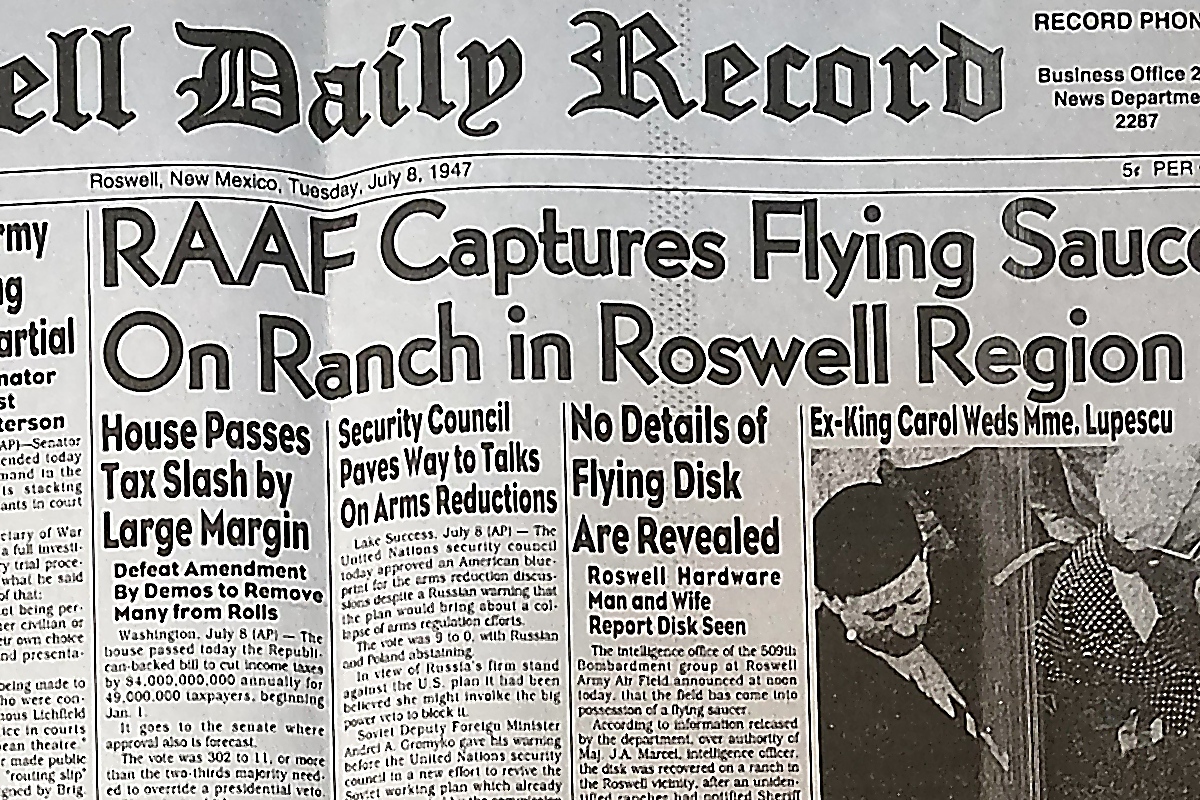
On the morning of July 8, 1947, First Lieutenant Walter Haut, the public information officer at Roswell Army Air Field, released a single paragraph to the press. The intelligence office of the 509th Bomb Group, he wrote, had come into possession of a "flying disc," recovered from a ranch northwest of town with the help of a local rancher and the Chaves County sheriff's office.
The Roswell Daily Record ran it that afternoon under a headline that would outlive everyone involved: "RAAF Captures Flying Saucer On Ranch in Roswell Region."
By the next day, the Army said it was a weather balloon. Except it wasn't an ordinary weather balloon either. The real explanation was a classified Cold War surveillance program, and it stayed buried for forty-seven years.
The Rancher Who Waited Two Weeks to Say Anything
W.W. "Mac" Brazel found the debris on his ranch near Corona, New Mexico, sometime in mid-June: tinfoil, rubber strips, tape, and thin wooden beams scattered across several acres. He had no phone and no radio. He initially dismissed it as unimportant.
What Brazel didn't know was that the country had spent the last two weeks in a UFO frenzy. On June 24, a pilot named Kenneth Arnold reported nine crescent- or boomerang-shaped objects flying past Mount Rainier at estimated speeds no known aircraft of the era could match. Arnold never actually said the objects were shaped like saucers. He described their motion as similar to a saucer skipping across water. The press turned his description of how they moved into a description of what they looked like, and "flying saucer" was born overnight. Within days, hundreds of copycat sightings poured in nationwide, and papers were offering cash for physical proof.
It wasn't until July 5, when Brazel mentioned the debris to his uncle in Corona, that anyone suggested a connection. The next day, July 6, Brazel drove into Roswell and told Sheriff George Wilcox what he'd found. Wilcox called the base.
RAAF Is Roswell Army Air Field, Not What You're Thinking
The acronym trips people up. RAAF, in this story, is Roswell Army Air Field, home of the 509th Bomb Group of the Eighth Air Force. That detail matters more than it sounds like it should: the 509th was, at that moment, the only military unit on Earth capable of delivering a nuclear weapon. It had dropped both bombs on Japan two years earlier. A "flying disc" story breaking out of America's most sensitive military installation, in the first full summer of the Cold War, was never going to stay a local curiosity.
Base commander Colonel William Blanchard sent Major Jesse Marcel and Captain Sheridan Cavitt out to the ranch to collect the material. Blanchard notified Eighth Air Force commander Brigadier General Roger Ramey. Then Haut's press release went out.
The Government's Own Paper Trail
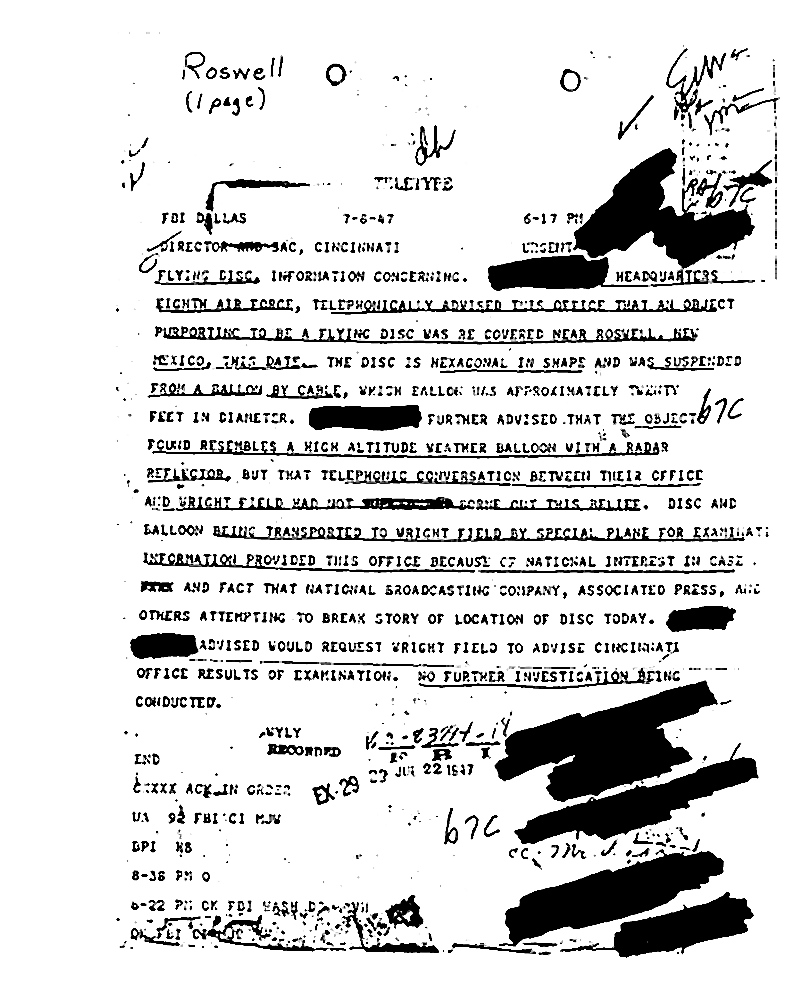
The document anchoring this piece isn't the newspaper. It's a Federal Bureau of Investigation teletype, sent from the FBI's Dallas field office at 6:17 PM on July 8, 1947, marked URGENT. It survives today in the FBI's declassified Vault, redactions and all.
The teletype describes what Eighth Air Force headquarters told the Dallas office by phone: an object "purporting to be a flying disc" had been recovered near Roswell that day, hexagonal in shape, suspended from a balloon roughly twenty feet in diameter. It notes the object was being flown to Wright Field in Ohio for examination, and that the FBI was being looped in only because the story was already breaking nationally through NBC and the Associated Press.
Read closely, it's a government agency trying to get ahead of a press story it didn't start and didn't fully understand yet, on the same day the story broke.
Twenty-Four Hours
The reversal came fast. General Ramey called a press conference in Fort Worth, where he, his chief of staff Colonel Thomas DuBose, and weather officer Irving Newton stood in front of photographers holding torn foil and wooden sticks laid across packing paper. Newton told reporters the material matched weather radar targets used at roughly eighty stations around the country. The story died almost as quickly as it had started.
Brazel, notably, didn't fully agree. Interviewed by the Daily Record on July 9, he described rubber strips, tinfoil, tape, and sticks, but added that he was sure it wasn't a weather observation balloon.
He was closer to right than anyone realized. A standard weather balloon in 1947 was a single rubber sphere about six feet across. What actually came down on Brazel's ranch was a Project Mogul array: a train of two dozen or more linked balloons, radar reflectors, and acoustic sensors stretching over 600 feet when assembled. It looked nothing like a weather balloon because it wasn't one.
What Was Actually Classified
The debris was real. The weather balloon explanation wasn't fabricated so much as incomplete: it was a cover story that concealed the classified purpose of the balloon system rather than an outright invention. What Brazel's ranch had intercepted was a component of Project Mogul, a classified U.S. military program run out of Alamogordo Army Air Field, using long trains of high-altitude balloons rigged with acoustic sensors to detect Soviet atomic bomb tests from a distance. What the Air Force later identified as debris from Project Mogul, likely its Flight 4, had launched from Alamogordo on June 4, 1947, and lost contact northwest of Roswell.
There's no evidence that officers at Roswell, including Marcel, Cavitt, or base commander Blanchard, had been read into Project Mogul's existence. In a real sense, they were kept in the dark by their own government to protect a program they weren't part of.
There's a strange coda to the "hieroglyphics" that later became central to alien-tech mythology. When NYU researchers assembled the Mogul balloon trains, they ran short of standard materials and used reinforcing tape from a New York toy and novelty manufacturer, printed with pinkish-purple floral and geometric patterns. Decades later, that tape pattern became "alien writing" in retellings of the story.
The Air Force didn't publicly confirm any of this until 1994, under pressure from a congressional inquiry. The classified explanation stayed secret for forty-seven years.
How a Weather Balloon Became an Alien Spacecraft
The Roswell story went quiet for three decades. It came back in 1978, when researcher Stanton Friedman interviewed a retired Jesse Marcel, who said the weather balloon explanation had been a cover story and increasingly suggested he believed the material wasn't of this earth. That interview, expanded into the 1980 book The Roswell Incident, is the actual origin point of the modern Roswell mythology, including the alien bodies that Marcel himself never once described.
The rest of it, the autopsy footage, the Majestic 12 documents, the golden helmets buried in the desert, came later, from other people, and none of it holds up. The Air Force's later investigations traced the "bodies" claims to memories of 1950s parachute test dummy retrievals, conflated over decades with unrelated plane crash casualties.
The government did lie about Roswell. It just wasn't the lie everyone remembers.