For 42 years, one family ran Nicaragua. On July 19, 1979, that arrangement ended in the space of a single afternoon.
Fighters from the Sandinista National Liberation Front, known by its Spanish initials FSLN, walked into Managua that day and met almost no resistance. The National Guard that had propped up the Somoza dynasty since 1937 had already come apart. Two days earlier, on July 17, President Anastasio Somoza Debayle had boarded a plane into exile, ending his family's hold on the presidency. His handpicked successor, Francisco Urcuyo, tried to serve out the rest of Somoza's term anyway. Urcuyo lasted barely a day before he too fled the country, crossing into Guatemala on July 18 as the U.S. ambassador departed Managua and Sandinista units closed in from every direction.
The popular version of this story ends there: a corrupt dictator falls, guerrillas take the capital, a revolution begins. The historical record is more complicated, and a document declassified decades later shows exactly how.
A Dynasty Built on American Backing
The Somoza family did not seize power on its own. The United States created and trained Nicaragua's National Guard during its occupation of the country, and Washington played a decisive role in elevating Anastasio Somoza García to command it. Nicaragua's Congress legally appointed him Guard commander, but American backing, including the strong support of U.S. Ambassador Arthur Bliss Lane, was what made his rise possible. Somoza won the presidency in a fraudulent election in 1937. His sons Luis and then Anastasio Debayle inherited the office in turn, and for four decades U.S. administrations treated the family as a reliable anti-communist partner in Central America, regardless of what that partnership cost ordinary Nicaraguans.
Opposition organized slowly at first. In 1961, university activists Carlos Fonseca Amador, Silvio Mayorga, and Tomás Borge Martínez founded the FSLN, naming the movement after Augusto César Sandino, the nationalist leader who had fought U.S. Marines in the country's mountains decades earlier. For years the group stayed small, a few dozen fighters absorbing heavy losses in failed rural campaigns. Fidel Castro's government in Cuba gave Nicaragua's students and peasants an early working example of what an armed uprising against a U.S.-backed regime could accomplish, but real momentum built gradually over the following years, driven as much by the devastating 1972 Managua earthquake and the graft that followed it as by any single outside influence.
The breaking point came on January 10, 1978, when gunmen assassinated Pedro Joaquín Chamorro, the newspaper editor who had spent years documenting Somoza-era corruption in the pages of La Prensa. Nicaraguans widely blamed the regime. A general strike followed within weeks, shutting down roughly 80 percent of business activity in Managua and several provincial capitals. That August, FSLN commander Edén Pastora led an operation that seized the National Palace during a legislative session and took roughly 2,000 hostages. The government paid $500,000 and released a group of political prisoners to end the standoff, a negotiated retreat that made the regime look weak for the first time in decades.
President Jimmy Carter's human rights policy added pressure from outside. Carter cut military aid over the Guard's record of torture and extrajudicial killing, and by 1979 the FSLN controlled most of the country outside the capital. Yet Carter's position was never as simple as later accounts suggest. At one point his administration sent Somoza a letter praising his promised electoral reforms, a gesture that infuriated human rights advocates in Washington and briefly made it look like the White House was returning to its old habit of backing the dictator. The pressure resumed, but the episode is a reminder that Carter's break with Somoza was gradual and contested inside his own administration, not a clean ideological line.
The Document
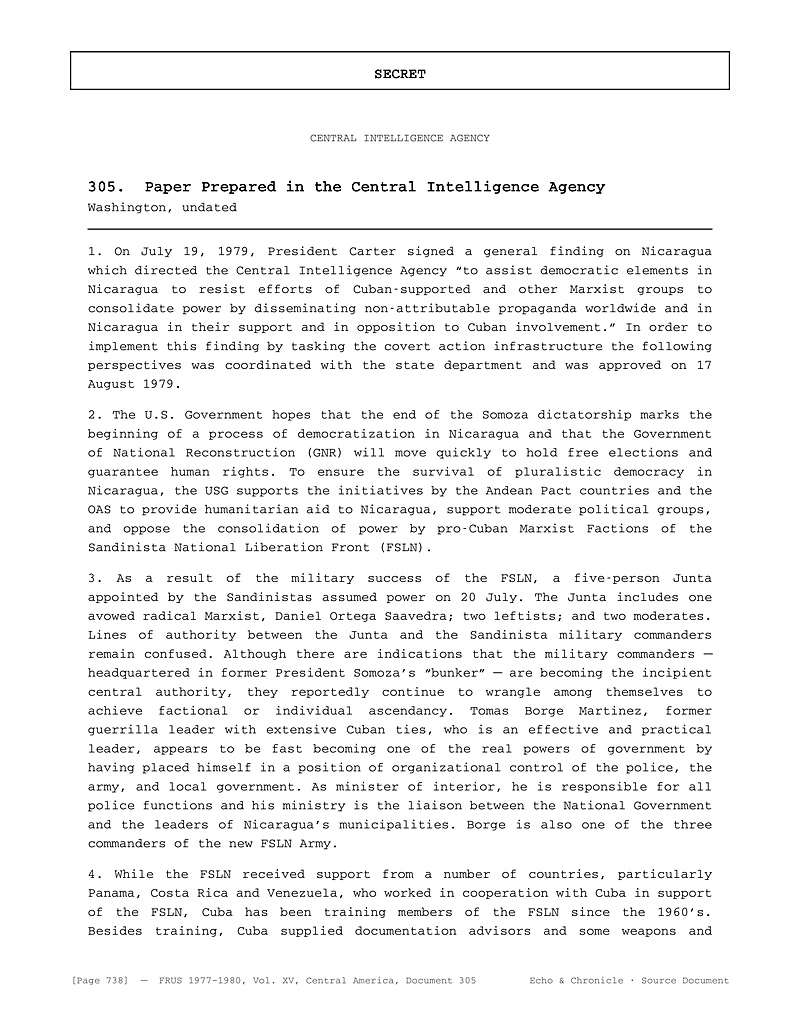
What happened after Somoza fled is where the record gets genuinely surprising. A CIA paper later published in the State Department's Foreign Relations of the United States series states plainly that on July 19, 1979, the same day Sandinista forces entered Managua, President Carter signed a covert action finding on Nicaragua. The finding directed the CIA "to assist democratic elements in Nicaragua to resist efforts of Cuban-supported and other Marxist groups to consolidate power by disseminating non-attributable propaganda worldwide and in Nicaragua in their support and in opposition to Cuban involvement."
That instruction was formalized into a six-point covert action plan approved a month later. It called for publicizing the actions of moderate factions inside the new government, exposing the FSLN's Marxist elements and their ties to Havana, and leaning on other Latin American governments to serve as a moderating influence. In other words, on the very day the United States was digesting the fall of a four-decade ally, its intelligence agency was already working to shape what came next, quietly and without attribution.
The government that Carter's finding targeted was not yet fully formed. A five-member Junta of National Reconstruction, formed by the broader anti-Somoza coalition rather than the FSLN alone, did not formally assume power until July 20, one day after the military takeover of the capital. Its members reflected the odd coalition that had brought Somoza down: Daniel Ortega, whom the CIA paper flatly labeled "an avowed radical Marxist," sat alongside moderates and leftists, including Violeta Barrios de Chamorro, the widow of the murdered newspaper editor whose death had helped trigger the uprising in the first place. She would go on to defeat the Sandinistas at the ballot box in 1990 and serve as Nicaragua's president until 1997.
What the Numbers Show
The revolution's human toll ran into the thousands, with the heaviest fighting concentrated in Managua, León, Estelí, and Masaya. By the time the guns fell silent, roughly 600,000 Nicaraguans were homeless and another 150,000 were refugees or in exile, out of a national population of just 2.8 million.
The new government's early record was genuinely mixed, not the simple morality tale either side later preferred. A national literacy campaign, staffed largely by student volunteers, brought the government's reported illiteracy rate down from 50.3 percent to 12.9 percent within five months, a figure UNESCO recognized with an award in 1980. Public health researchers writing in the New England Journal of Medicine and the American Journal of Public Health documented real gains as well: infant mortality fell from roughly 121 to 80 per 1,000 live births between 1978 and 1983, and life expectancy rose noticeably over the same stretch, though published estimates of the exact increase vary by source. At the same time, international human rights organizations, including Amnesty International and the Inter-American Commission on Human Rights, later documented executions and forced relocations carried out by Sandinista forces against Miskito communities on the Caribbean coast, evidence that the new government's own record on rights was far from clean.
Within two years, the CIA's quiet propaganda campaign of 1979 had given way to something much larger. Ronald Reagan's administration began arming and funding the Contras, and Nicaragua spent the 1980s as one of the Cold War's bloodiest proxy battlegrounds. That war grew out of ideological conflict, Cuban involvement, and Sandinista consolidation of power as much as any single American decision, but the document Carter signed the day Managua fell, before the new government had even been sworn in, foreshadowed the increasingly adversarial U.S. policy that followed.