Most people picture the end of a nineteenth century war as a formal surrender. Flags lowered. Officers exchanging swords. A ceremony with weight to match the fighting that came before it.
That is not how the Spanish-American War ended.
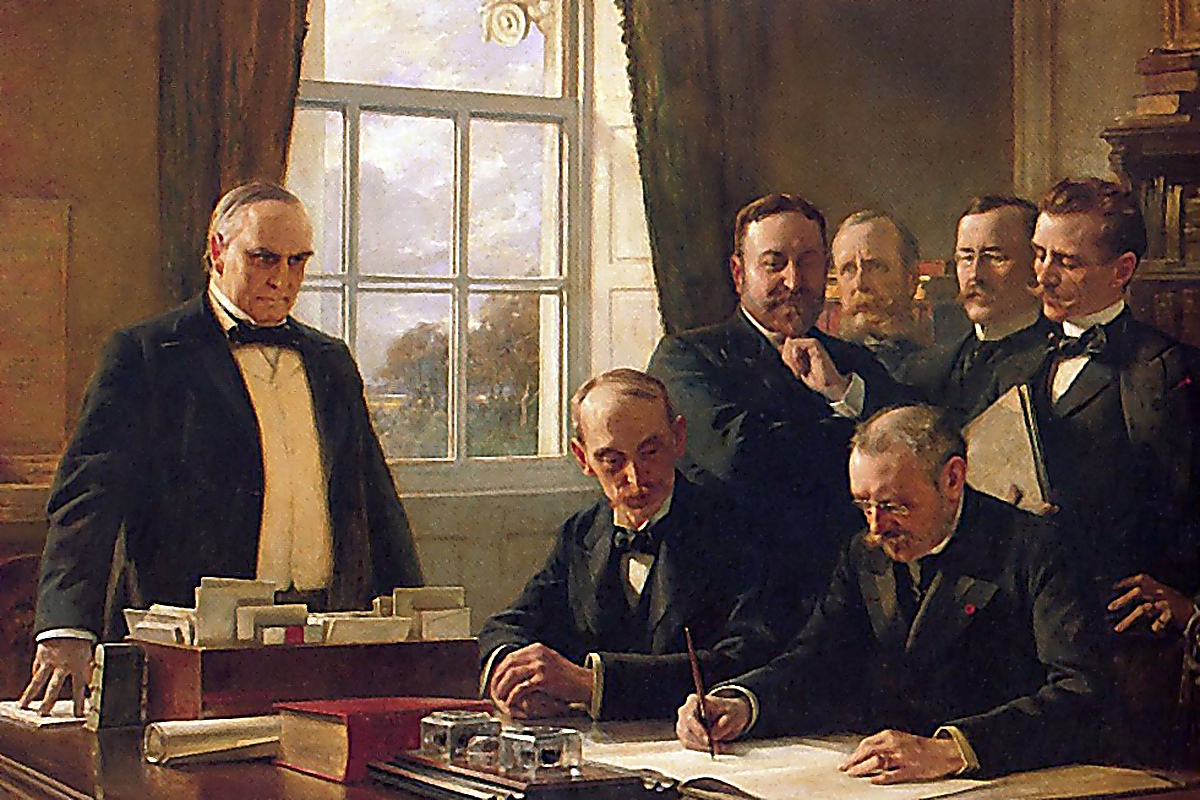
It ended in a cabinet room. Two men sat at a table that had been made for Ulysses S. Grant three decades earlier and had already hosted Grant's own cabinet meetings. One of them, French Ambassador Jules Cambon, was not even Spanish. He was signing on Spain's behalf because Spain and the United States had no formal diplomatic relations left to conduct the business themselves. William McKinley stood off to the side, watching a war he had spent months trying to avoid get closed out in about the time it takes to read this paragraph.
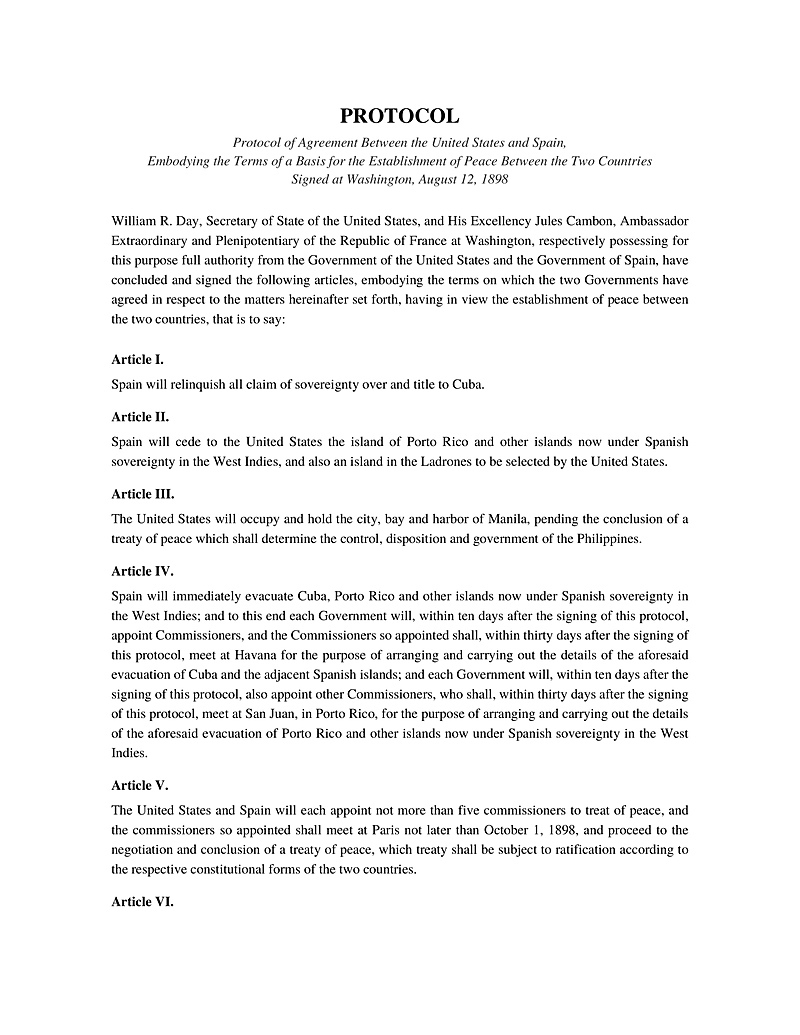
The document itself is almost clinical for something that reordered the map of the Caribbean and the Pacific. Six articles. Spain relinquishes Cuba. Spain cedes Puerto Rico and an island in the Ladrones to be selected by the United States, which became Guam. The United States occupies and holds Manila while a real peace treaty gets worked out in Paris. Commissioners get ten days to be appointed and thirty days to start meeting in Havana and San Juan to arrange the evacuations. And then, in Article VI, the line that mattered most to the men actually shooting at each other that week: hostilities are suspended, effective immediately, notice to go out to every commander in the field.
That was August 12, 1898. The formal Treaty of Paris would not be signed until December 10, four months later. But the fighting was over. The protocol suspended hostilities the moment Day and Cambon set their seals to the page, while the formal peace still had to be negotiated on paper in Paris.
The chain of events behind the signing moved fast by the standards of the era. Santiago had fallen in mid-July after the Battle of San Juan Hill and the destruction of the Spanish fleet off Cuba. American forces had landed in Puerto Rico on July 25 and were advancing across the island, but the campaign was still underway, not finished, when the armistice suddenly stopped it. By early August, Madrid's government had run out of realistic options. When McKinley later explained the terms to his own peace commissioners, he did not pretend the outcome had been in doubt. He wrote to them that Spain's demands were "conceded" and that the concession had been "solemnly recorded in the protocol of the 12th of August."
Here is the part that rarely makes it into the standard account. Only months earlier, Puerto Rico had begun governing itself under the 1897 Charter of Autonomy, a genuine measure of home rule that island leaders had spent years negotiating for. But the experiment had already been shattered by the war and the American invasion before the armistice was even signed. The protocol placed Puerto Rico's disposition in the hands of the governments negotiating the peace, Washington and Madrid. No one from Puerto Rico had a seat at that table, in the armistice or in the Paris negotiations that followed.
Puerto Rican leaders did not simply accept that. Once it became clear the island's future was being decided without them, representatives including Eugenio María de Hostos and José Julio Henna traveled to Washington to press American officials directly for a voice in what came next, before the Senate ever voted on ratification. It did not change the outcome. The Treaty of Paris was signed in December with no Puerto Rican signature on it, and the island passed from one sovereign to another exactly as the August protocol had framed it.
The debate over what the United States had actually signed up for played out afterward, in the Senate, where ratification of the treaty passed by exactly the two-thirds margin required, 57 to 27, in February 1899. Senator George Frisbie Hoar of Massachusetts, a Republican, warned his colleagues that the treaty would make the country "a vulgar, commonplace empire, controlling subject races and vassal states." He was outvoted. Two days before that vote, fighting had already broken out in Manila between American and Filipino forces, the opening of a war in which American forces would suffer far more military deaths than they had in the conflict with Spain.
The document below is the actual protocol, six short articles that closed a war and opened a debate about American power that in some ways never really finished.