On the evening of July 16, 1898, a telegram reached the White House from a camp outside Santiago de Cuba. It was short, and it was final. General William Shafter reported that the surrender had been "definitely settled," that the city would change hands the next morning, and that the Spanish flag would come down at nine o'clock sharp.
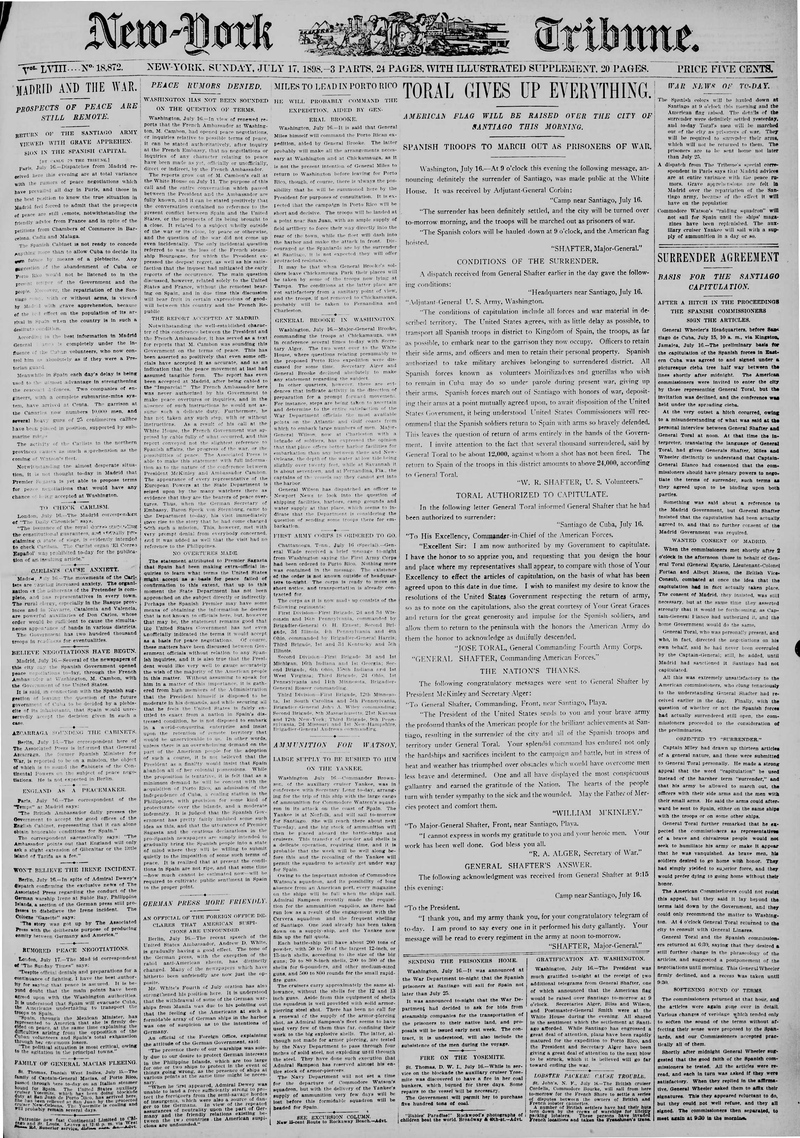
Reporters had a simpler way of putting it. The New-York Tribune's front page the next day ran a single headline across four columns: "TORAL GIVES UP EVERYTHING."
The historical record shows the surrender was far more generous than the headline suggests.
What Washington asked for
The demand that reached Shafter from Washington was blunt: unconditional surrender by noon, or the attack on the city would resume. General José Toral, commanding the besieged Spanish division, had spent days trying to negotiate softer terms and been turned down each time. When his final request for terms was relayed to the White House, the answer came back in minutes. Washington insisted Toral first accept unconditional surrender before the remaining details would be worked out.
Toral accepted that basis. But the details of how the surrender would actually be carried out were then worked out by commissioners from both sides under a ceiba tree between the lines, and what they produced was considerably more generous than the stark ultimatum Washington had delivered. Toral had a hand in shaping it.
What Spain actually got
According to the terms Shafter cabled back to Washington that same evening, Spanish officers kept their side arms. Soldiers kept their personal property. Volunteers and guerrilla units who preferred to stay in Cuba were allowed to do so, on parole, without giving up their weapons at all. The main body of troops marched out of Santiago "with the honors of war," stacking their arms at an agreed point rather than handing them over in disgrace. The protocol went further still: American commissioners recommended that the Spanish government permit the enlisted men to retain their rifles upon returning to Spain, rather than treating them as captured trophies.
Toral had also pushed, in the final round of negotiations, to have the word "surrender" dropped from the documents entirely in favor of "capitulation," arguing his army should be allowed to march out with dignity rather than be humiliated. He got his way. The Tribune's own correspondent, filing from General Wheeler's headquarters outside the city, thought the request notable enough to report by name.
Toral's army was beaten in every strategic sense. It was surrounded, outnumbered, cut off from its fleet, short on food, and losing men to disease with no realistic hope of relief. But the terms reflected a defeated army being granted professional military honors rather than subjected to a deliberately humiliating surrender.
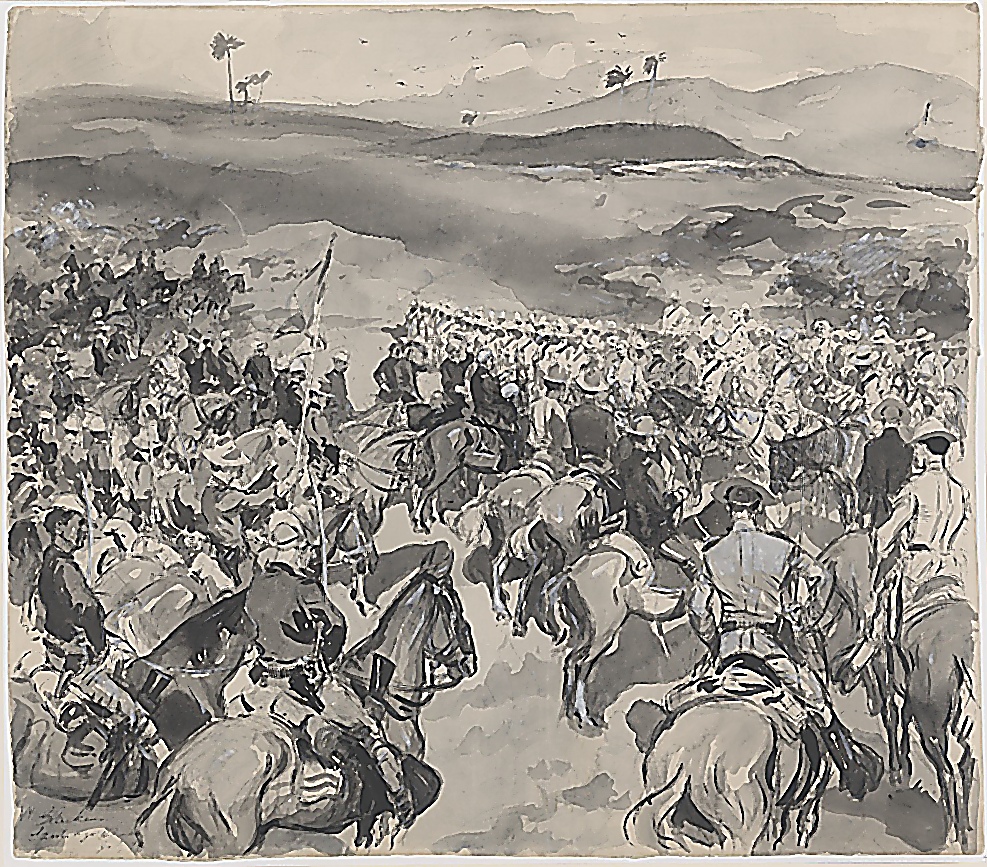
 William Glackens's wash drawing shows the scale of the procession as Spanish troops marched out of Santiago under the terms of capitulation, cavalry and infantry stretching back toward the hills.
A bigger surrender than the headline suggested
The scale of what changed hands on July 17 was also larger than the fight for one city would suggest. Shafter's own dispatch to Washington cited two figures he attributed directly to Toral: more than 24,000 troops returning to Spain from the district, a number that covered garrisons well beyond Santiago itself, and roughly 12,000 of those men who surrendered without a single American shot fired against them.
The story most people know is a siege of one city, capped by a naval battle and a charge up a hill. The paperwork signed on July 16 and executed on July 17 covered an entire Spanish military division across eastern Cuba, most of whom the United States Army never engaged at all.
The army that isn't in the headline
There is one more absence worth noting on that Tribune front page, and it says something about whose war this was allowed to be. Cuban revolutionary forces under General Calixto Garcia had been fighting the Spanish garrison at Santiago for years before a single American soldier landed at Daiquiri. When Shafter's men extended their siege lines toward the bay, it was Garcia's rebels holding the northwest flank. When a Spanish relief column tried to fight its way into the city on July 3, it was Garcia's forces it had to break through first.
Garcia was not at the table under the ceiba tree. When the city formally changed hands, his army was kept out of it, on Shafter's orders. The Tribune's exhaustive front page, three full columns on the terms of surrender, the congratulatory telegrams, the thanks of the nation, does not mention him once.
That silence is its own kind of primary source. The paper that told Americans exactly how generously their army had treated a defeated Spanish garrison had nothing to say about the Cuban army that had done much of the fighting to get there.
What came after
The surrender at Santiago effectively ended major organized fighting in Cuba, though scattered operations continued and peace was still a month away. Yellow fever and malaria were already moving through Shafter's camps faster than Spanish bullets ever had, and within weeks officers including Theodore Roosevelt were pushing to get the Fifth Corps out of Cuba entirely. Spain and the United States would not sign a formal peace protocol until August 12, and the Treaty of Paris that closed out the war was not signed until December.
Cuba would not see genuine self-government for years afterward. The island remained under American military occupation until 1902, and under a legal right of U.S. intervention until 1934. The soldiers who had done the fighting alongside Shafter's army in the summer of 1898 spent most of that time watching from outside the room.