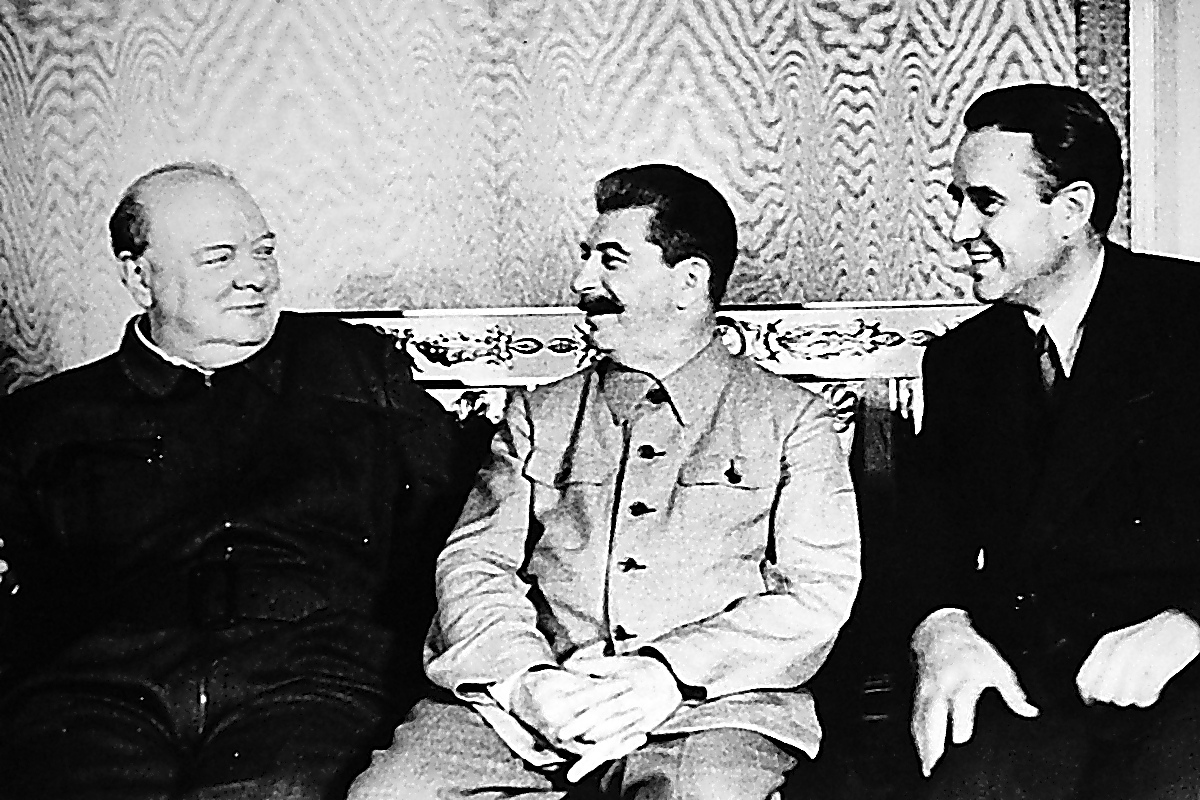
The conventional popular version of World War II can make the United States, Britain, and the Soviet Union look like a united front, three allies marching toward Berlin with a common strategy. That version leaves out August 13, 1942, when Joseph Stalin accused his own allies, in writing, of abandoning him.
Stalin's Red Army had been fighting the main German land war in Europe for more than a year without the Western European land front he desperately wanted. German forces held Leningrad under siege, threatened Moscow, and were pushing deep into the Caucasus. What the Soviets wanted was a second front. American and British troops landing in Western Europe would force Hitler to split his forces and pull divisions off the Eastern Front.
There was a real commitment behind Stalin's complaint, though the three governments understood it differently. An Anglo-Soviet communique published on June 12, 1942, after Soviet foreign minister Vyacheslav Molotov met with British officials in London, announced that "full understanding was reached with regard to the urgent tasks of creating a second front in Europe in 1942." Stalin read that as a promise. British planners, however, had attached reservations to that commitment, including the warning that they could give no promise that a landing would actually take place. Then, in August, Churchill traveled to Moscow and told Stalin in person that British and American planners had concluded a 1942 invasion of Europe would fail.
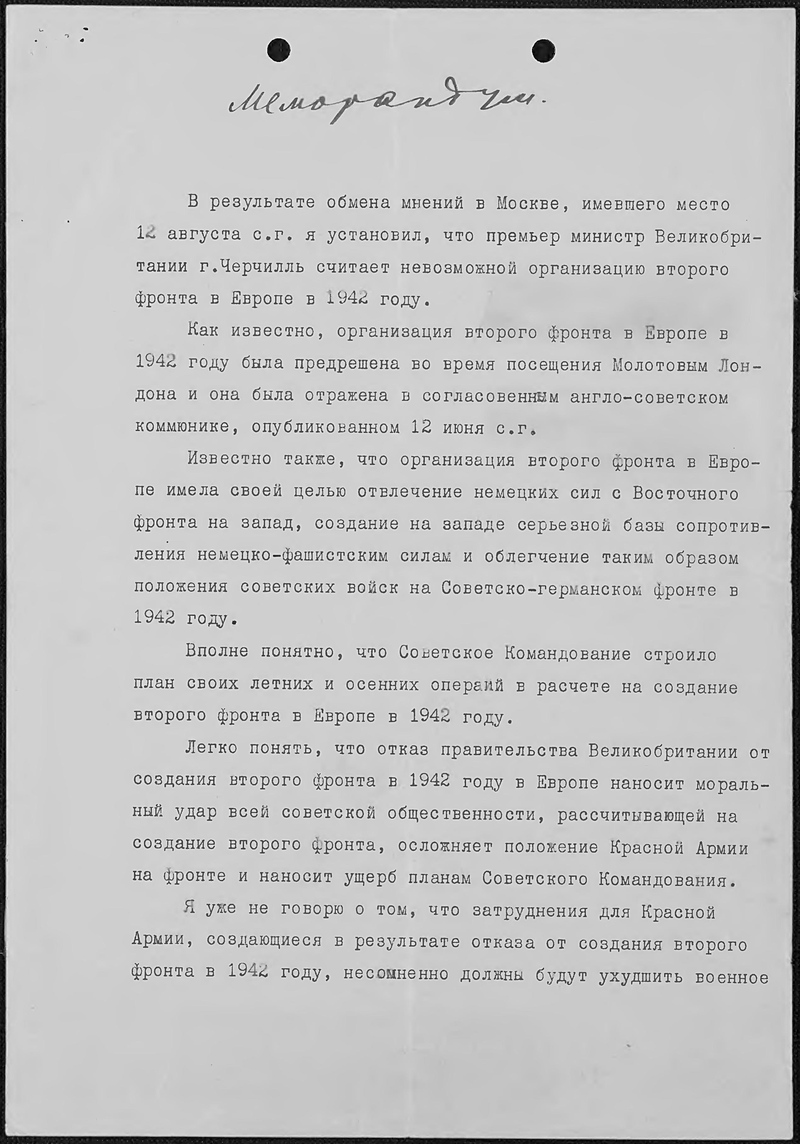
Stalin did not take the news quietly. He handed W. Averell Harriman, the American diplomat representing President Roosevelt, a memorandum addressed to both Harriman and Churchill. It is a document with almost no diplomatic softening. Stalin laid out what he regarded as the timeline of a broken promise, argued that 1942 offered the best window for an invasion the Germans might ever give the Allies, and put his case on paper, under his own signature.
The Memorandum, August 13, 1942
The full text below is the U.S. State Department's official translation.
As the result of an exchange of views in Moscow which took place on the 12th August of this year, I ascertained that the Prime Minister of Great Britain, Mr. Churchill, considered that the organization of a second front in Europe in 1942 to be impossible.
As is well known, the organization of a second front in Europe in 1942 was pre-decided during the sojourn of Molotov in London, and it found expression in the agreed Anglo-Soviet communique published on the 12th June last.
It is also known that the organization of a second front in Europe had as its object the withdrawal of German forces from the Eastern front to the West, and the creation in the West of a serious base of resistance to the German-Fascist forces and the affording of relief by this means to the situation of the Soviet forces on the Soviet-German front in 1942.
It will be easily understood that the Soviet Command built their plan of summer and autumn operations calculating on the creation of a second front in Europe in 1942.
It is easy to grasp that the refusal of the Government of Great Britain to create a second front in 1942 in Europe inflicts a moral blow to the whole of the Soviet public opinion, which calculates on the creation of a second front, and that it complicates the situation of the Red Army at the front and prejudices the plan of the Soviet Command.
I am not referring to the fact that the difficulties arising for the Red Army as the result of the refusal to create a second front in 1942 will undoubtedly have to deteriorate the military situation of England and all the remaining Allies.
It appears to me and my colleagues that the most favourable conditions exist in 1942 for the creation of a second front in Europe, inasmuch as almost all the forces of the German army, and the best forces to boot, have been withdrawn to the Eastern front, leaving in Europe an inconsiderable amount of forces and these of inferior quality. It is unknown whether the year of 1943 will offer conditions for the creation of a second front as favourable as 1942. We are of the opinion, therefore, that it is particularly in 1942 that the creation of a second front in Europe is possible and should be effected. I was, however, unfortunately unsuccessful in convincing Mr. Prime Minister of Great Britain hereof, while Mr. Harriman, the representative of the President of the United States, fully supported Mr. Prime Minister in the negotiations held in Moscow.
J. Stalin Moscow, August 13, 1942.
Notice that last line. Stalin did not simply record a disagreement with Churchill. He also named Harriman, noting that Roosevelt's representative had supported Churchill's position. The wording conveniently presented the decision as essentially British, even though Churchill was speaking for the United States as well. It reads less like a diplomatic cable and more like a formal complaint, filed against two allies at once, with the American representative named for the record.
Churchill answered the following day. His reply laid out the military case against an early landing on the French coast: the Germans had enough strength in the West to contain a limited Anglo-American force, and Churchill argued that a failed lodgment would not force Germany to divert a single division from the Eastern Front. Churchill's August 14 aide-memoire closed by reaffirming the Allies' resolve to aid the Soviet Union, writing that "we reaffirm our resolve to aid our Russian allies by every practicable means."
The Western Allies did not sit still. Instead of a landing in France, they committed to Operation Torch, the invasion of French North Africa, which put roughly 100,000 Allied troops ashore in French Morocco and Algeria that November. It was a real offensive, just not the one Stalin had asked for. The actual cross-Channel invasion of France was still nearly two years away.
The alliance held together long enough to win the war, but the strain visible in this one memo did not go away. It resurfaced at Yalta in February 1945, when the same three powers argued over the fate of Poland and Eastern Europe, and it hardened into the Cold War within a few years of Germany's surrender. The second front eventually came on June 6, 1944. Stalin's memo is a reminder that the wartime alliance was never a partnership built on complete trust. It was a coalition of governments whose interests overlapped enough to defeat Germany, even as their visions of the war and the postwar world increasingly diverged.