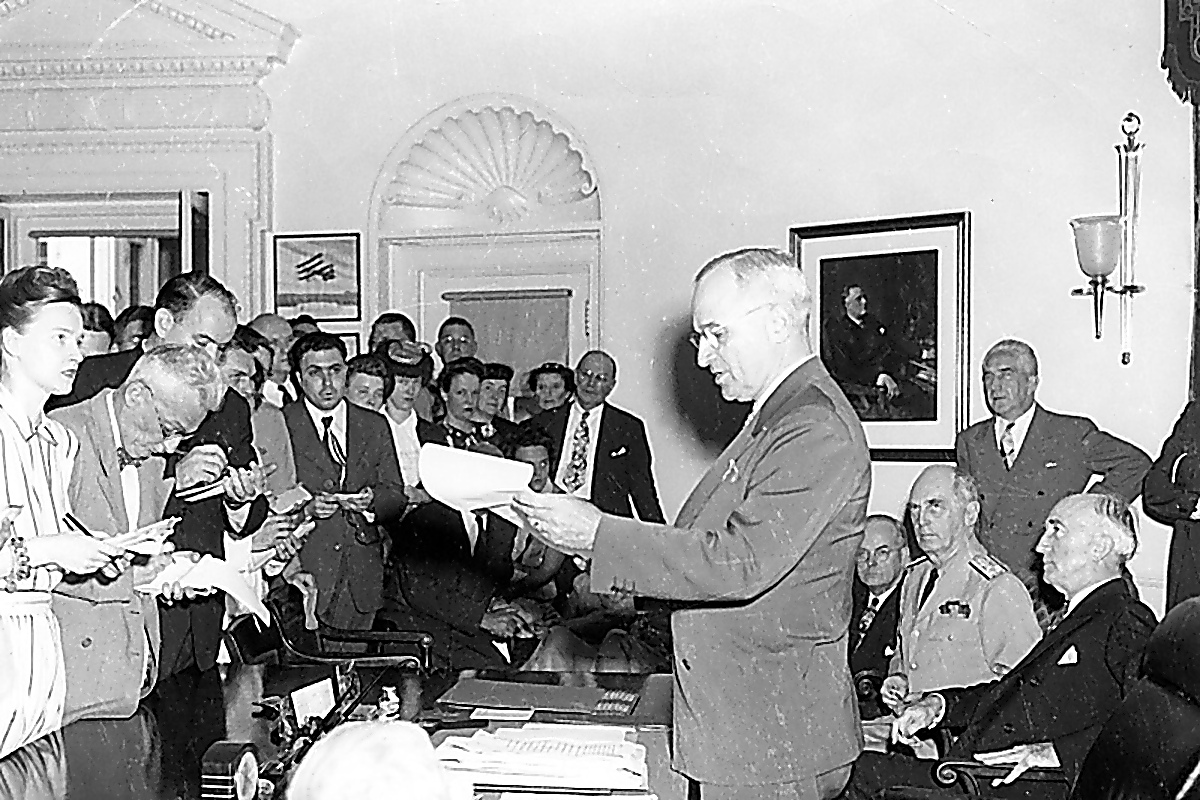
There was no soaring rhetoric. No march to a podium, no cheering crowd assembled to hear him. When Harry Truman announced the end of the war to the American public, he did it without a formal speech or ceremony: standing at his desk, reading from a sheet of paper, done in under three minutes.
It was 7 p.m. on August 14, 1945, and the Oval Office was packed. Cabinet members, secretaries, reporters, and members of the President's own family had crowded in. Truman did not build to the moment. He opened by reading the message itself.
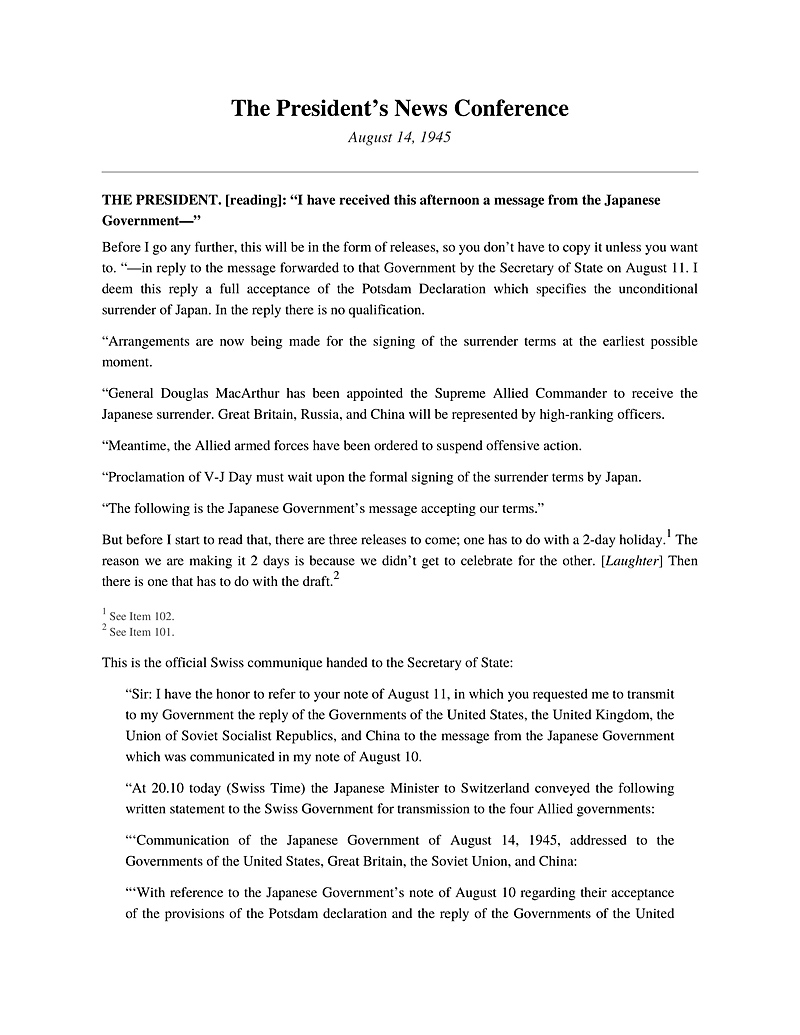
"I have received this afternoon a message from the Japanese Government," he said, then stopped himself before he'd gotten a full sentence in. "This will be in the form of releases, so you don't have to copy it unless you want to." It is a strange thing to hear a president say in the seconds before announcing the end of the deadliest war in human history: a courtesy note about paperwork.
What followed was not a proclamation. It was a status report. Japan had accepted the Potsdam Declaration's terms of unconditional surrender, with no qualifications attached. Arrangements were being made for a formal signing. General Douglas MacArthur had been named Supreme Allied Commander to receive it, with Britain, the Soviet Union, and China each sending representatives. Allied forces had been ordered to suspend offensive action. And then, almost as an aside that mattered more than anything else in the room realized at the time: V-J Day itself could not be proclaimed yet. That would have to wait for Japan's signature on the formal terms.
Then Truman read the Japanese government's message in full, relayed through the Swiss legation in Washington since the United States and Japan had no direct diplomatic channel. It ran through the bureaucratic chain that had carried it: a note from August 11, a communique from August 10, an Imperial rescript authorizing the surrender, and the promise that the Emperor would order Japan's armed forces to cease hostilities and surrender their arms. It is dense, procedural language. There is no mention of the atomic bombings dropped on Hiroshima and Nagasaki in the days before. The document simply confirms, in the flattest bureaucratic register available, that the killing was going to stop.
When Truman finished reading, a voice in the room called out, "I congratulate you!" Truman's reply was five words: "That is all." A reporter, Joe Fox of the Washington Star, thanked him. Then, according to the official transcript, applause and further congratulations followed, and the eighteenth news conference of Truman's presidency was over.
Outside the White House, none of that restraint held. Word spread through Washington within minutes, and a crowd gathered chanting "We want Harry," until Truman and First Lady Bess Truman came outside to address them. In New York, the news reached Times Square by early evening and the city produced what is still described as the largest spontaneous celebration in American history: strangers embracing, ticker tape falling from office windows, a Navy photographer named Victor Jorgensen capturing a sailor kissing a woman in the crowd, a moment now preserved in the National Archives under the title he gave it himself, "Kissing the War Goodbye."
The gap between those two scenes, the terse procedural reading in the Oval Office and the eruption in the streets, is the part most retellings smooth over. Popular memory has compressed August 14, 1945, into a single triumphant image: the war is over, Japan surrenders, America celebrates. What actually happened is stranger and more bureaucratic than that. The war's ending arrived first as a diplomatic note relayed through a neutral country's legation, read aloud by a president who felt the need to apologize for the paperwork before he got through his opening sentence. The formal surrender, scheduled for September 2 aboard the USS Missouri in Tokyo Bay, was still nineteen days away. Truman would proclaim that day V-J Day.
Truman's own words that evening carried none of the finality the moment deserved in hindsight. He never called it victory. He never called it peace. He read a message, confirmed there was no qualification attached to Japan's acceptance, and told the room that was all he had.
It was enough. The country did not need him to say more.