Ask most people when the Department of Defense was created and they'll say 1947. That's understandable. It's also not quite right.
The National Security Act of 1947 created the National Military Establishment and the office of Secretary of Defense. It did not create a cabinet department called the Department of Defense. That came two years later, when Congress passed the National Security Act Amendments of 1949. Truman signed them on August 10, 1949, converting the National Military Establishment into the Department of Defense and rewriting, almost sentence by sentence, how much authority its Secretary actually had over the military departments underneath him.
This isn't a name-on-the-building distinction. It's a specific clause Congress rewrote after watching the old one fail for two years.
What 1947 Actually Said
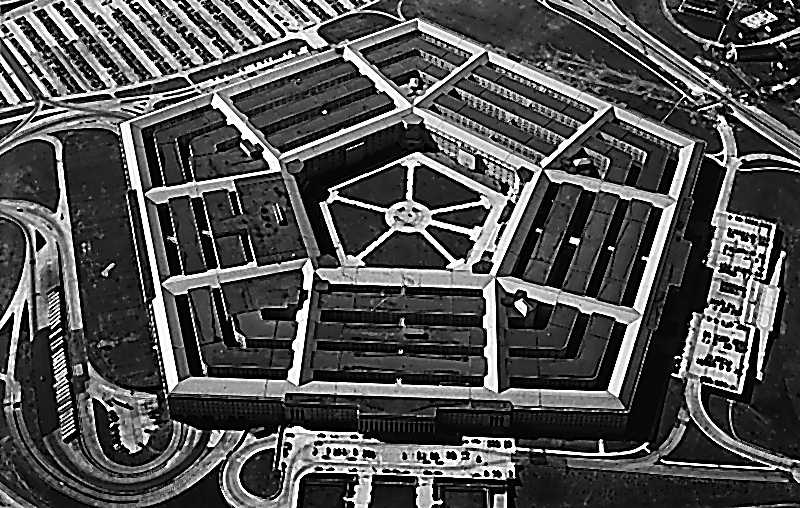 The Pentagon, photographed not long after its wartime completion. The building was finished in 1943, four years before the National Military Establishment it would come to house even existed on paper. Library of Congress, public domain.
Most retellings of this story get it wrong in one of two directions. Either they say the 1947 Secretary of Defense had no real power, which isn't true, or they skip past 1947 entirely and assume the department we know today just showed up whole. Neither holds up against the actual text.
The 1947 act gave the Secretary of Defense four duties to perform. The second one read: "Exercise general direction, authority, and control over such departments and agencies." That phrase, direction, authority, and control, was already on the books in 1947. James Forrestal, the first man to hold the job, had it in writing from day one.
But look at what sat right next to it. The same law stated that the Departments of the Army, Navy, and Air Force would be "administered as individual executive departments by their respective Secretaries," and that "all powers and duties relating to such departments not specifically conferred upon the Secretary of Defense by this Act shall be retained by each of their respective Secretaries." Forrestal's authority was a list of enumerated powers sitting on top of three departments that were still separately administered by their own men. Whatever Congress hadn't explicitly handed him stayed exactly where it had always been.
Those three secretaries also continued to head their respective executive departments, and each kept a statutory seat on the new National Security Council, the very council on which Forrestal was supposed to help coordinate national security policy. In practice, the structure left the service secretaries with substantial independent authority and institutional power, particularly in the areas the statute hadn't specifically assigned to Forrestal. He had the title. He did not have the leverage the title implied.
The Man Who Tried to Run It Anyway
Forrestal had pushed for something closer to a true, centralized department before the 1947 bill passed. He got a narrower compromise instead, and then spent nearly two years trying to administer national defense through it. Budget fights between the Army, Navy, and the newly independent Air Force escalated into bitter interservice conflict, most visibly in the fight over aircraft carriers and strategic bombers that became known as the Revolt of the Admirals. Forrestal had "direction, authority, and control" in his job description. The problem was that those words operated inside a structure that still left the three military departments separately administered, with powers the statute had never specifically transferred to him.
By early 1949, colleagues described him as exhausted and increasingly unwell. He submitted his resignation that March, effective the 31st. He was hospitalized at Bethesda Naval Hospital in the weeks that followed and died there on May 22, 1949, after a fall from the sixteenth floor. He did not live to see the law rewritten.
The Document That Actually Changed the Sentence
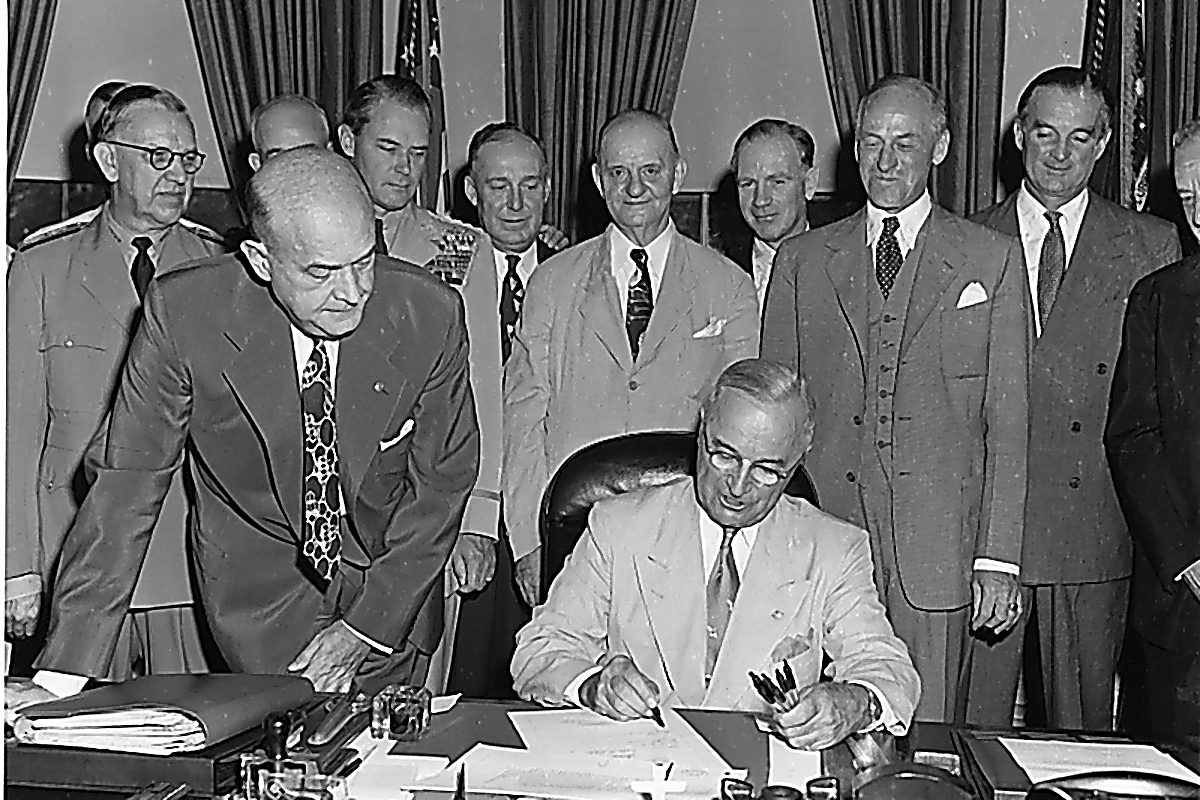
Three months after Forrestal's death, Congress passed the National Security Act Amendments of 1949. Truman signed them on August 10, 1949, at his Oval Office desk. Secretary of Defense Louis Johnson, General Omar Bradley, Admiral Louis Denfeld, General Hoyt Vandenberg, and members of Congress are among those the Truman Library identifies as present.
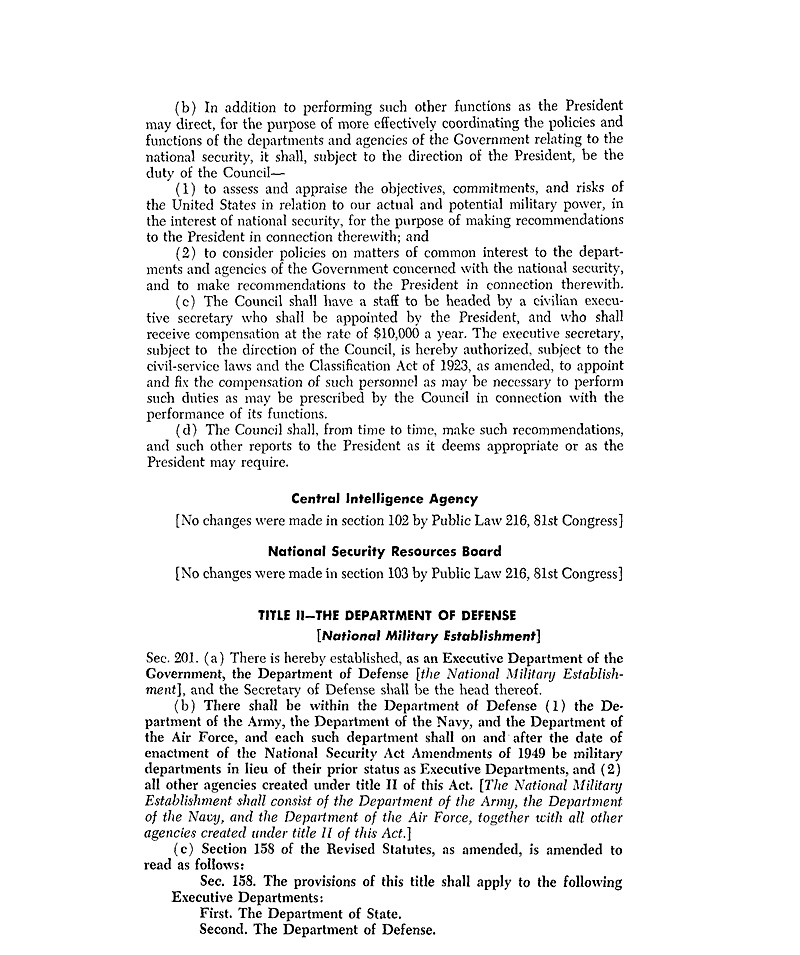
The headline change is not ambiguous. Section 201 of the amended act reads: "There is hereby established, as an Executive Department of the Government, the Department of Defense." The bracketed language beside it, struck from the original, shows exactly what that line replaced: "the National Military Establishment."
The change that actually mattered comes a few paragraphs later, in the same section Forrestal's old job description had come from. The itemized list of four duties was gone. In its place, one direct sentence: "Under the direction of the President, and subject to the provisions of this Act, he shall have direction, authority, and control over the Department of Defense." And the clause that had let the service secretaries retain anything not explicitly given to the Secretary was rewritten too. The 1949 law now stated that the Departments of the Army, Navy, and Air Force "shall be separately administered by their respective Secretaries under the direction, authority, and control of the Secretary of Defense." Read those two versions side by side and the presumption had shifted. In 1947, the service departments retained powers Congress had not specifically transferred to the Secretary. In 1949, the departments were explicitly placed under the Secretary's direction, authority, and control.
The amendments also removed the three service secretaries from their seats on the National Security Council, and created the statutory position of Chairman of the Joint Chiefs of Staff, first held by General Omar Bradley. The Chairman was not a battlefield commander in the modern sense. The statute made him a non-voting presiding officer of the Joint Chiefs, formalizing a single chairmanship that had not previously existed as a permanent statutory position.
Why the Date Gets Lost
Part of why 1947 gets remembered and 1949 doesn't is that 1947 is the better story. It has the new Air Force, the new CIA, the new National Security Council, an entire reorganization of the national security state packed into one bill. The 1949 amendments read, next to that, like housekeeping. A name change. A reworded sentence. A new office down the hall. None of it sounds like a founding moment.
But the government's own paperwork puts the department's formal creation in 1949. The organization chart printed inside the official compilation of the amended act is titled, in full, "Organization for National Security, National Security Act as Amended, 10 August 1949." Not 1947. The department that exists today, the one where the Secretary's authority runs down through the military branches as the starting assumption rather than the exception, is the product of the second law. Congress didn't build it in one clean stroke in 1947. It built a weaker version, watched it strain for two years under the man who tried to run it, and rewrote the sentence that mattered just months after Forrestal was gone.