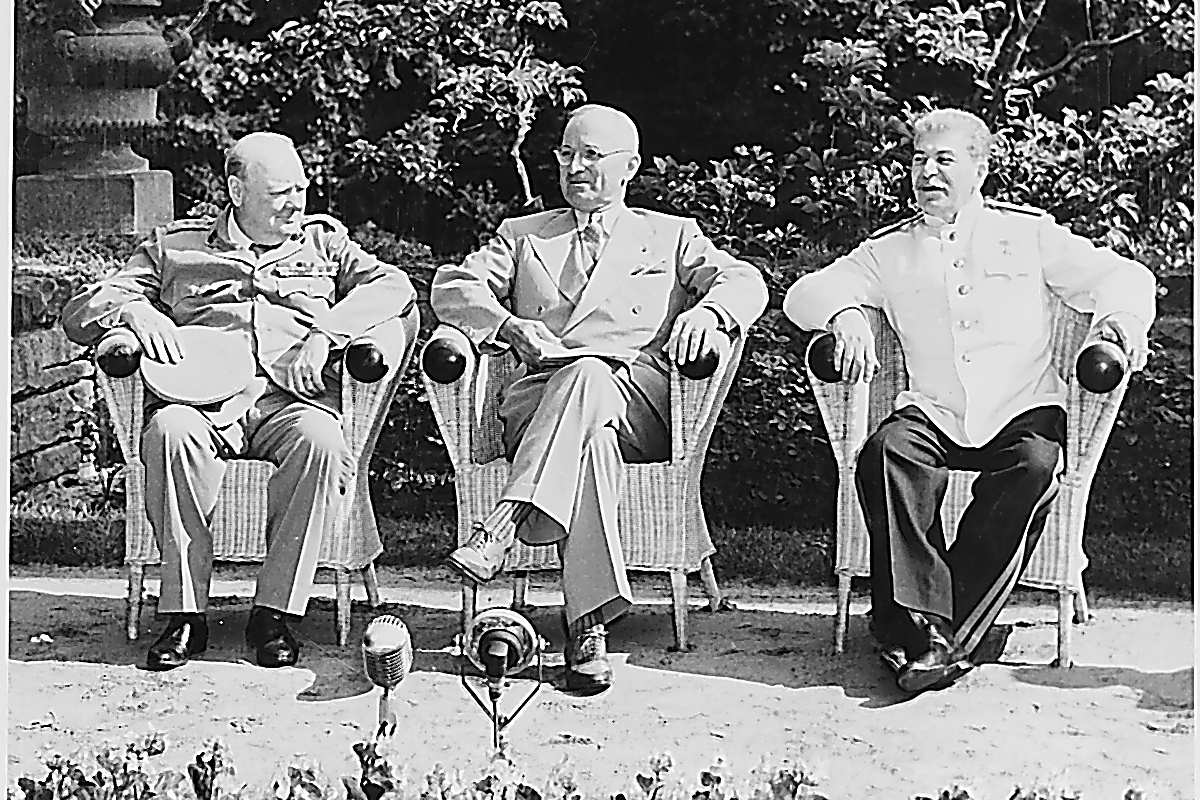
Here is the story most people know: on July 24, 1945, President Harry Truman walked up to Joseph Stalin at the Potsdam Conference and, in a moment loaded with historical weight, revealed that the United States had a devastating new weapon. Stalin, caught off guard, gave a vague reply and walked away. Truman had just changed the balance of power in the room.
Here is what actually happened. Truman told Stalin almost nothing, and Stalin already knew the broad outlines of what he was being told.
A conversation with no drama in it
The Potsdam Conference had been running since July 17, with Truman, Stalin, and British Prime Minister Winston Churchill hammering out what postwar Europe and the fate of a defeated Germany would look like. Nine days earlier, on July 16, the United States had detonated the world's first atomic weapon in the New Mexico desert. Truman got word of the test's success while at the conference and, by his own account, sat on the information for a week.
At the close of the afternoon session on July 24, he finally acted. Truman later described it in his memoirs in almost offhand terms: "On July 24 I casually mentioned to Stalin that we had a new weapon of unusual destructive force." No ceremony, no formal announcement, just a few words through his interpreter, Charles Bohlen, after the day's business had wrapped up. He deliberately avoided the phrase "atomic bomb," calling it instead a weapon "of unusual destructive force."
Stalin's reaction was just as understated. He said he was glad to hear it and hoped the Americans would put it to good use against Japan. Then the conversation moved on, and by most accounts nobody nearby thought much of it in the moment.
According to Soviet Marshal Georgy Zhukov's later memoirs, that calm did not last past the end of the day. Stalin summoned Lavrentiy Beria that evening and ordered him to accelerate the Soviet atomic project. If Zhukov's account holds up, the unimpressed shrug at Potsdam was theater.
The part that gets left out
The usual telling of this moment treats Stalin's calm response as the mystery, as if he simply failed to grasp what he was being told. That reading gets it backward. Stalin was not confused. He was informed.
Soviet intelligence had been tracking the Manhattan Project for years, fed by sources embedded inside the American, British, and Canadian atomic programs, including Klaus Fuchs, Theodore Hall, and David Greenglass. By the summer of 1945, Soviet intelligence had assembled a remarkably detailed picture of American progress, far more complete than most U.S. officials outside the Manhattan Project itself possessed. When Truman leaned in to share what he believed was a closely guarded secret, he was, in effect, confirming something Stalin's own case officers had already reported to Moscow.
That context reframes the entire scene. Truman was not delivering a shock. Historians still debate exactly what he was trying to accomplish, whether he was testing a piece of leverage he believed was still secret, simply extending a courtesy notice to an ally before the weapon was used, or applying quiet pressure ahead of the war against Japan. Whatever the intent, the leverage he thought he was holding did not land as one, because there was little left for Truman to reveal.
What Truman wrote down the next morning
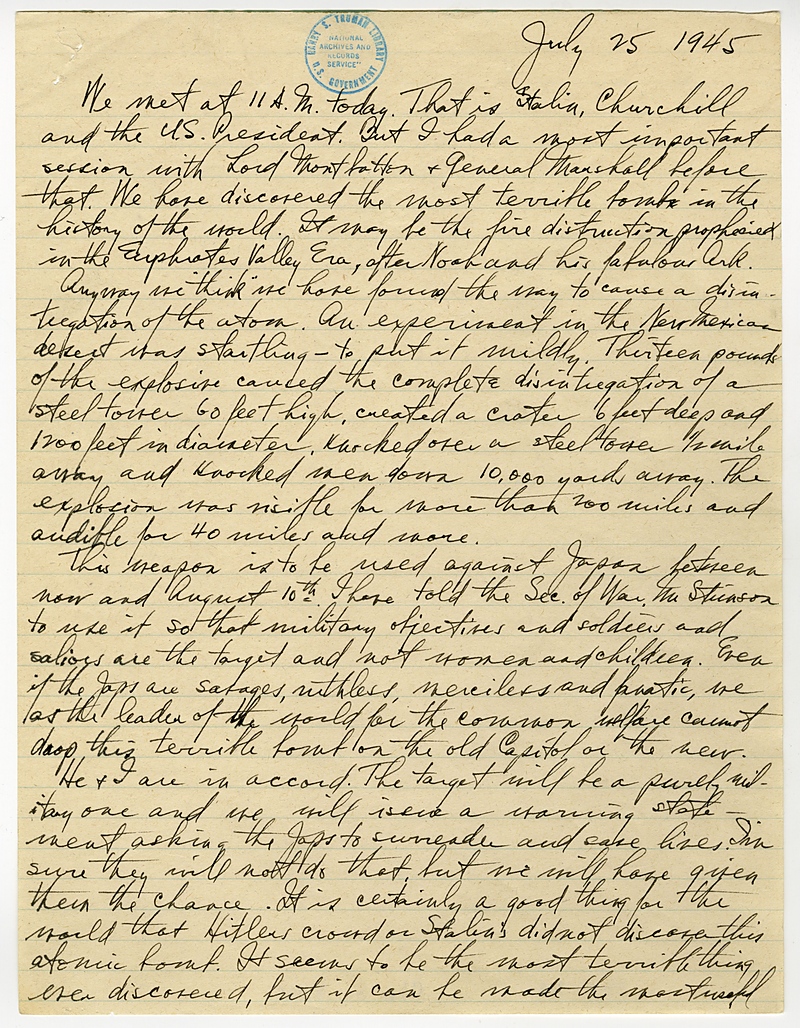
Truman kept an informal, handwritten diary during the conference, and the entry covering this stretch is dated July 25, the morning after the exchange with Stalin. In it, he described the Trinity test result in his own words as "the most terrible bomb in the history of the world," adding that it might be "the fire distruction prophesied in the Euphrates Valley Era, after Noah and his fabulous Ark." He recorded the raw numbers reported to him: a steel tower disintegrated, a crater six feet deep and twelve hundred feet across, men knocked off their feet ten thousand yards from the blast.
The same entry shows Truman deciding, in writing, that the weapon should be aimed at military targets rather than women and children, a distinction that proved difficult to hold in practice, since Hiroshima and Nagasaki were both legitimate military objectives, home to army headquarters, depots, and naval and industrial facilities, that also happened to be large, densely populated cities. He also noted his intention to have Secretary of War Henry Stimson issue a warning statement to Japan first, "asking the Japs to surrender and save lives," while predicting, correctly, that Japan would not take the offer. That warning became the Potsdam Declaration, issued two days later on July 26. It threatened Japan with "prompt and utter destruction" but never mentioned the bomb by name, and Japan's leadership let it pass without a real answer.
The diary page linked with this article, held by the Harry S. Truman Library and the National Archives, is the president's own account, written in his own hand within a day of the Stalin conversation. It is worth reading past the famous line about the bomb. The surrounding paragraphs, about Poland's shifting borders and the Bolshevik land grab at the Oder and Neisse rivers, are what actually dominated Truman's attention that week. The atomic bomb was, for him, a single paragraph in a much longer argument about the shape of postwar Europe.
Why the standard version survives
The clean version of this story, a stunned Stalin absorbing a secret in real time, is more satisfying than the truth. It gives Truman a clear win and turns Potsdam into a hinge moment where American technological supremacy visibly rattled the Soviets. The actual sequence is messier and less dramatic than the legend: an American president reveals what he believes is a closely held secret to a Soviet leader who has known its broad outlines for months, and nobody in the room lets on that the whole exchange is little more than a formality.
For Stalin, the bomb secret was already gone. What is preserved on paper is the moment Truman still believed it wasn't.