On the morning of June 14, 1985, TWA Flight 847 lifted off from Athens bound for Rome with one hundred fifty-three passengers and crew on board. It never made it.
Two men had smuggled a pistol and two grenades through airport security. Shortly after takeoff, they breached the cockpit, assaulted the crew, and forced Captain John Testrake at gunpoint to change course. Its passengers would not reach freedom for another seventeen days.
What unfolded over those days was not just a hijacking. The hijackers identified themselves publicly as the Organization of the Oppressed on Earth, though the operation is broadly attributed to Hezbollah. What unfolded over those days was broadcast live to a global television audience, that exposed how unprepared the United States was to confront the new face of political violence in the Middle East.
The First Stop in Beirut
The hijackers ordered Testrake to divert to Beirut. Before the plane was permitted to land, Testrake radioed Lebanese air traffic control in a transmission that would be replayed around the world: he told controllers that one of the hijackers had pulled a grenade pin and would blow up the aircraft. They were allowed to land.
In Beirut, nineteen passengers were released in exchange for fuel. Then the plane took off again for Algiers, where twenty-one more passengers were let go after hours of negotiation. The hijackers' demands centered on the release of more than seven hundred Shia Muslim prisoners held in Israeli custody, and the release of a group of Kuwaiti prisoners known as the Kuwait Seventeen, who had been involved in the 1983 bombing of the U.S. Embassy in Kuwait.
The plane returned to Beirut.
Robert Stethem
During the second stop in Beirut, the hijackers singled out one passenger because of what his military ID card revealed.
Robert Stethem was twenty-three years old, a Navy diver from Waldorf, Maryland. The hijackers beat him repeatedly throughout the ordeal. On June 15, after beating him severely, they shot him aboard the aircraft, threw his body onto the tarmac, and shot him again.
His murder was meant to demonstrate that the threats were not theater.
While Stethem was killed, seven American passengers whom the hijackers believed to be Jewish were separated from the others and removed to a Shia prison in Beirut. Approximately twelve additional armed militants boarded during the Beirut stop, reinforcing the hijackers. The situation was no longer simply a hijacking. It had become a hostage crisis spread across a city in the middle of a civil war.
Seventeen Days
Over the days that followed, the plane's remaining passengers and crew were dispersed to multiple locations across Beirut, making any rescue operation effectively impossible. The city was divided among militia factions. There were no clear lines, no perimeter, no government capable of exercising effective authority over the areas where the hostages were held.
Nabih Berri, the leader of the Amal militia and a minister in the Lebanese cabinet, positioned himself as the public face of the negotiations. The Reagan administration maintained publicly that it would not negotiate with terrorists. Privately, the diplomatic channels ran through Syria, Lebanon, Israel, and a State Department legal adviser named Abraham Sofaer, who constructed an argument that any prisoner release by Israel would not constitute yielding to the hijackers' demands because the U.S. had already objected to Israel's detention of Lebanese prisoners before the crisis began.
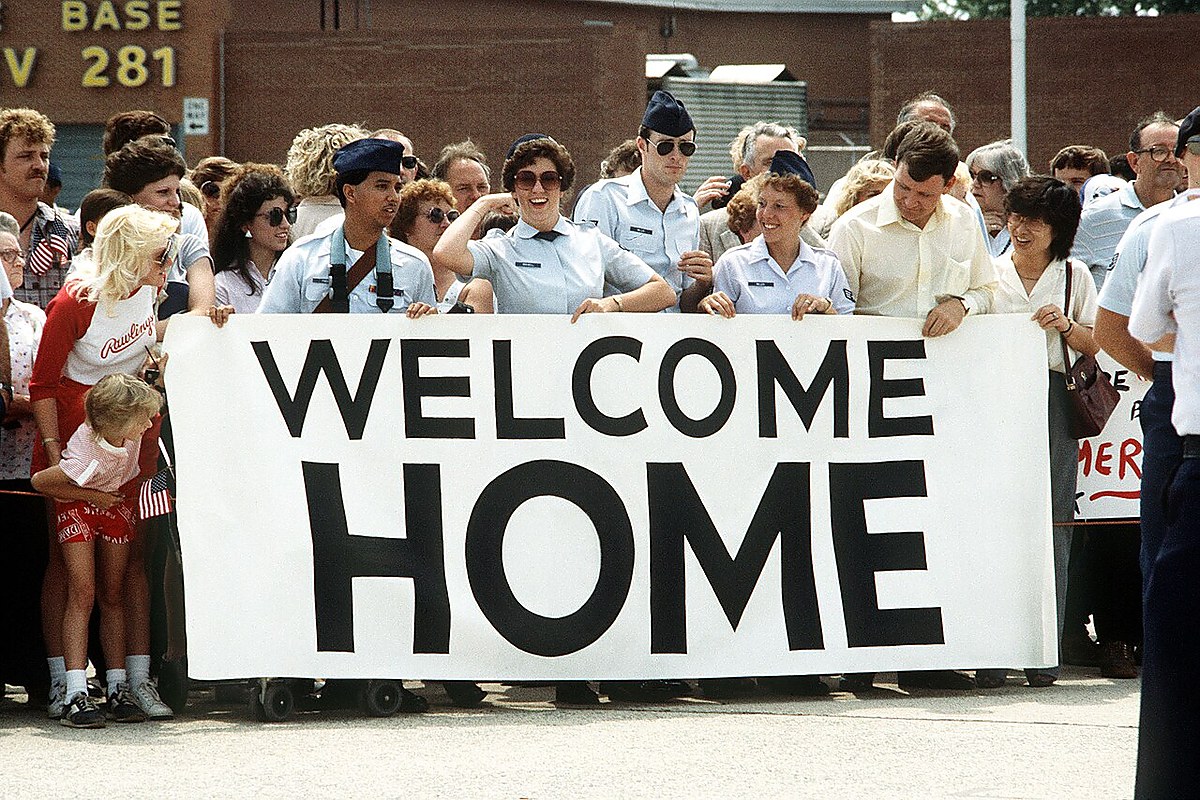
One hostage was released on June 26 after developing heart trouble. The remaining thirty-nine Americans were freed on June 30, gathering in a schoolyard in militia-controlled West Beirut before being driven to Damascus by the International Red Cross. From Damascus they flew to West Germany. Vice President George H.W. Bush met them at Rhein-Main Air Base. They were debriefed, examined, and then flown to Andrews Air Force Base in Maryland.
Over the following weeks, Israel released more than seven hundred Shia prisoners, maintaining throughout that the releases had nothing to do with the hijacking.
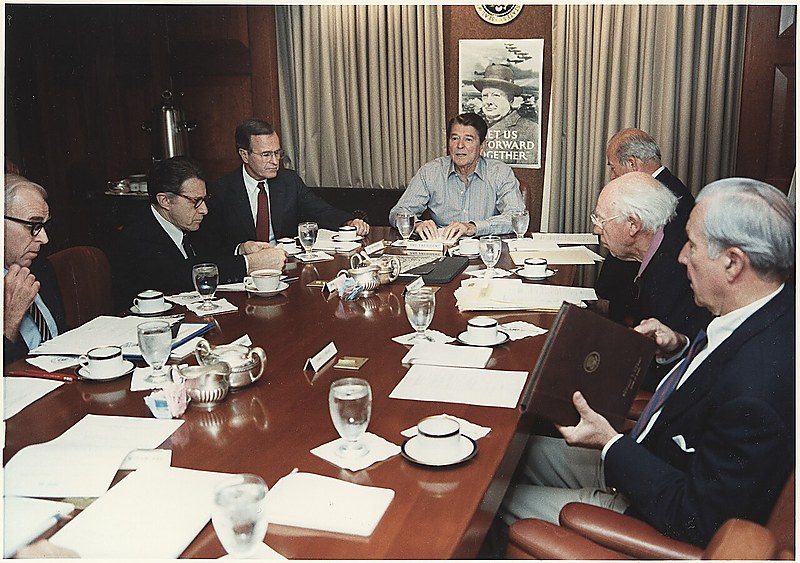 President Reagan chairs a National Security Council meeting on the TWA Flight 847 crisis, Situation Room, 1985. National Archives, public domain.
Reagan's Statement
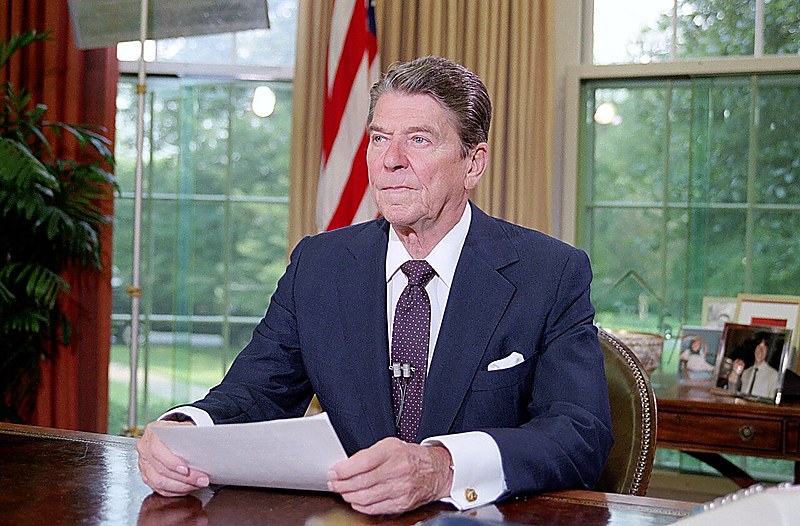 President Reagan addresses the nation from the Oval Office following the release of the TWA Flight 847 hostages, June 30, 1985. Reagan Presidential Library, public domain.
On the evening of June 30, Reagan spoke from the Oval Office. He announced that the thirty-nine Americans were free and on their way to Frankfurt. He called it a moment of joy. He also made clear it was not a moment for celebration. He insisted that the murderers of Robert Stethem would be held accountable and that nations that harbor terrorists would face consequences.
The accountability he promised was partial at best. Mohammed Ali Hammadi, identified as one of the principal hijackers, was arrested at Frankfurt airport in January 1987 carrying liquid explosives. The United States sought extradition. Germany refused, tried him domestically, convicted him of murder and hostage-taking, and sentenced him to life in prison. In December 2005, German authorities paroled him. He returned to Beirut.
Two of his collaborators, Hasan Izz-Al-Din and Ali Atwa, were placed on the FBI's Most Wanted Terrorists list. Ali Atwa was widely reported to have died of cancer in Lebanon in 2021, though the FBI has never formally confirmed his death or removed him from its Most Wanted Terrorists list. Izz-Al-Din remains a fugitive.
Imad Mughniyeh, believed to have played a supervisory role in the operation, was killed by a car bomb in Damascus in February 2008, in an operation later attributed to Israeli and American intelligence.
What the Document Shows
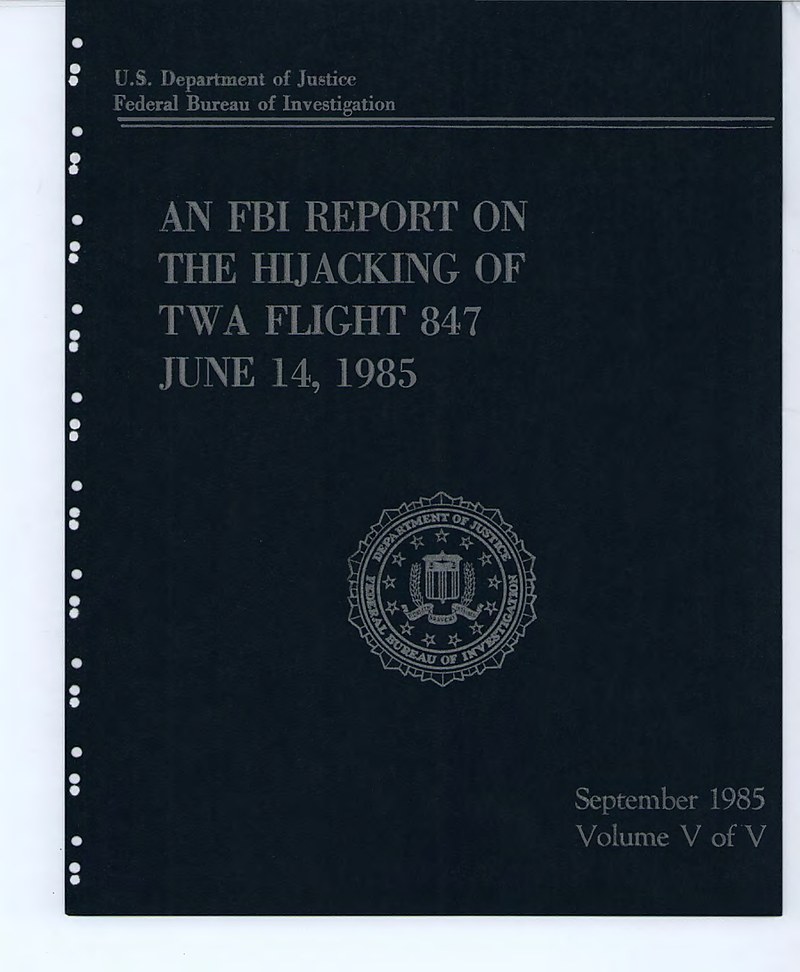
The FBI report filed in September 1985, three months after the hostages came home, runs five volumes. The copy reproduced here comes from Oliver North's National Security Council files at the White House, where it was held classified until its declassification and release by the Reagan Presidential Library. It runs five volumes. The cover page you see above identifies it as Volume V of V. It was classified at the time and has since been declassified and released by the Reagan Presidential Library.
The document is significant not just for what it contains, but for where it was filed. North was the NSC staff member managing the administration's counterterrorism portfolio. Within months of this report being filed, the same cast of characters, similar hostage-focused negotiations and many of the same back channels would reappear in what became the Iran-Contra affair.
The FBI's five-volume report on TWA 847 represents the moment the U.S. government tried to understand what had happened. The question of whether it learned the right lessons is more complicated.