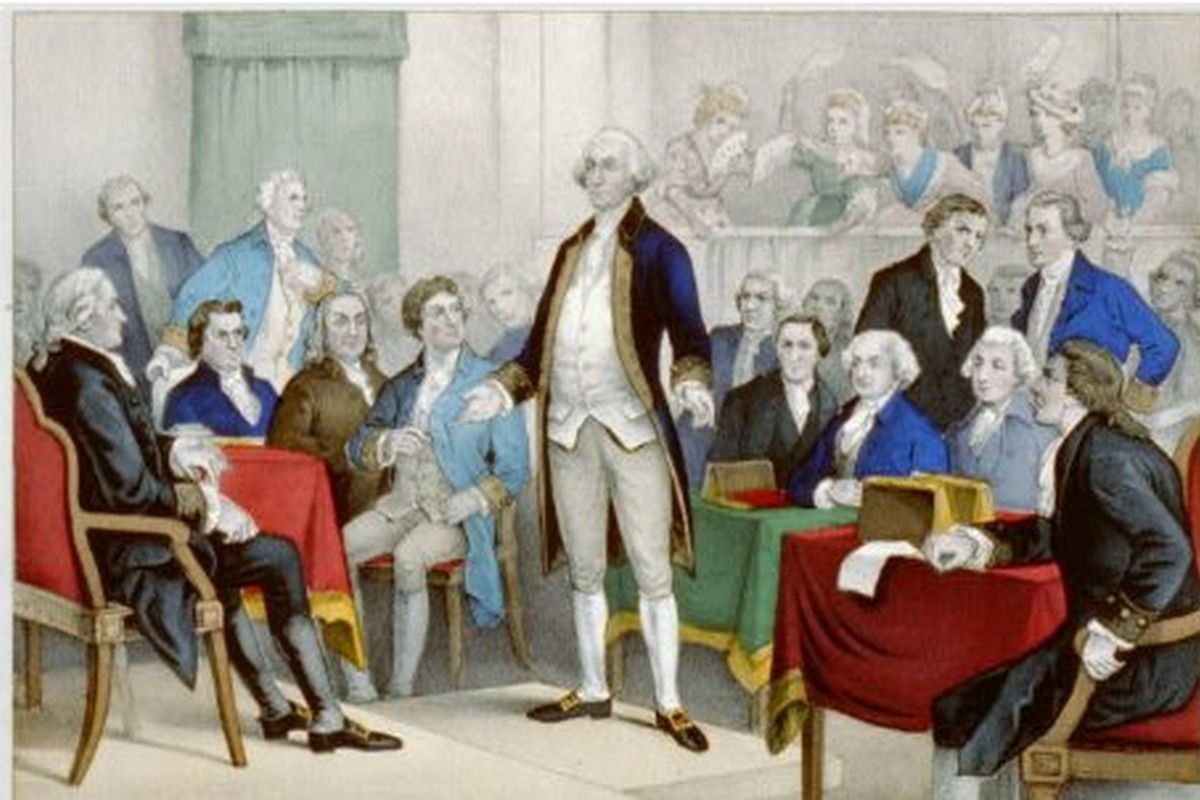
Philadelphia, June 15, 1775. The Second Continental Congress had been arguing, in fits and starts, about who should command the army it had created the day before. Outside Boston, more than fourteen thousand New England militiamen were already dug in around a city occupied by British regulars. Someone needed to take charge of them, and Congress had spent days circling the question without settling it.
John Adams decided to force the issue.
He rose and told the assembled delegates that he had one man in mind for the job: a gentleman from Virginia, well known to everyone present, whose military experience, fortune, and character would unite the colonies behind him in a way no one else could. Adams did not say the name. He did not need to.
George Washington was sitting near the door. According to Adams's later account, the moment Washington realized who was being described, he quickly slipped into the adjoining library room.
The man presiding over the session did not move at all. He sat at the front, and according to Adams, his face told the story before anyone could stop him.
The President's Reaction
John Hancock had been elected president of the Continental Congress only three weeks earlier, and by every account he was good at the job. He had run legislative bodies and town meetings in Massachusetts for years, his wealth reassured the moderates, and his ties to Boston's radical faction kept him credible with the firebrands. He was, in other words, a man used to being the person in the room everyone deferred to.
Adams, writing decades later in his autobiography, remembered watching Hancock's expression change as the nomination became obvious. He described it as a sudden and sinking collapse, mortification and resentment written across Hancock's face as plainly as if he had spoken them aloud.
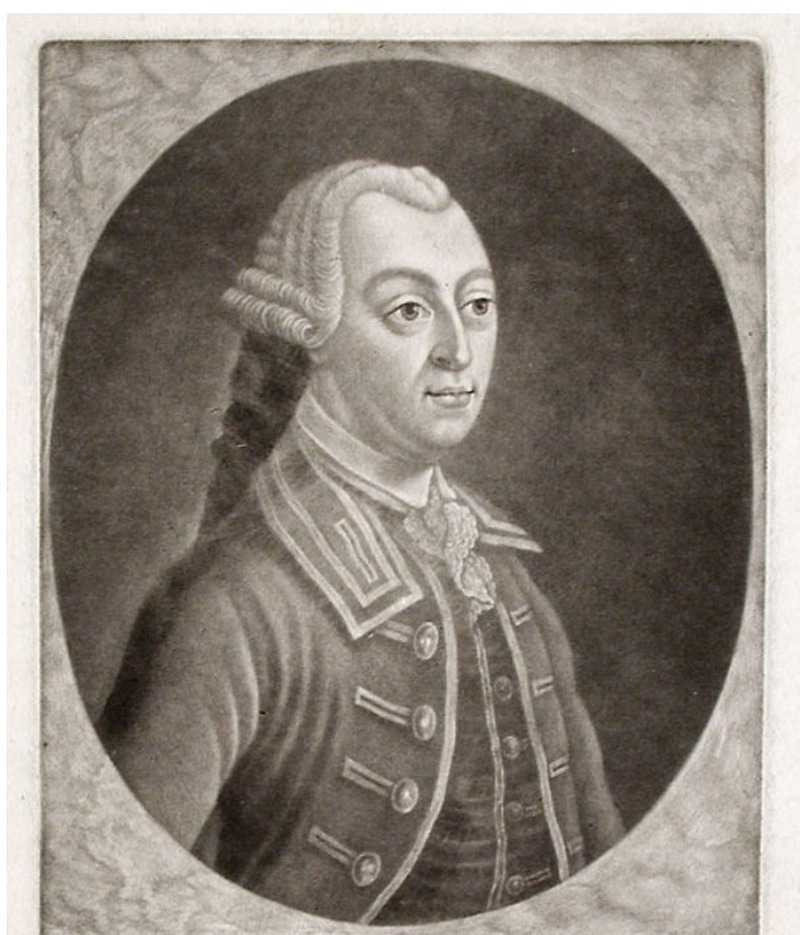 John Hancock, President of the Continental Congress, circa 1776.
The implication, which Adams left for readers to draw themselves, was that Hancock had expected the command to be his.
It is a vivid scene, and it has been repeated by historians for two centuries. There is just one problem with it: Adams wrote it down in 1801, twenty-six years after it supposedly happened, and no other source from 1775 corroborates it. Historian Donald Proctor has gone so far as to argue that the evidence runs the other way entirely, that nothing from the period suggests Hancock wanted the command at all. Hancock and Washington remained on cordial terms for years afterward. In 1778, Hancock named his own son after him.
So did it happen the way Adams remembered it, or did an old man's memory sharpen a moment that was, at the time, much less dramatic? There is no way to settle it definitively. What is certain is what Congress did next, and that part of the story does not depend on anyone's facial expression.
A Vote Without Debate, Mostly
The Journals of the Continental Congress record June 15 in the dry, procedural language official minutes always use. Congress resolved that a general be appointed to command all forces raised for the defense of American liberty. It set his pay at five hundred dollars a month. Then it proceeded to the choice of a general, by ballot, and George Washington was unanimously elected.
That single word, unanimously, papers over a real debate that had taken place in the days before. Adams's account describes delegates raising the obvious objection: the army outside Boston was entirely a New England army, it already had a general it seemed satisfied with in Artemas Ward, and putting a Virginian in charge of New England's soldiers was a gamble. Edmund Pendleton of Virginia and Roger Sherman of Connecticut both spoke against it. Others were less direct but no warmer.
That was precisely Adams's point in proposing Washington in the first place. A New England army with a New England general was a regional rebellion. A continental army with a Virginian at its head was something closer to what the moment actually required, a united colonial response rather than a Massachusetts grievance that the other colonies were being asked to underwrite. Adams worked the room between sessions, the opposition softened, and by the time the formal ballot was taken, the dissenters had been persuaded to stand down. The nomination itself came not from Adams but from Thomas Johnson of Maryland, which was its own small signal: the choice of a Virginian was being formally proposed by a delegate from neither Virginia nor New England.
"I Do Not Think Myself Equal"
Washington was informed of his election the following day, June 16, and Congress's official record preserves what he said when he stood to respond. It is not the speech of a man who had been angling for the job.
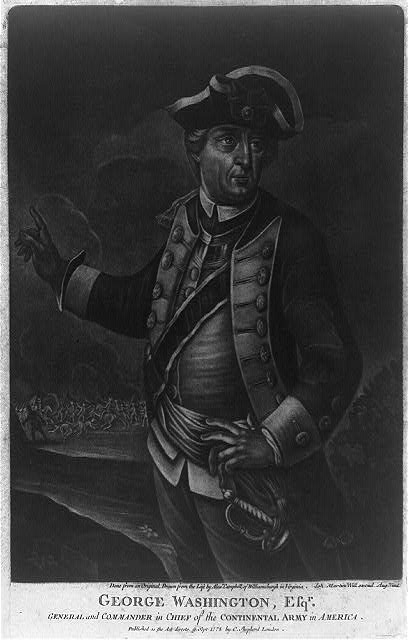 George Washington, Esqr., General and Commander in Chief of the Continental Army in America, engraved from an original drawn from life by Alexander Campbell of Williamsburg, Virginia, 1775.
He told Congress he was sensible of the honor done him, but that he felt great distress, from a consciousness that his abilities and military experience might not be equal to the trust being placed in him. He said he would take up the duty because Congress desired it, and would exert every power he possessed in the service of the cause. Then he added the line that has outlasted almost everything else from that day: that he wished it remembered by every gentleman in the room, with the utmost sincerity, that he did not think himself equal to the command he was being honored with.
He also turned down the salary. Congress had just voted the commanding general five hundred dollars a month. Washington said no pecuniary consideration could have tempted him to accept the position in the first place, and that he wanted no profit from it. He would keep a careful account of his expenses, and asked only that those be reimbursed when the war was over.
John Adams was struck by it. Writing to Elbridge Gerry two days later, he called it charming, a man of one of the first fortunes on the continent leaving his comfortable life and risking everything for the cause, asking for nothing but his expenses back. Eliphalet Dyer of Connecticut came away with a similar impression, describing Washington as modest, discreet, virtuous, sober, and calm, the opposite of the swaggering officer type Dyer might have expected.
Privately, Washington was less composed than his speech suggested. According to Dr. Benjamin Rush, who spoke with Patrick Henry shortly afterward, Washington told Henry plainly that he considered himself unequal to the position his country had placed him in. Then, with tears in his eyes, he said something closer to a premonition than a thank-you: that from the day he took command of the American armies, he dated his fall, and the ruin of his reputation.
He wrote to Martha two days later in much the same register, telling her that he had used every effort in his power to avoid the appointment, and that it had been impossible to refuse without exposing his character to censure and bringing pain to his friends. He was, by his own account, a man who had been maneuvered into the most consequential job in the colonies and was not at all sure he wanted it.
What Congress Actually Built
The same session that elected Washington spent considerable time on matters that rarely make it into the popular telling: pay scales, staff positions, and the architecture of an army that, as of June 14, had existed only on paper.
Over the following two days, Congress worked out what the new Continental Army would actually look like. Two major generals, at one hundred and sixty-six dollars a month. Eight brigadiers, at one hundred and twenty-five. An adjutant general, a commissary general, quartermasters, paymasters, engineers, aides-de-camp, secretaries, down to a commissary of musters at forty dollars a month. Artemas Ward, the New England general whose presence had complicated the debate over Washington, was named first major general. Horatio Gates became adjutant general with the rank of brigadier. Charles Lee was named second major general.
Adams, writing again to Gerry, allowed himself a moment of anxiety about what they had just done. He worried that the pay Congress had voted for all these officers was so generous that people would think it extravagant, and that he and his colleagues had tried their utmost to reduce it and failed. He noted, with a kind of weary honesty, that the egalitarian instincts so popular in New England were not shared by gentlemen from the other colonies, who held a high opinion of what a continental general's rank ought to command and were determined to see it reflected in his pay.
It is a small detail, but it captures something the grander narrative tends to leave out: building a continental army out of thirteen separate political cultures meant constant, granular negotiation over things as unglamorous as a quartermaster's salary, and those negotiations were happening in the same rooms, on the same days, as the decisions that would define the war.
The Commission
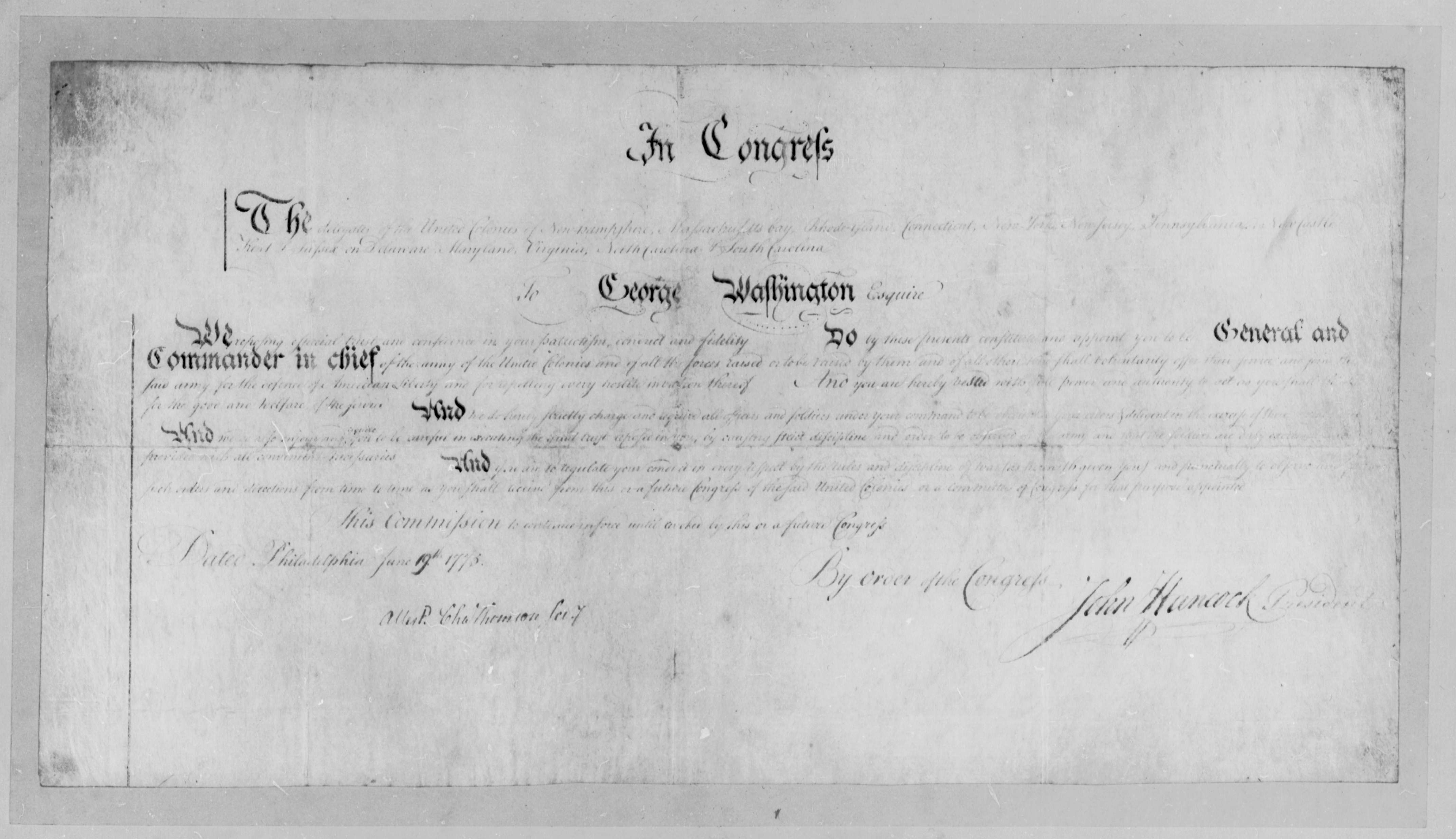
On June 17, the committee assigned to draft Washington's commission reported back, and Congress approved the language by paragraph. The document named him General and Commander in Chief of the army of the United Colonies and of all forces now raised or to be raised, vested him with full power to act for the good and welfare of the service, and charged him to regulate his conduct by the rules and discipline of war provided to him. It was ordered transcribed for signature.
Then Congress did something that made the moment unmistakably continental rather than regional. It resolved, unanimously, that because the delegates of all the colonies, from Nova Scotia, which Congress still hoped to bring into the cause, to Georgia, had chosen George Washington as their commander, Congress would maintain and assist him, and adhere to him, with their lives and fortunes in the same cause.
The finished commission was dated Philadelphia, June 19, 1775, and signed by John Hancock as president, attested by secretary Charles Thomson. Whatever Hancock felt three days earlier, watching Adams build a case for a man who was not him, his signature is the one on the document that sent Washington to Boston.
Washington left almost immediately. He arrived in Cambridge on July 2 and took formal command of the army the following day, an army he had not yet seen, in a war that, eleven months earlier, had not yet begun.
Whether John Hancock's face really fell the way John Adams remembered it twenty-six years later is a question the historical record cannot answer. What the record does show is that within four days, Congress had taken an army of New England militiamen and placed a Virginian at its head, with the unanimous backing of every colony from Nova Scotia, which Congress still hoped to bring into the cause, to Georgia, and that the man receiving the command spent those same four days admitting, to Henry, to Martha, to Congress itself, that he doubted he was equal to it.