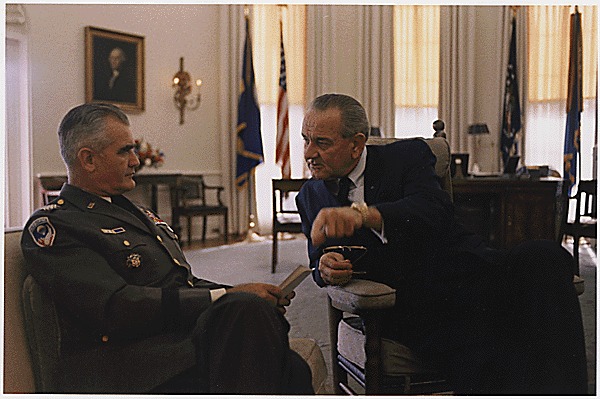
On June 10, 1968, General William Childs Westmoreland stood before reporters in Saigon and defended the strategy that had effectively ended his Vietnam command.
He spoke calmly. He said the war was not stalemated. He said the attrition approach was sound, that the numbers supported it, that the enemy was being worn down. He passed command of the Military Assistance Command, Vietnam to his deputy, General Creighton Abrams, and flew to Washington to become Army Chief of Staff. A promotion, the Pentagon called it.
What Westmoreland did not address, and what could not easily be addressed in that Saigon briefing room, was that the numbers underlying his optimism had been the subject of a bitter internal dispute for more than a year. Intelligence officers inside his own command had argued, with increasing urgency, that official estimates of enemy troop strength were being kept artificially low, constrained to support a public narrative of progress that the raw intelligence did not fully sustain. Some of those officers later said they were ordered to keep the numbers below a politically acceptable ceiling. The extent to which that reflected deliberate deception or genuine methodological disagreement has been debated by historians ever since.
What is not seriously disputed is what happened next.
A War With No Yardstick
Westmoreland took command of MACV in June 1964 and inherited a conflict with no obvious way to measure success. There was no territory to capture and hold, no capital to seize, no front line to advance. The enemy largely controlled when and where to fight. They were not trying to defeat the United States militarily. They were trying to outlast it politically.
Westmoreland's answer was attrition. If the communists could not be driven from the battlefield by conventional means, they could be ground down numerically. The logic was straightforward: kill enemy fighters faster than Hanoi could replace them and eventually the math would force a settlement. The instrument for measuring this progress was the body count, a tally of confirmed enemy dead compiled after every engagement.
Defense Secretary Robert McNamara, a former Ford Motor Company president with a strong inclination toward quantitative management, was drawn to metrics. Body counts, kill ratios, enemy weapons captured, villages pacified: these were the statistics of a war being administered from Washington as much as fought in the field. Westmoreland embraced the system and cited the Battle of Ia Drang in November 1965 as evidence it was working. American firepower, concentrated through helicopter mobility, could inflict losses the communists could not sustain.
The problem was structural from the start. A body count is impossible to verify independently. Soldiers in the field had incentives to report high numbers. Civilian deaths were sometimes reclassified. The metric counted kills but said nothing meaningful about replacement rates. North Vietnam was moving men south along the Ho Chi Minh Trail at a pace that Westmoreland's public assessments consistently underestimated. A strategy could produce impressive kill statistics and still be losing ground.
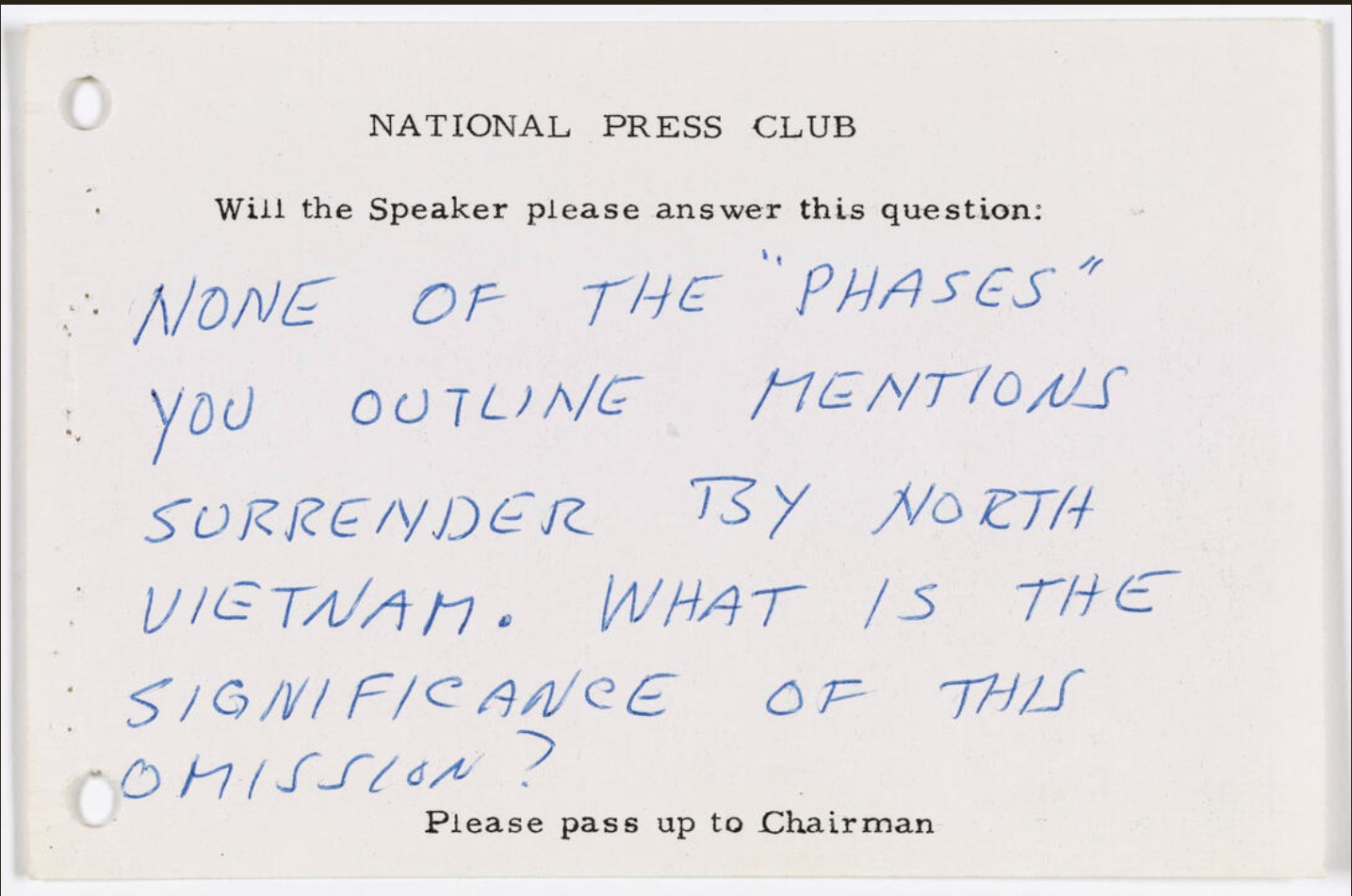
Reporter's question card submitted to General Westmoreland at the National Press Club, Washington, D.C., November 21, 1967. The question asks why none of the phases Westmoreland outlined includes North Vietnamese surrender. National Archives / LBJ Presidential Library.
The Progress Offensive
By late 1967, President Johnson's public approval numbers were in serious decline. The public had been told for two years that the war was being won. The enemy's supposed losses were staggering. And yet the war showed no signs of ending. The distance between official optimism and visible reality had become a running story in the American press, known widely as the credibility gap.
The Johnson administration responded with what insiders called a "progress offensive." Senior officials were dispatched to reassure Congress and journalists. National Security Adviser Walt Rostow suggested the administration find ways of directing press coverage toward evidence of progress. Westmoreland was brought home to Washington in November 1967 to be the public face of the effort.
On November 21, 1967, he stood at the podium of the National Press Club and told the assembled press corps that the war had reached a point "where the end begins to come into view." He outlined four phases of the conflict and described a trajectory toward American withdrawal and South Vietnamese self-sufficiency.
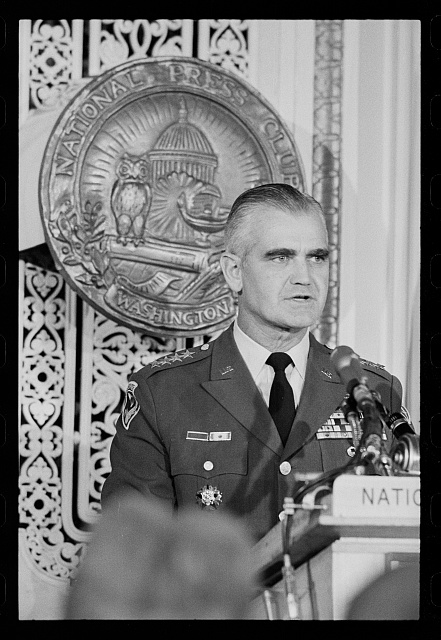 General Westmoreland at the National Press Club, Washington, D.C., November 21, 1967. His address declared the war had reached a point 'where the end begins to come into view.' Reporters in the audience submitted pointed written questions about the substance of his claims. Library of Congress, U.S. News and World Report Collection.
The reporters in that room pushed back in writing. Question cards passed up to the chairman that afternoon pressed Westmoreland on the gaps in his argument. One card asked directly why none of the phases he outlined mentioned surrender by North Vietnam, and what the significance of that omission was. It was a pointed observation. Westmoreland's four-phase plan had no endpoint that required the enemy to stop fighting. It required the enemy to run out of people willing to die, which was a different proposition entirely. The reporters could see the gap. The television audience that evening largely could not.
Seven weeks later, the Tet Offensive began.
The Order of Battle Dispute
What the November press conference did not surface, and what the Johnson administration was not publicizing, was that a serious intelligence dispute had been running inside MACV for most of 1967. It centered on what military planners called the order of battle: the official estimate of total enemy forces in South Vietnam.
MACV's official figures held communist troop strength at roughly 300,000. CIA analysts, working from the same raw reporting, argued the real number was considerably higher, potentially over 500,000. The gap came down to a definitional question about which categories of fighters to count. MACV included main force units and regional forces. The CIA argued for including self-defense militia, political cadre, and local guerrilla infrastructure. These were the people who planted mines, collected intelligence, and kept supply lines running. Excluding them produced a dramatically lower official number.
In September 1967, MACV and CIA analysts met in Saigon to try to reconcile their estimates for a Special National Intelligence Estimate that would inform policymakers in Washington. The CIA pushed for higher figures. MACV pushed back. The resistance, as testimony later established, involved more than analytical disagreement.
Colonel Gains Hawkins, who served as head of MACV's Order of Battle branch for most of 1967, later stated that official enemy strength figures were kept below what the underlying intelligence supported. In a 1982 Washington Post opinion piece, Hawkins wrote that he was ordered to hold the numbers in a range that would not undermine the optimistic public assessments coming from Westmoreland and the administration. Whether that instruction reflected a deliberate political decision or the institutional pressure of operating inside a command that had staked its credibility on a particular set of numbers is a question historians have not resolved cleanly. What Hawkins said, and said on the record, was that the numbers were constrained.
Westmoreland's entire strategic framework depended on what planners called the crossover point, the moment when American attrition would exceed North Vietnamese replacement capacity. But the crossover point calculation was only meaningful if the baseline enemy strength figure was accurate. If that baseline was being held artificially low, the crossover point would appear closer than it actually was. Progress would appear real. The end would appear to be coming into view.
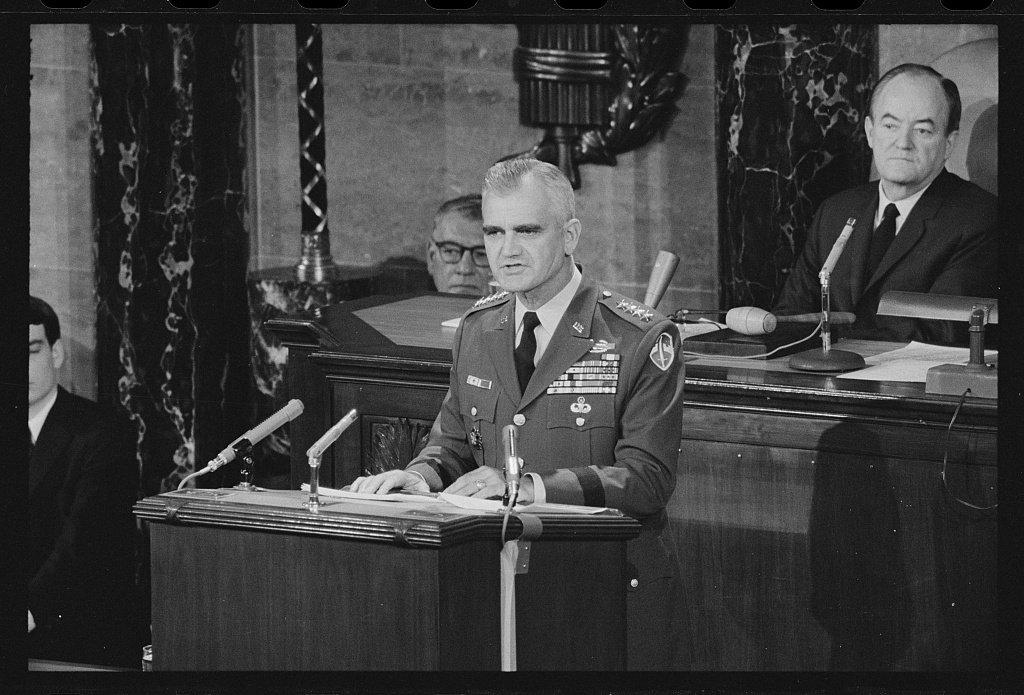 General Westmoreland addresses a joint session of Congress on April 28, 1967, with Vice President Hubert Humphrey seated behind him. Westmoreland told Congress that American resolve was the enemy's primary vulnerability, and urged continued strong support for the war effort. Library of Congress, U.S. News and World Report Collection.
Tet
On January 30, 1968, North Vietnamese and Viet Cong forces launched coordinated attacks on more than 100 South Vietnamese cities and towns. They struck provincial capitals, military installations, the U.S. Embassy compound in Saigon, and the former imperial capital of Hue. The scale and coordination of the offensive caught American and South Vietnamese commanders off guard. Westmoreland had been focused on the Marine base at Khe Sanh, which he believed was the primary communist objective. Whether Khe Sanh was meant to draw American attention away from the broader offensive, or vice versa, has never been definitively resolved.
What is clear is that the offensive demolished the public credibility of everything Westmoreland had been saying. An enemy that was supposedly approaching its breaking point had just executed the most ambitious military operation of the war.
American and South Vietnamese forces responded aggressively. The communists were repelled at most locations within weeks. Their casualties across the full offensive were enormous, with some estimates putting losses above 45,000 killed. In that military sense Westmoreland's characterization of Tet as an American victory was not unreasonable. The battles went largely in America's favor. But the political damage was complete and irreversible. Journalist Walter Cronkite flew to Vietnam in February 1968, toured the wreckage, and returned to tell CBS viewers that the most realistic assessment he could offer was that the war was mired in stalemate. Johnson reportedly watched the broadcast and remarked that if he had lost Cronkite, he had lost middle America.
Westmoreland and Chairman of the Joint Chiefs General Earle Wheeler then formally requested 206,756 additional troops above the previously approved ceiling of 525,000. That request, which quickly leaked to the press, landed with devastating effect. It told the public, clearly and in the government's own numbers, that the strategy was not working and that the men running it knew it.
The Handoff
The classified internal history of the war that McNamara had commissioned in 1967, later known as the Pentagon Papers, documented in detail what happened inside the administration after Tet. The 206,000-troop request forced the Johnson administration to confront a decision it had been deferring. Incoming Secretary of Defense Clark Clifford ordered a complete reassessment of American strategy, bringing together military commanders, Pentagon civilians, and the CIA.
The CIA's assessment was stark. Adding 200,000 troops would not produce victory. The communists had the manpower and logistical capacity to absorb any American increase and keep fighting. The outcome would be a larger and more costly version of the same stalemate. Pentagon systems analysts pushed for abandoning search-and-destroy operations in favor of a strategy focused on defending populated areas and coastal regions rather than pursuing the enemy into remote border territory. General Wheeler called that approach a fatal flaw that would invite more fighting in civilian areas. The final recommendation to Johnson was a compromise: an immediate deployment of roughly 22,000 additional troops, a limited reserve call-up, and a deferral of the larger strategic question.
Johnson rejected the full troop request, set a new ceiling of approximately 549,500 personnel, and addressed the nation on March 31, 1968. He announced a partial halt to bombing North Vietnam and called for peace negotiations. He said South Vietnam must take on more of the combat burden. At the end of the speech, he said he would not seek re-election.
Three days later, North Vietnam agreed to begin preliminary talks.
On June 10, 1968, Westmoreland held his farewell press conference. He defended the body count strategy. He said the war was not stalemated. He handed command to Abrams and left Vietnam. The public was told a change of commanders represented a change of approach. Abrams, in private communications to his own staff before assuming command, said he intended to avoid any implication of great change or new strategy. The war continued for seven more years.
The Reckoning That Never Came
In January 1982, CBS broadcast a documentary titled "The Uncounted Enemy: A Vietnam Deception." Correspondent Mike Wallace and producer George Crile presented the testimony of former MACV intelligence officers, including Gains Hawkins, and CIA analyst Sam Adams, who had argued for higher enemy strength estimates throughout 1967. The documentary alleged a conspiracy at the highest levels of American military intelligence to suppress accurate reporting in the year before Tet.
Westmoreland sued CBS for $120 million in libel damages. The trial, which opened in 1984, became a prolonged legal argument about what the order of battle numbers had actually shown and who had given what instructions to whom. Former military officers and intelligence analysts testified on both sides. The picture that emerged was of an institutional environment in which accurate reporting was unwelcome and those who produced it faced resistance, though the precise chain of command behind that resistance was contested throughout the proceedings.
In early 1985, with the jury still deliberating, Westmoreland dropped the lawsuit. CBS issued a statement saying it had never intended to assert that Westmoreland was unpatriotic or disloyal in performing his duties as he saw them. It retracted nothing substantive from the documentary.
The underlying question, whether the suppression of enemy strength estimates was an organized deception or the accumulated effect of institutional and political pressure, was never adjudicated in a court of law. Westmoreland died in 2005 maintaining that his assessments had been honest. Gains Hawkins, who said on the record that he had been ordered to produce numbers that did not reflect the intelligence, was never charged with anything. Neither was anyone else.
What the body count system produced, in the end, was a war that looked like it was being won in the statistics and lost in the field. The metric was designed to measure progress toward a crossover point that the enemy's actual strength made unreachable. Fifty-eight thousand Americans died in Vietnam. The strategy that was supposed to shorten the war had no reliable mechanism for recognizing that it was failing.
The Vietnam Veterans Memorial was dedicated in Washington, D.C. on November 13, 1982. The wall is black granite, and it reflects the faces of the people who stand before it.