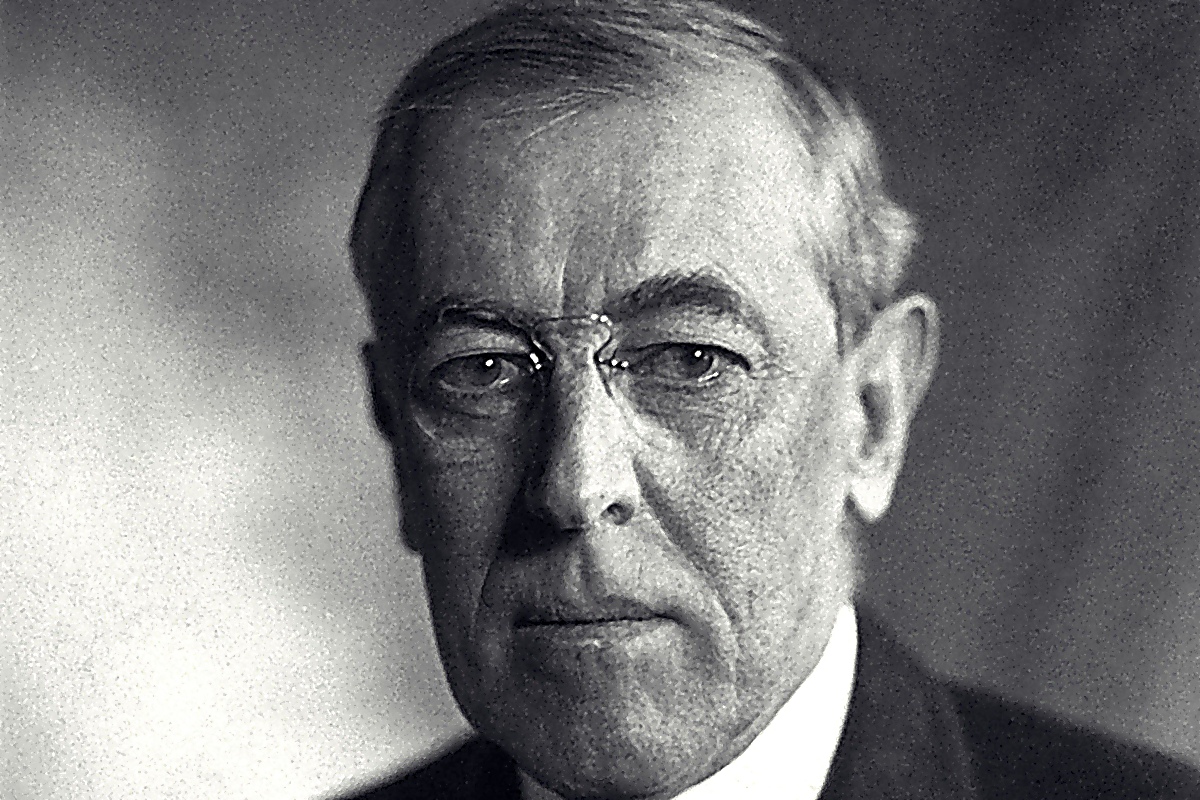
Most accounts of this day say Woodrow Wilson appeared before the Senate Foreign Relations Committee to defend the Treaty of Versailles. That is true in the sense that mattered politically. It is not quite true in the literal sense the phrase suggests.
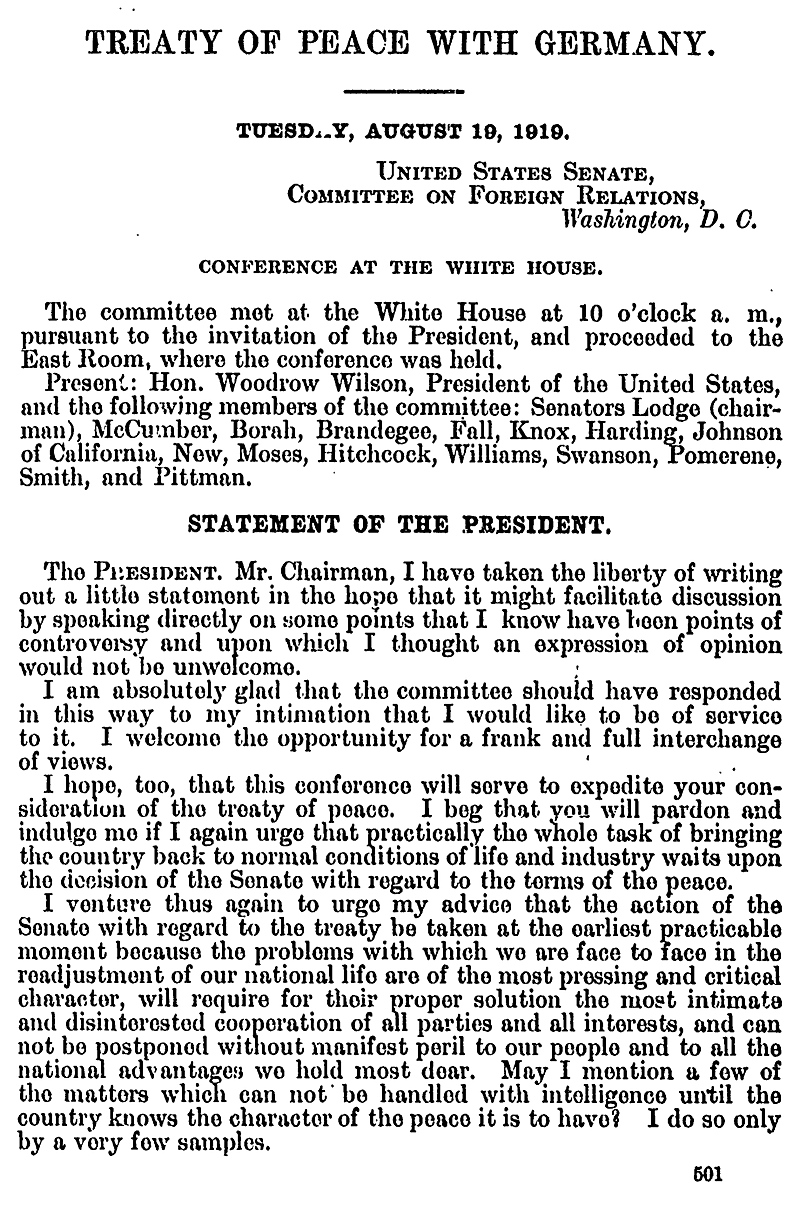
Wilson never walked onto the Senate floor that day. The committee came to him. The stenographic transcript of the meeting opens not with a description of a marble hearing room on Capitol Hill, but with a single line: the committee met at the White House at ten o'clock in the morning and proceeded to the East Room, where the President waited for them.
It is a small distinction, and it is easy to see why it gets flattened in the retelling. Wilson had, in fact, broken precedent five weeks earlier, on July 10, when he personally carried the treaty to the Senate chamber and delivered it into the body's hands, something no president had done before. That moment produced the widely quoted line about not wanting to "break the heart of the world." August 19 is usually folded into that same story of a president confronting the Senate. But by the time the committee actually sat down to question him, the setting had shifted from the Senate's turf to his own. The transcript makes it a matter of record.
Why the setting mattered
Two events had already made avoidance the safer strategy for Wilson. On July 31, Chairman Henry Cabot Lodge had opened six weeks of committee hearings that gave critics of the League of Nations a public stage, and Wilson had watched from a distance as skeptics picked at the treaty's language day after day. Lodge's Republicans held a Senate majority of only two, which meant a coalition of moderates and undecided senators could plausibly be won over. Wilson chose a different course. Rather than face the committee on its own ground, he invited its members to a private conference at the White House, where he read a prepared statement and then answered questions for roughly three and a half hours, according to the transcript's own closing note.
The choice of venue mattered symbolically, even if the transcript does not say why Wilson made it. A hearing on Capitol Hill would have put the President in the posture of a witness summoned before a body with power over him. A conference at the White House, arranged at his own invitation, put him in his own house instead, receiving a committee he had asked to come see him. However Wilson thought about that choice, the session ended on his terms: he invited the senators to stay for lunch, and the transcript closes on that note.
What the transcript actually shows
The conversation itself is where the popular version of this story gets even thinner. Wilson did not simply restate his case. Senator William Borah walked him through the League covenant's Article 10 clause by clause, pressing him to admit that no international body could compel the United States to act, only to advise it. Wilson agreed. Senator Frank Brandegee then spent a considerable stretch of the transcript picking apart the difference between a "moral" obligation and a "legal" one, a distinction Wilson defended but that many senators in the room plainly found unconvincing. Wilson himself put the stakes of that one article in the plainest terms he used all day.
Article 10 seems to me to constitute the very backbone of the whole covenant.
That sentence is worth sitting with, because Article 10 was exactly the article Lodge and the reservationists set out to neutralize that November, and exactly the point on which Wilson refused to bend. He told the committee himself that without it, the League would be little more than an influential debating society. The Lodge reservations did not strike Article 10 from the treaty text itself; they were conditions attached to the Senate's resolution of ratification, requiring congressional approval before the United States could act under that article. Wilson would not accept a ratification loaded with those conditions, and the Senate never ratified any version of the treaty, reserved or otherwise. American membership in the League died in that impasse.
The hearing also produced admissions that rarely make it into textbook summaries. Under direct questioning from Senator Hiram Johnson of California, Wilson acknowledged that Japan's promise to eventually restore the Shantung Peninsula to China rested on an understanding reached in Paris that was, in his own description, technically oral but literally written and formulated, and that he had been unable to get Japan to commit to a date for the transfer. Senator Albert Fall got Wilson to concede he had not even considered whether Germany, excluded from the League at signing, would have any say over amendments made before it was admitted. The senators pressed him hard on both points, working through the fine print of a document he had already signed and was now asking them to accept without changes.
The distinction that mattered later
None of this changes what everyone already knows about how the story ends. The treaty was rejected on November 19, 1919, and again the following March, when the Senate once more failed to approve it with the Lodge reservations. The defeat came from a coalition of Irreconcilables who opposed the League outright, Reservationists who wanted conditions attached to ratification, and Wilson Democrats who followed the President in rejecting those reservations. Wilson's own refusal to accept any reservation touching Article 10 was not a late, stubborn stand. The transcript from August 19 shows it was the same position Wilson held that morning at the White House, argued out loud, on the record, months before the votes that finished it.
The setting is a small detail. But it says something about how this fight actually worked. Wilson did not have to go to the Senate's turf. He received the Senate at the White House, made his case in the room where he lived and worked, and still could not move the men who would decide the treaty's fate.