4,048 Stars. Each One Is 100 Americans. Most People Walk Right Past Them.
There is a wall on the National Mall in Washington, D.C., covered in gold stars. Most visitors see it and keep walking. What the wall is actually saying is this: 4,048 stars, each one representing 100 Americans killed in World War II. Four hundred thousand dead. The full count is there, in gold, in public, on the western edge of a plaza most people cross without stopping.
The inscription beneath the stars reads: Here we mark the price of freedom.
The memorial that contains that wall was dedicated on May 29, 2004. By the time it opened, the generation it was built to honor was dying at a rate of more than 1,000 people per day. It had taken seventeen years from the moment someone first asked for it to exist.
One Veteran, One Question
The story of the National World War II Memorial begins in 1987 with a man named Roger Durbin. Durbin was a World War II veteran from Ohio who attended a town hall meeting held by his congresswoman, Representative Marcy Kaptur, a Democrat from Toledo. He asked her a single question: why was there no memorial on the National Mall dedicated to the Americans who had served in World War II.
Kaptur did not have a good answer. She introduced legislation that same year authorizing the American Battle Monuments Commission to establish such a memorial in Washington. The bill never came to a vote before the congressional session ended.
She introduced it again in 1989. Same result. She introduced it again in 1991. Same result. In January 1993, she introduced it a fourth time. Senator Strom Thurmond introduced companion legislation in the Senate the day before. This time it moved. The Senate passed it in March. The House passed an amended version in May. President Bill Clinton signed Public Law 103-32 into law on May 25, 1993, six years after Durbin first asked his question.
The authorization was one thing. Building it was another.
Eleven Years of Fighting
After the law was signed, the real work began, and it was not smooth. A site had to be selected, a design had to be chosen, and then both had to survive the approval process that governs what goes up on the National Mall.
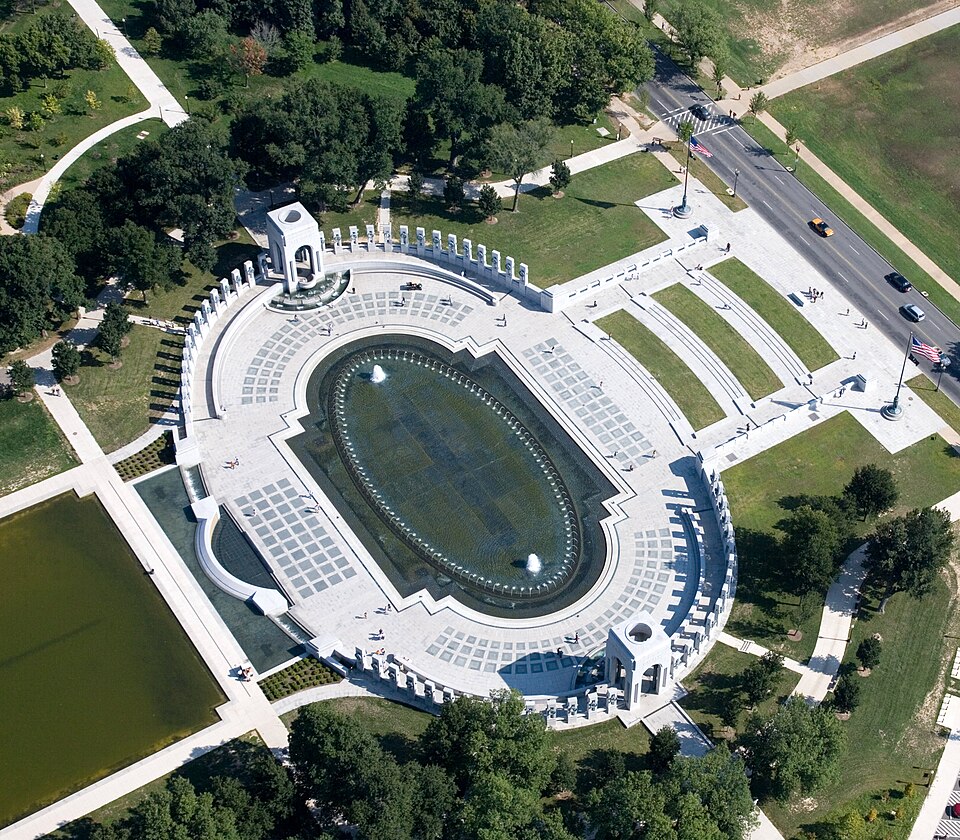
The site selected in October 1995 was the Rainbow Pool, a fountain at the eastern end of the Reflecting Pool, positioned between the Washington Monument and the Lincoln Memorial. The location was the most prominent available on the Mall. It was also immediately controversial. Critics argued the memorial would interrupt what had been an unbroken visual corridor between the two monuments, a line of open space that had stood for more than seventy years. They also pointed out that the site had historically been used for public demonstrations and protests, and a permanent structure would close it off permanently.
A nationwide design competition drew 400 submissions. The commission selected a design by Friedrich St. Florian, an Austrian-American architect, in 1997. The design was also contested. Critics called it overbearing and pompous. The Washington Post described it as a hodgepodge of cliche with the emotional impact of a slab of granite. The Philadelphia Inquirer raised comparisons to authoritarian architecture of the 1930s. The design went through years of revision as it moved through the required approval processes.
Congress eventually cut through the delays in a way that became its own controversy. Lawmakers passed legislation exempting the World War II Memorial from further site and design review, and dismissed pending legal challenges. The stated reason was straightforward: veterans were dying faster than the process was moving. Ground was broken in November 2000.
Bob Dole and the Money
Building the memorial required $197 million. The federal government contributed approximately $16 million. The rest had to be raised privately.
Senator Bob Dole, who had lost the use of his right arm to a German shell in Italy in 1945, served as co-chairman of the fundraising effort alongside Frederick W. Smith, the founder of FedEx and a former Marine. Dole drove the campaign for years. Veterans groups, corporations, and individual Americans contributed. The American Legion, the Veterans of Foreign Wars, and the Veterans of the Battle of the Bulge all donated. A direct mail campaign brought in millions more from ordinary citizens.
The 4,048 gold-plated silver stars on the Freedom Wall were cast at Valley Bronze in Joseph, Oregon. Dave Jackman, the foundry's president at the time, later recalled watching buckets of the stars move through production and doing the arithmetic in his head. Each star was 100 men. The buckets kept coming.
May 29, 2004
The memorial opened to the public on April 29, 2004. The formal dedication ceremony was held on May 29, with President George W. Bush presiding. Thousands of people attended, most of them elderly, many of them in wheelchairs, most of them wearing the caps of the American Legion or Veterans of Foreign Wars posts they had belonged to for decades.
The memorial as completed contains 56 granite pillars, each 17 feet tall, arranged in a semicircle around an oval plaza and reflecting pool. Each pillar is inscribed with the name of one of the 48 states as they existed in 1945, along with the District of Columbia, the territories of Alaska and Hawaii, Puerto Rico, Guam, American Samoa, the Philippines, and the U.S. Virgin Islands. Two triumphal arches anchor the north and south ends of the oval, inscribed with Atlantic and Pacific. Twenty-four bronze bas-relief panels along the entry walls depict scenes from the war: the physical exam, the oath, combat, the dead, and finally the homecoming.
The Freedom Wall stands on the west side of the plaza. Behind it, across 17th Street, the Lincoln Memorial is visible in the distance.
What Remains
Sixteen million Americans served in World War II. In 2004, when the memorial finally opened, fewer than four million were still alive. By 2024, the number had fallen below 100,000.
The memorial sits on 7.4 acres between two of the most visited monuments in the country. More than 4.6 million people walked through it in 2018 alone. Most of them passed the Freedom Wall.
It takes about thirty seconds to count what it is actually saying. Four thousand and forty-eight stars. One hundred dead per star. Four hundred thousand Americans who did not come home.
Roger Durbin, the veteran who asked the question that started all of it, died in 2000. The memorial he set in motion opened four years after his death.
Public Law 103-32 was signed by President Bill Clinton on May 25, 1993, authorizing the American Battle Monuments Commission to establish the memorial. Ground was broken in November 2000. The memorial opened on April 29, 2004, and was dedicated by President George W. Bush on May 29, 2004. Fewer than 100,000 of the 16 million Americans who served in World War II remain alive today.