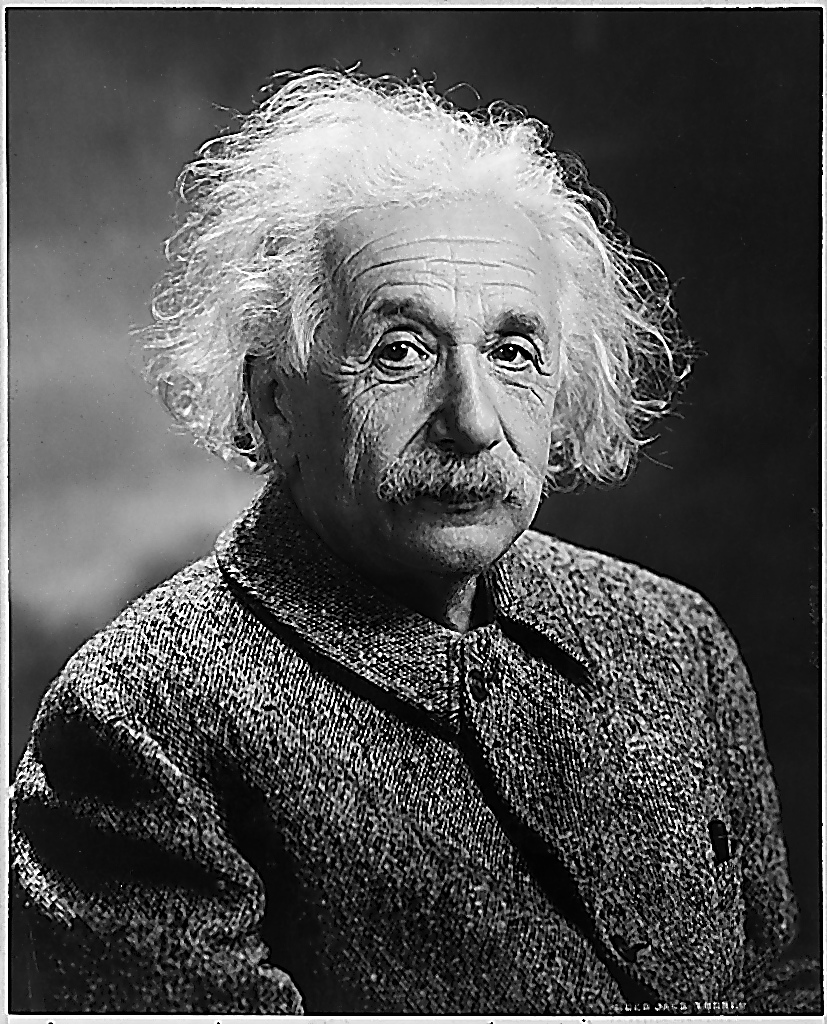
Ask most people who built the atomic bomb, and Einstein's name comes up before anyone actually involved in building it. It makes sense. He is the face of twentieth century physics, the wild hair and the tongue and E = mc². The popular shorthand treats him as the man who split the atom and handed the country a weapon.
He did neither. Einstein never worked on the Manhattan Project. He never saw the classified research that turned nuclear theory into an actual weapon until after the bombs had been used. His only direct contribution to launching the effort was a signature, on a letter he did not write, that took ten weeks to reach the president after he signed it.
A Letter Einstein Didn't Draft
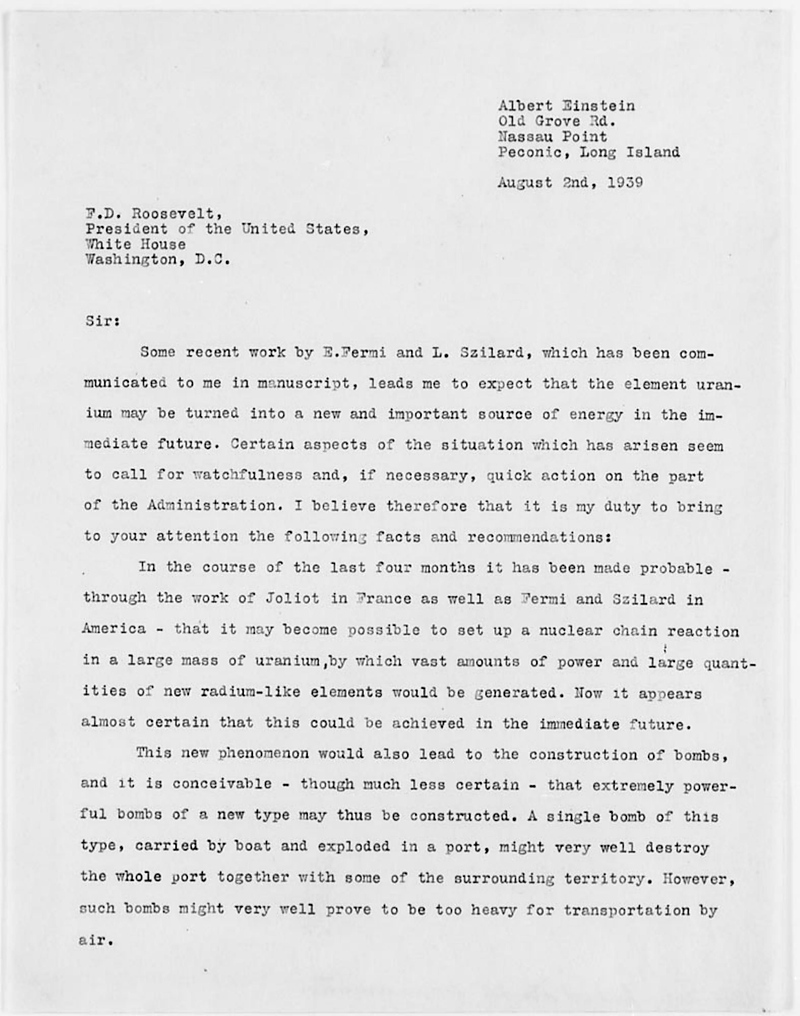
The letter dated August 2, 1939, and addressed to "F.D. Roosevelt, President of the United States" was the work of Leo Szilard, a Hungarian physicist who had fled Europe and spent the 1930s worrying that nuclear fission could be weaponized before anyone in Washington took the idea seriously. Szilard had conceived of a nuclear chain reaction back in 1933, patented it in secret through a British filing, and by the summer of 1939 was watching German physicist Siegfried Flügge publish openly on how atomic energy might be harnessed. That was the trigger. If German scientists were writing about it in public, Szilard reasoned, German officials were probably already working on it in private.
Szilard needed someone with enough stature to get a letter read by a president. He had that person: Albert Einstein, whom he had known since the 1920s, when the two of them had co-patented a household refrigerator design together. On July 12, 1939, Szilard and physicist Eugene Wigner drove out to the cottage Einstein was renting on Nassau Point, on the North Fork of Long Island, and explained what recent experiments with uranium might mean for weapons. Einstein's reply, delivered in German, was somewhere between surprise and understatement: he had not thought about that at all.
Three weeks later Szilard came back, this time with physicist Edward Teller behind the wheel, and dictated the letter's contents to Einstein directly. Back at Columbia, Szilard dictated an English version to a stenographer who later admitted she thought she was typing for a lunatic. Both a short version and a longer one were mailed out to Einstein for a signature. He sent both back signed, with a preference for the longer draft, which is the version that eventually reached the White House.
The Warning, In His Own Hand
Whatever Einstein's role in composing it, the letter carried his name and his authority, and its warning was direct. Recent work by Enrico Fermi and Szilard, it read, made it probable that uranium "may be turned into a new and important source of energy in the immediate future," and that certain aspects of the situation called for "watchfulness and, if necessary, quick action on the part of the Administration."
Then came the part that mattered. This new phenomenon, the letter continued, could lead to bombs of a type never built before, powerful enough that a single one carried by boat and detonated in a harbor might destroy the harbor along with the surrounding territory. The letter also raised a specific concern about Germany: it noted that Czechoslovakian uranium mines under German control had abruptly stopped selling their ore, and pointed out that the son of a senior German diplomat was working at the Kaiser Wilhelm Institute in Berlin, where uranium research was underway.
Nobody involved knew whether an atomic bomb would prove practical. The estimate at the time was that a chain reaction would need several tons of uranium, which is part of why the letter guessed such a weapon would be too heavy to fly and would have to be delivered by ship. It would take the British MAUD Committee's analysis the following year, built on theoretical work by physicists Otto Frisch and Rudolf Peierls, to show that the critical mass needed might be measured in kilograms rather than tons, small enough to load onto an airplane.
Ten Weeks of Silence
Einstein signed the letter and mailed it back to Szilard on August 9. Szilard then handed it, along with a cover letter of his own, to Wall Street economist Alexander Sachs, a Roosevelt confidant who had agreed to deliver it personally. Sachs asked the White House for a meeting. Before one could be scheduled, Germany invaded Poland on September 1 and the administration's attention went entirely to the outbreak of war in Europe.
Sachs did not sit down with Roosevelt until October 11, more than ten weeks after Einstein had signed the letter. According to Sachs's own later account, the first meeting did not go well. Roosevelt was polite but unconvinced, worried mostly about where the money would come from. Sachs asked for a second chance the following morning and reportedly won the president over with a story about Napoleon turning down Robert Fulton's offer to build steam powered warships, and what that refusal had cost France. Whether Roosevelt found the anecdote persuasive or simply appreciated the pitch, he told his aide General Edwin Watson that the matter required action. Within days Roosevelt had authorized an Advisory Committee on Uranium, though its first act was modest: about six thousand dollars for uranium and graphite, a fraction of what the research would eventually cost.
That committee is the direct ancestor of the Manhattan Project, which would spend roughly two billion dollars and employ well over a hundred thousand people before it produced a working weapon in 1945. Even so, most historians treat the letter as an accelerant rather than a prerequisite. Britain's own findings and America's entry into the war after Pearl Harbor would likely have pushed the United States toward a bomb program regardless. What the letter did was help move the issue onto Roosevelt's desk in 1939, well before Pearl Harbor forced the issue.
The Part He Never Played
Einstein was not one of the hundred thousand. When Army officials evaluated him for a security clearance in 1940, they turned him down, citing his pacifism and his left-leaning politics as security risks. He spent the war consulting for the Navy's Bureau of Ordnance on conventional explosives, with no access to and no knowledge of how the uranium research he had helped launch was actually progressing.
He learned what it had built the way much of the country did, from news reports on August 6, 1945, relayed to him by his secretary, Helen Dukas. Einstein spent much of the rest of his life on nuclear disarmament, co-founding the Emergency Committee of Atomic Scientists in 1946. In a 1947 piece for Newsweek, he said that if he had known Germany would fail to build a bomb, he would have done nothing. By his own account to Linus Pauling in 1954, he came to view the letter as the one great mistake of his life.
Signing the letter took him only a few minutes. Living with its consequences took the rest of his life.