For nine and a half months, Petersburg meant one thing: siege. That siege was never supposed to happen. On the evening of June 15, 1864, Petersburg may never have been more vulnerable than it was for a few hours. Then the moment passed.
The Setup
By mid-June 1864, Grant shifted the pressure south. Destroying Lee's army remained the underlying goal, but after Cold Harbor, Grant moved the Army of the Potomac across the James River without Lee realizing its true destination, aiming it instead at Petersburg, the rail hub that supplied Richmond. Cut those lines, and Lee's army would be forced into an increasingly desperate position.
Speed mattered because Lee did not yet know where Grant's army had gone. As long as that held, Petersburg was vulnerable in a way it would not be again.
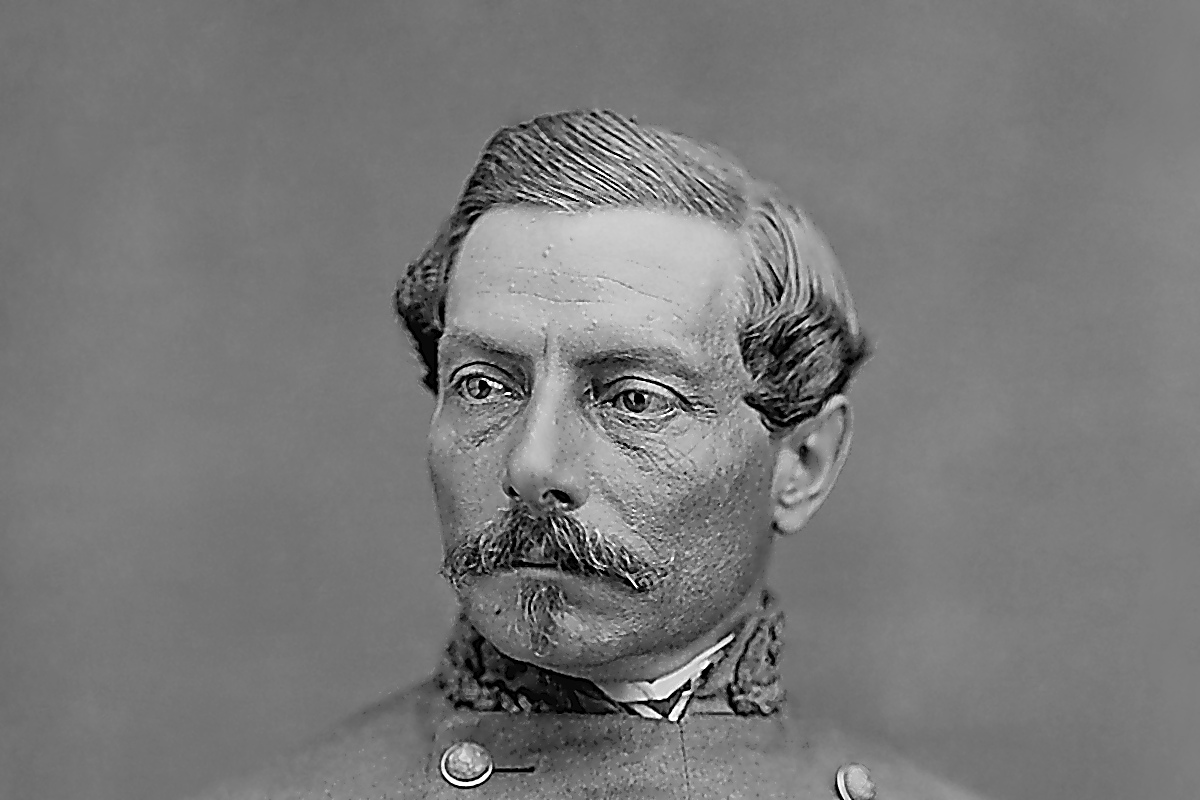
The man trying to save the city was General P. G. T. Beauregard, who had been warning Richmond about exactly this danger since June 9. Petersburg's defenses, known as the Dimmock Line, ran ten miles in a horseshoe of artillery redans and earthworks around the city. Beauregard could man only a fraction of it: roughly 2,200 men under Brigadier General Henry A. Wise, stretched, by Beauregard's own account, thin enough to post barely one soldier for every four and a half yards. From there south to the Appomattox River, a stretch of four and a half miles, Beauregard later wrote plainly that the line was defenseless.
Against them came Major General William F. "Baldy" Smith's XVIII Corps, with roughly 10,000 men immediately available for the assault, and Winfield Scott Hancock's II Corps not far behind.
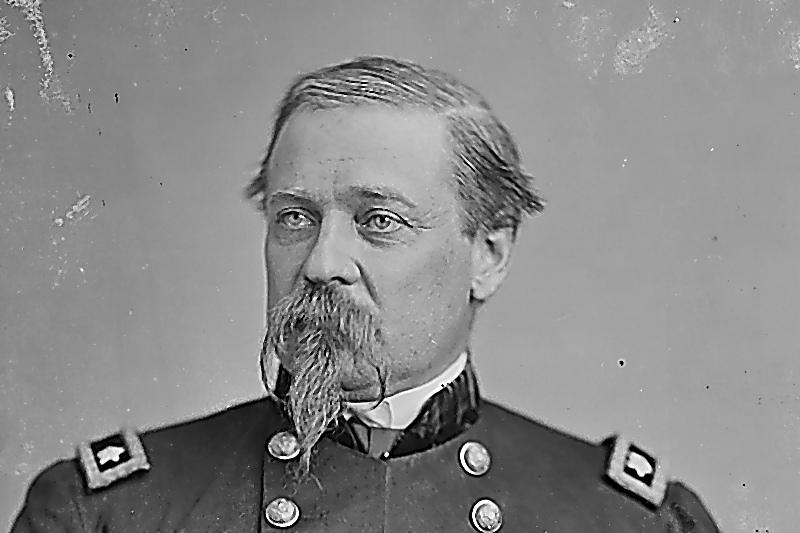 Major General William F. "Baldy" Smith, whose XVIII Corps broke the Dimmock Line on the evening of June 15, 1864. National Archives and Records Administration.
June 15: The Breakthrough
Smith's advance was slow from the start. His cavalry screen under Kautz ran into unexpected resistance at Baylor's Farm and pulled back. His artillery horses were watered all at once, delaying his guns for hours. By the time he was ready to move, it was nearly seven in the evening.
Smith sent skirmishers forward first, and Confederate gunners, expecting a full assault to follow, held their fire rather than give away their positions to a skirmish line. The skirmishers walked straight into the works. Hinks's division of U.S. Colored Troops helped break Battery 6, then rolled the line south through Batteries 7 to 11, in what Union observers at the time called the division's first major combat success in Virginia. By nightfall, Smith's men had broken through more than a mile of the Dimmock Line and taken sixteen guns. Beauregard's defenders fell back to a new, hastily organized line at Harrison's Creek.
Beauregard, writing decades later, did not soften what this meant: "Petersburg at that hour was clearly at the mercy of the Federal commander, who had all but captured it."
Grant had failed to tell Hancock that Petersburg was even the objective, and Hancock lost hours waiting on orders that came late and unclear. His corps arrived tired and thirsty, no longer positioned to exploit the gap Smith had already opened.
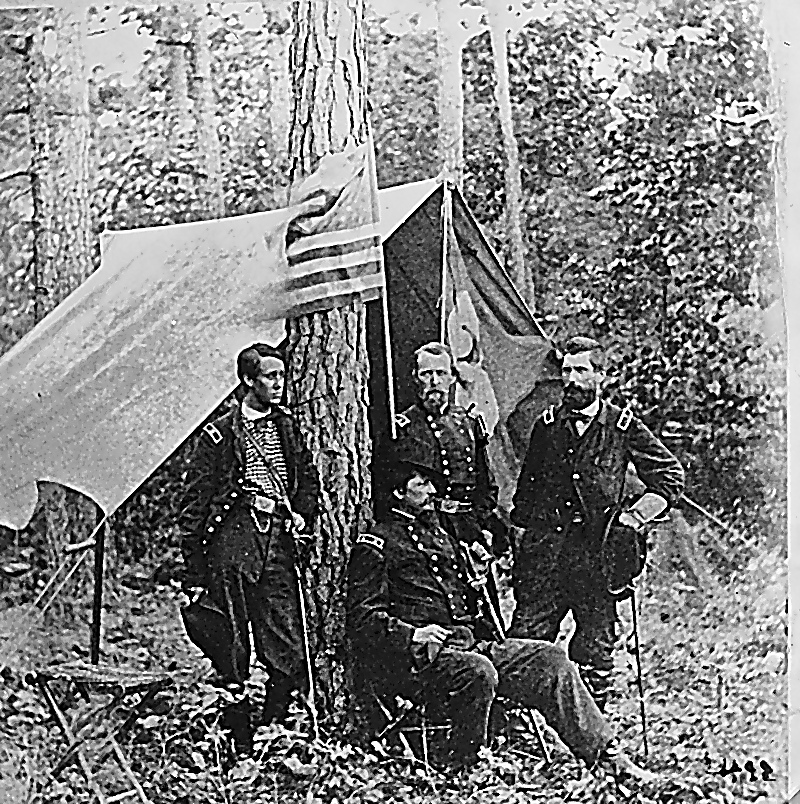 General Winfield Scott Hancock (seated) with division commanders Francis Barlow, David Birney, and John Gibbon at Petersburg, 1864. Birney and Gibbon are the two officers Beauregard named as having offered their divisions to Smith on the night of June 15. Library of Congress.
The Halt
Behind the captured batteries, the Confederate defenses were still improvised and incomplete. Hancock outranked Smith, but his corps had only just arrived after a day of confused orders, and Smith had spent the day studying the ground. Hancock deferred to Smith's judgment.
Smith telegraphed Butler: "Unless I misapprehend the topography, I hold the key to Petersburg."
Then he stopped.
Smith later defended the decision by pointing to his troops' exhaustion, his uncertainty about the ground ahead, and what he described as his Black troops being "intoxicated by their success" and difficult to keep in order. Beauregard's postwar verdict was blunter: Smith had failed to finish the job not for lack of opportunity but because "he could not realize the fact of the unparalleled disparity between the two contending forces."
Whether Petersburg would certainly have fallen to a night assault is impossible to know. What is clear is that the opportunity to try was real, and by morning it was gone.
Overnight, Beauregard gambled. He stripped his own defenses at Bermuda Hundred, ordering Bushrod Johnson's entire division to march for Petersburg, betting that Union general Benjamin Butler would not notice or exploit the opening. Butler didn't. By the morning of June 16, Beauregard had roughly 14,000 men behind the new defenses. Still badly outnumbered, but no longer the thin screen that had stood between Grant and Petersburg that afternoon.
June 16 to 18
Over the next two days, Union assaults captured ground in pieces but never broke through cleanly. Beauregard held on with a shrinking, exhausted force, telling Lee plainly in a June 17 telegram that he was fighting Grant's whole army with less than 11,000 men. Lee, still uncertain of Grant's true objective and receiving incomplete information from Petersburg, was slow to commit the Army of Northern Virginia south. Rooney Lee's cavalry reconnaissance helped confirm that Grant's army had crossed the James, and Lee began shifting his army south in earnest on the night of June 17 into 18.
By the time Lee reached Petersburg on the morning of the 18th, Beauregard had already pulled his men back overnight to a new, shorter line near Taylor's Creek, built and occupied without the Federals noticing. The Union's planned dawn attack walked into positions the Confederates had already abandoned, then stalled when it hit the real line behind them.
That day's fighting produced the Civil War's worst regimental loss in a single action. The 1st Maine Heavy Artillery, converted from garrison duty into infantry only weeks before, advanced roughly 900 men into an open field and lost 632 of them in a matter of minutes.
Aftermath
Meade wrote to his wife that it looked like they would have to go through "a siege of Petersburg before entering on the siege of Richmond." He was right. The digging that began that evening would not stop for nine and a half months.
Grant later wrote in his memoirs, "I believed then, and still believe, that Petersburg could have been easily captured at that time." Whether he was right remains impossible to prove. What is clear is that Petersburg was never again as vulnerable as it was on the night of June 15, and that the hours Smith gave Beauregard changed the campaign that followed.