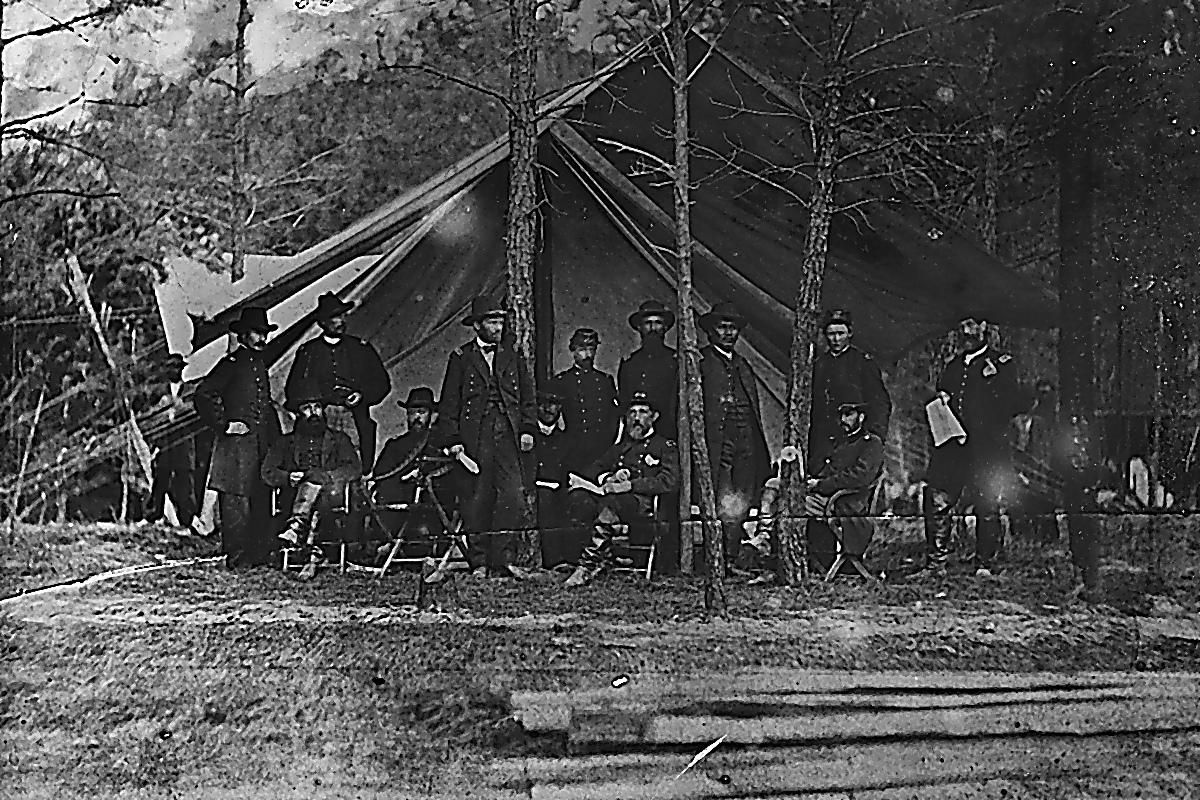
The Seven-Minute Myth at Cold Harbor
You have probably heard the number. Seven thousand Union soldiers, cut down in seven minutes, on a June morning outside Richmond in 1864. It shows up in documentaries, in comment sections, in half the popular retellings of the Civil War's bloodiest reputation. It is the number that turned Ulysses S. Grant into "the butcher" in the popular imagination.
The casualties were real. The seven minutes is much shakier than the casualty count itself.
Shelby Foote's widely read narrative history helped cement this image in the public mind, and he wrote that the seven thousand fell in the first seven or eight minutes of the assault. Other historians who accept a similar casualty figure, including James McPherson, Bruce Catton, and Mark Grimsley, describe it unfolding across something closer to half an hour. The National Park Service and the American Battlefield Trust both frame it as roughly thirty minutes. And Gordon Rhea, who spent years working through regimental returns for his 2002 volume on the battle, comes in well below all of them: three thousand five hundred to four thousand Union casualties for the entire June 3 morning assault, with the full day's fighting landing around six thousand against an estimated one thousand to fifteen hundred Confederate.
They disagree sharply over the numbers and the time span, and none of them is describing a precisely measured seven-minute casualty count. What they agree on is that a great many men fell very fast against a fortified line that had been given three days to prepare for them. The specific "seven minutes" detail is a compression, a number that got sharper and more dramatic each time someone repeated it, until it hardened into something that sounds like a documented fact but isn't quite one. That's worth understanding, because it says something about how a battle's reputation gets built. It does not make what actually happened at Cold Harbor any less brutal.
How the armies got to a crossroads outside Richmond
By the end of May 1864, Grant and Robert E. Lee had already fought their way through the Wilderness, Spotsylvania Court House, and the North Anna River, a month of nearly continuous contact that had cost both armies enormously. Grant's approach after each engagement was the same: sidestep left, force Lee to react, and try to get between the Army of Northern Virginia and Richmond before Lee could dig in again. Lee, outnumbered but fighting close to his own capital, kept beating him to the next position.
That pattern played out again in the last days of May. Grant pulled his army across the Pamunkey River and pushed southeast, and Lee shifted to meet him, settling behind Totopotomoy Creek about nine miles north of Richmond. Neither general was entirely certain where the other was heading. Lee sent cavalry under Wade Hampton to find out, and on May 28 that cavalry ran into Union horsemen under David McM. Gregg at Haw's Shop, one of the war's bloodiest cavalry engagements, fought mostly dismounted and left inconclusive.
Two days later, a small Confederate cavalry brigade got pushed back to a crossroads called Old Cold Harbor. It was an unremarkable spot, ten miles northeast of Richmond, named for a tavern that offered shelter but no hot food, a "cold harbor" in old English usage. The ground had already seen fighting once before. Two years earlier, during the Seven Days, the Battle of Gaines's Mill had been fought over nearly the same terrain, and Union soldiers digging in during the 1864 fighting kept turning up skeletal remains from that earlier battle. Whatever it lacked in scenery, Cold Harbor mattered because it sat on the roads Union reinforcements would use coming up from the Pamunkey, and because holding it would let Grant threaten Richmond directly.
Three days that gave Lee everything he needed
What happened at Cold Harbor between May 31 and June 3 was less a single battle than a slow accumulation of delay, most of it on the Union side, and Lee used every hour of it.
On May 31, Philip Sheridan's cavalry seized the Old Cold Harbor crossroads and held it against Confederate probing. Grant wanted infantry there fast, and this is where the trouble started. Horatio Wright's VI Corps and William "Baldy" Smith's XVIII Corps were both ordered to the crossroads, but a mistake in Smith's orders sent his corps several miles off course toward New Castle Ferry before it was corrected. Wright's men, meanwhile, were on a fifteen-mile march. Neither corps arrived in fighting shape until the afternoon of June 1, and Smith's men reached the field hours after Wright's already had.
Late on the afternoon of June 1, Meade ordered an attack anyway. Wright's and Smith's exhausted men briefly broke through the Confederate rifle pits before a counterattack drove them back. It cost about 2,200 Union casualties against roughly 1,800 Confederate and accomplished little beyond confirming how strong the Confederate position was becoming.
June 2 turned into a day of delay. Winfield Scott Hancock's II Corps, marching through the night to reinforce the line, got lost and did not arrive until 6:30 in the morning, hours later than planned. Meade pushed the assault back, first to 5 p.m., then, at Grant's urging, all the way to the early morning of June 3. Every hour of that delay went to Lee, who used it to build what a wartime newspaper correspondent called an "intricate, zig-zagged" system of trenches, seven miles long, with interlocking fields of fire and range stakes driven into the ground so his gunners could judge distance before the fog even lifted. Lee had also pulled in reinforcements, including Robert Hoke's division, bringing his strength to roughly 59,000 against Grant's 108,000 or more.
Corps commanders had been told to use the delay to examine the ground in front of their own positions. Accounts from the time suggest reconnaissance was inadequate in several sectors, and one Union officer who was there later called the failure to reconnoiter one of the campaign's most costly decisions. The dense woods and swampy terrain made proper reconnaissance genuinely difficult, and there was little coordination between the corps commanders and Meade's headquarters about how the attack would actually be carried out. Baldy Smith later said the plan amounted to proof there had been no plan at all. Many Union soldiers, veterans of the campaign's earlier slaughters, spent the evening of June 2 writing their names on slips of paper and pinning them inside their coats so their bodies could be identified.
June 3: the assault
At 4:30 a.m. on June 3, roughly 50,000 Union troops from three corps stepped off into fog and heavy ground mist. Beyond a shared jump-off time, marked by a single signal gun, there was little coordination holding the attack together. Within minutes, swampy terrain and heavy brush broke up the Union formations, and each corps ended up squaring off against whatever section of the Confederate line happened to be directly in front of it, rather than moving as one connected force. That let Lee's men enfilade the attackers from angles built into the fortifications, catching Union troops in crossfire they had no way to avoid.
The worst of it came fast. How fast, and how many men it cost, is exactly the disputed range described above: Rhea's reconstruction of three thousand five hundred to four thousand at the low end, the roughly seven thousand figure used by McPherson, Catton, and others at the high end, spread across a window that different sources place anywhere from a few minutes to half an hour. The only real Union success came on the far left, where Francis Barlow's division, part of Hancock's corps, broke through part of Breckinridge's line and briefly held it, taking several hundred prisoners and four guns before Confederate artillery and a counterattack drove them back out. Everywhere else, the attack stalled within the first hour. Union soldiers who survived the initial fire dug in where they stood, using bayonets and tin cups to dig, and in at least some places, according to accounts from the time, the bodies of dead comrades as part of their makeshift cover.
By 7 a.m., Meade was sending Grant messages asking whether to continue. Grant's reply, in his own words, was to suspend any assault that clearly was not going to succeed, but to reinforce any that was. At 12:30 p.m., after riding the lines himself, Grant ordered a suspension of further advance. An order went out that afternoon to renew it. Baldy Smith refused to obey the renewed order, and the refusal did not result in disciplinary charges against him.
Grant's report to Henry Halleck that afternoon read, "Our loss was not severe, nor do I suppose the enemy to have lost heavily." It was a statement wildly at odds with the scale of what had actually happened, and the truth of it became apparent to Union headquarters over the following hours as reports came in. That night, according to his staff, Grant told them, "I regret this assault more than any one I have ever ordered."
The four days after
What followed June 3 might be the worst part of the whole battle. Thousands of wounded Union soldiers lay in the open ground between the lines, unable to be reached by either side without drawing fire. For two days, June 3 and June 4, almost nothing was done about it while the armies traded sharpshooter and artillery fire. On June 5, Grant opened correspondence with Lee, proposing that unarmed men from both sides be allowed to move between the lines and recover their dead and wounded without having to formally request permission each time.
Lee turned the specific proposal down, not because he refused to let the wounded be recovered, but because he worried an informal, standing arrangement would lead to confusion between the lines. He proposed instead the customary procedure: a flag of truce, requested and granted each time either side needed one. On June 6, Grant and Lee did agree to a window, eight to ten that evening, for both sides to collect their wounded. But Lee's letter confirming it didn't reach the front lines until after ten o'clock, once the window had already closed. Hancock's outposts were never informed in time that the cease-fire had been arranged. Two Confederate officers and six men who went out looking for the bodies of their officers were captured by Union pickets who had no idea a truce existed. The matter had to be taken up again on June 7, when the parties finally arranged a truce that reached the troops, and a cease-fire took effect that evening, four days after the assault. By then, most of the wounded left between the lines had died. Frank Wilkeson, a Union soldier serving with an artillery battery who later wrote one of the war's more unsparing soldier memoirs, walked the ground afterward and recorded that every corpse he saw had turned black, and that the wounded who had not been reached in time had been left to be, in his words, "eaten alive by beetles" in the nights before help came.
The armies then sat facing each other in trenches, sometimes only yards apart, for another five days of sniping and artillery duels, before Grant finally disengaged on the night of June 12 and marched his army toward the James River and, eventually, Petersburg.
What the numbers actually say
There are really three competing estimates in play for June 3 alone, and popular history tends to flatten them into one. Seven thousand casualties in seven minutes is the version that is often repeated, and it is the version with the weakest support. Seven thousand casualties in roughly thirty minutes is the version used by several respected historians and by institutions like the National Park Service and the American Battlefield Trust. And three thousand five hundred to four thousand casualties for the entire morning assault is Rhea's much lower reconstruction, built from regimental returns rather than after-the-fact estimation. Rhea's number is the product of the most detailed reconstruction of the June 3 casualties done to date, but it has not replaced the higher figures in the wider literature. Both numbers still circulate, and reasonable historians land in different places.
The battle's total casualties, covering the full engagement from May 31 through June 12, are more settled, though even here different sources draw the boundaries of "Cold Harbor" slightly differently. The commonly cited Union total for the engagement is 12,737, a figure that traces back to the Official Records recapitulation and is used by the American Battlefield Trust and others. Confederate totals vary more, with figures ranging from roughly 1,500 up to 5,287 depending on the historian. That spread has less to do with which army kept better records than with differences in methodology: which days count as part of the battle, and how completely a given historian was able to reconstruct incomplete regimental returns.
That range matters, because it is exactly the kind of detail that gets lost when a battle turns into a legend. "Seven thousand in seven minutes" is clean and quotable. The actual record, pieced together from official returns, staff correspondence, and after-the-fact reconstruction by historians working from incomplete casualty rolls, is messier and in some ways more damning. Cold Harbor was not a single catastrophic instant. It was three days of avoidable delay, reconnaissance that mostly never happened, and an assault launched against a Confederate position whose strength Union command had badly underestimated.
Grant would write in his memoirs, years later, that he had always regretted ordering the last assault at Cold Harbor, and that no advantage had come from the losses it cost. He was not wrong about that. He also never claimed it happened in seven minutes.
Sources: Official Records, Series I, Volume XXXVI, Part 1, p. 180 (casualty recapitulation); Part 3, pp. 524-527 (June 3 dispatches), pp. 600-609, 638-639, 666-667 (Grant-Lee correspondence on recovery of the wounded, June 5-7, 1864). Gordon C. Rhea, Cold Harbor: Grant and Lee, May 26-June 3, 1864 (LSU Press, 2002). U.S. Grant, Personal Memoirs of U.S. Grant. Frank Wilkeson, Recollections of a Private Soldier in the Army of the Potomac (G.P. Putnam's Sons, 1886). Robert N. Thompson, "Cold Harbor: The Folly and Horror," Military History magazine, November 2006, on the command breakdown and the June 3 assault.