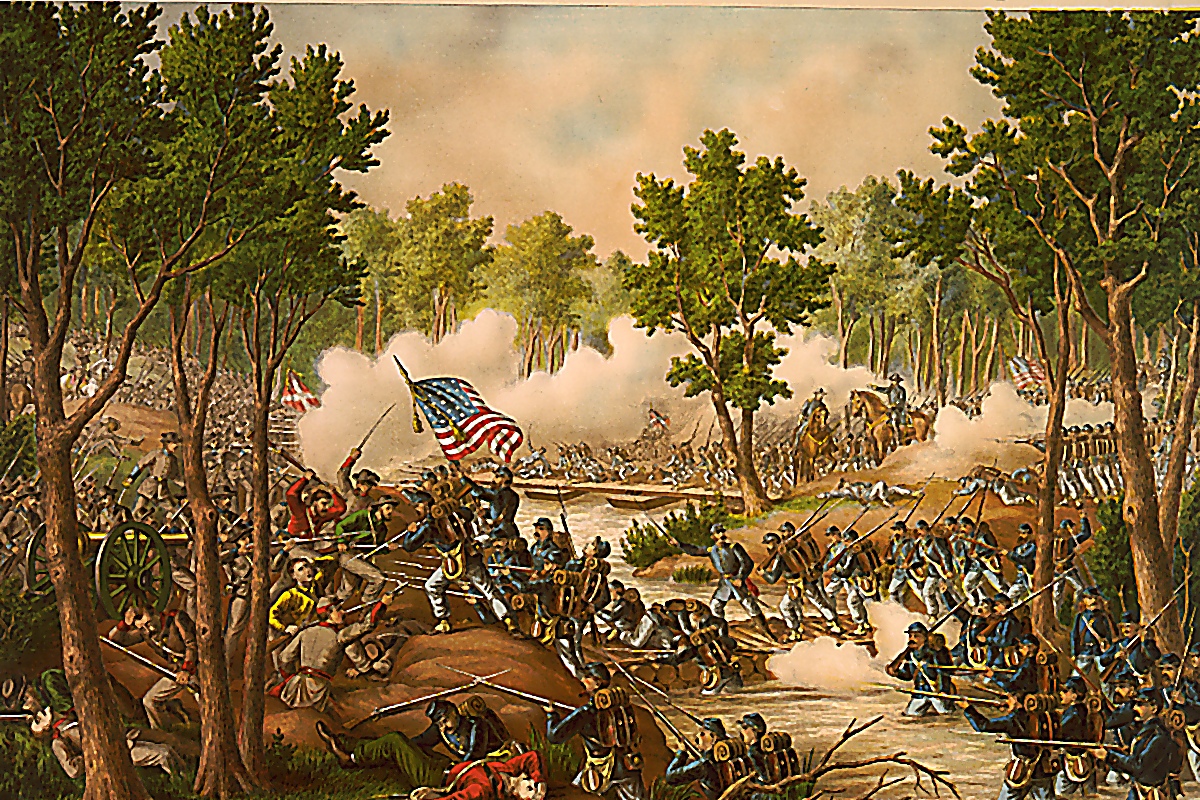
The Dress Rehearsal for the Bloody Angle
Popular memory treats May 12, 1864, as an inexplicable horror, twenty hours of hand to hand slaughter at a bend in the earthworks men started calling the Bloody Angle. What gets left out is that Ulysses S. Grant had already run something close to this experiment two days earlier, at a fraction of the scale, and watched the successful tactic collapse the moment it needed support. Two days later, with Meade coordinating a much larger supporting plan behind it, the army tried again. The tactic worked again. So did the collapse, at a scale nobody could contain.
The Race South
By the night of May 7, Grant had already broken with every Union commander who came before him. After two brutal, inconclusive days fighting Robert E. Lee in the tangled undergrowth of the Wilderness, the expected move was retreat north across the Rapidan to regroup, the way Hooker had done after Chancellorsville a year earlier almost to the day. Instead, when the Army of the Potomac reached a crossroads that night, Grant turned it south. His soldiers, expecting the familiar northward march of defeat, realized what was happening and began cheering in the dark, throwing their hats in the air. On to Richmond, they shouted.
The destination was Spotsylvania Court House, a crossroads village of a few stores and houses ten miles south, strategically important only because whoever held it stood between the other army and Richmond. Lee guessed the destination correctly and won the race by hours. His cavalry under Fitzhugh Lee reached a low ridge called Laurel Hill on the morning of May 8 and threw up makeshift barricades of fence rails just ahead of the arriving Federals. Confederate infantry under Richard Anderson, who had marched all night without rest after taking over James Longstreet's corps when Longstreet was wounded in the Wilderness, arrived just in time to reinforce the position. Union attacks throughout the day were repulsed with heavy losses. By nightfall, Lee's engineers were laying out earthworks that would eventually run more than four miles, and Grant's chance at open ground was gone.
Digging In, and a General's Last Words
Overnight, Confederate soldiers dug in using whatever they had, bayonets, tin cups, their hands, when there were not enough spades to go around. By morning on May 9 they had built a formidable line, with one visible weakness: a mile long salient bulging north toward the Union position, a shape soldiers on both sides started calling the Mule Shoe. A salient is a hard place to defend, exposed to fire from three directions at once, and Lee's own engineers flagged the problem. Lee chose to hold it anyway, trusting the high ground and thirty pieces of artillery packed inside it.
That same morning, Major General John Sedgwick, commanding the Union VI Corps, was walking his line while his men flinched at long range sharpshooter fire. Irritated, he needled them for cowering at shots fired from such a distance. "They couldn't hit an elephant at this distance," he said, in the version of the remark passed down by the officers who were with him. Within moments a bullet struck him below the left eye and killed him instantly, making him the highest ranking Union officer killed in the entire war. Horatio Wright took over the VI Corps in his place, and would command it again on May 12.
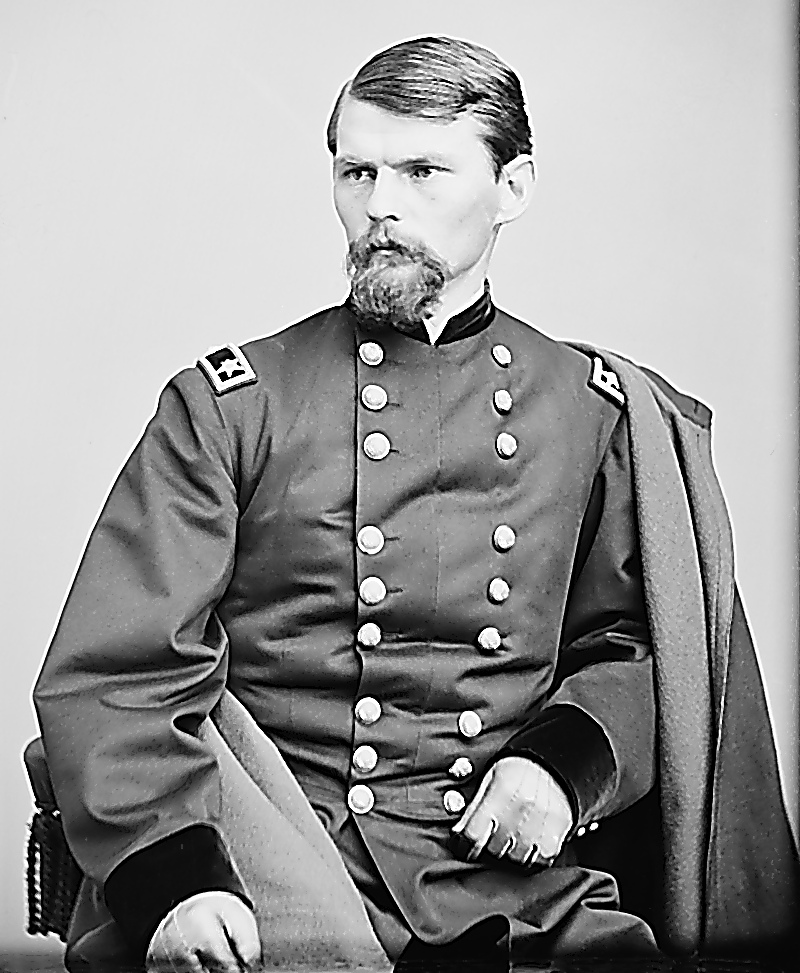 Col. Emory Upton, whose column formation broke the Mule Shoe's west face on May 10, 1864.
Upton's Column
Grant spent May 9 and 10 probing Lee's line on both flanks without success. Late in the afternoon of the 10th, a twenty four year old colonel named Emory Upton proposed something radically different from the way the Army of the Potomac had been assaulting fortified positions. Rather than a wide firing line, the kind that had been shredded by rifle and canister fire on every previous assault, Upton wanted a narrow, fast moving column. Twelve regiments, arranged four lines deep, ordered not to stop, not to fire, until they were standing inside the enemy trench.
Shortly after six in the evening, Upton's men, somewhere near five thousand of them, crossed two hundred yards of open ground and hit a Georgia brigade under George Doles so fast that the defenders barely got off more than a shot or two before Union soldiers were over the parapet. The attack achieved exactly what Upton had hoped the column would do. The first line broke through and fanned out to widen the gap, and the following lines poured in behind, driving deep enough to nearly reach the McCoull house at the heart of the salient.
Then it stalled. Gershom Mott's division, assigned to move in behind Upton and exploit the breakthrough, stalled under heavy Confederate artillery fire and never reached the fighting. With no reinforcement arriving and Lee's forces counterattacking from three directions, Upton pulled his men back out over the same open ground they had just crossed. Of the roughly five thousand men who went in, more than a thousand did not return.
Grant was impressed enough that Upton was soon promoted to brigadier general. The attack had proven the tactic worked. It had also proven, in the same afternoon, that a breakthrough with no organized force behind it collapses. What's worth being honest about is that Mott's failure wasn't simple cowardice or carelessness. His division had been battered at the Wilderness days earlier, was under artillery fire it could not effectively answer, and was operating with the same imperfect information and communication every unit at Spotsylvania had to contend with. It is easier, in hindsight, to call this a lesson than it was to solve it in real time.
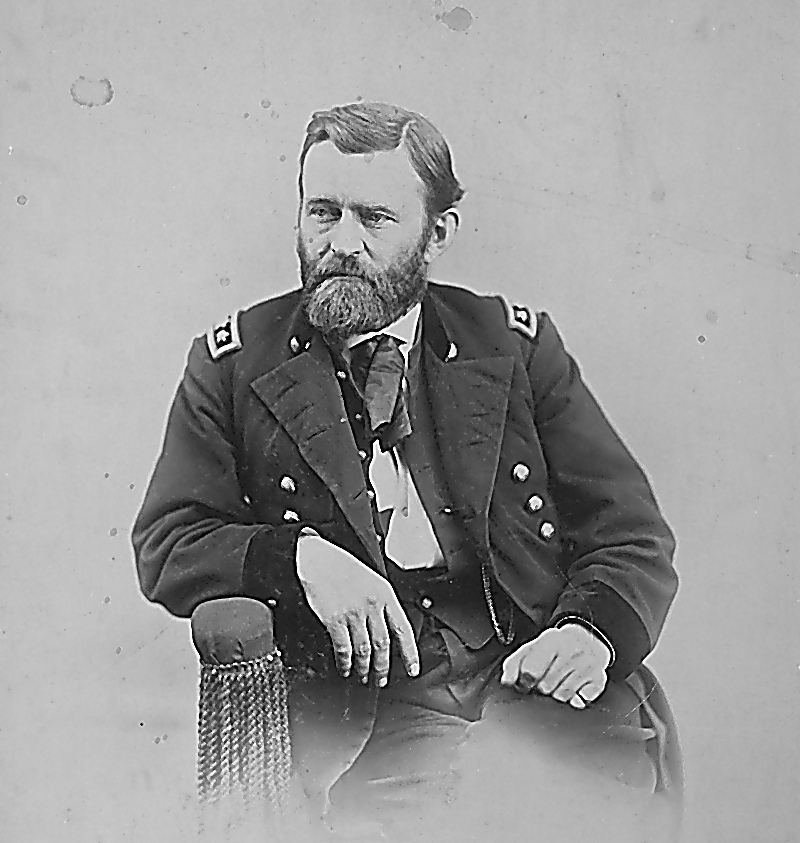 Ulysses S. Grant, whose private dispatch to Halleck on May 11 became public only after Secretary of War Stanton released it to the press.
"A Brigade Today. Will Try a Corps Tomorrow."
A Union cavalryman stationed at headquarters overheard Grant discussing the day's events with his staff and wrote down what he heard: a brigade today, will try a corps tomorrow. It is tempting to read that line as proof Grant simply decided to repeat Upton's plan at a larger scale and hope for a better outcome. The truth of what was actually organized for May 12 is more serious than that. This was not going to be Hancock's corps alone, sent in with nothing behind it the way Mott had failed to back up Upton. Meade, who held operational command of the Army of the Potomac and was responsible for the tactical coordination between corps, built a much larger plan: Hancock's II Corps would strike the apex of the salient, while Burnside's IX Corps hit the eastern leg and Warren's V Corps and Wright's VI Corps applied pressure elsewhere, designed to keep pressure on other parts of Lee's line and make it harder for him to concentrate reserves against Hancock.
There was no attack on May 11 while the army repositioned. Grant did send a dispatch that morning to Chief of Staff Henry Halleck in Washington, summarizing six days of brutal fighting and closing with a line that would soon become famous: I propose to fight it out on this line if it takes all summer. It was not written as a public rallying cry. Secretary of War Edwin Stanton released it to the newspapers, and it took on a life of its own from there.
That evening, Hancock's II Corps moved into position near the Brown family farm under a torrential downpour. On the Confederate side, Lee had picked up intelligence suggesting Grant might be withdrawing toward Fredericksburg, and to keep his artillery mobile for a pursuit, he ordered the guns pulled out of the Mule Shoe, a decision Grant had no way of anticipating and could not have planned around. Allegheny Johnson, commanding the division inside the salient, grew suspicious enough as the night wore on to request the guns back. The order did not reach the artillery camps until roughly half past three in the morning, shortly before Hancock's men were set to move.
The Bloody Angle
Hancock's assault began at 4:35 on the morning of May 12, in thick fog left over from the night's rain. The damp morning ruined many Confederate powder charges, leaving some defenders unable to fire when the Federals reached the works. Some of the returning Confederate guns fared no better. Several arrived at the line just as Hancock's men swept over it and were captured before they could be effectively employed, a few without firing a shot. Hancock's men overran the position in minutes, virtually destroying one brigade, capturing Allegheny Johnson and fellow general George Steuart along with nearly four thousand prisoners and much of the battered Stonewall Brigade.
For a moment it looked like exactly the breakthrough Grant and Meade had planned for. Then the same problem that had stopped Upton reappeared, compounded by everything that comes with attempting the same kind of breakthrough on a vastly larger scale. Thousands of Union soldiers, most of them strangers to the ground, crowded into a captured position roughly half a mile wide, in dense fog, with thousands of prisoners needing to be guarded and moved. The interior of the salient was no help either. Felled trees, abatis, and hastily dug entrenchments that made sense as a defensive position were now an obstacle course for the men who had just taken it, and mud from the overnight rain slowed everything further. It is not accurate to say nobody had a plan for what came next. It is accurate to say the plan required a level of coordination that fog, mud, thousands of prisoners, and a salient's worth of broken terrain made close to impossible to execute in real time.
The rest of Meade's supporting plan did not fully hold up either. Warren's V Corps, tasked with pressuring Laurel Hill to keep Confederate reserves pinned in place, attacked so weakly that Meade nearly relieved him of command that same day. Without that pressure holding, more of Lee's army was free to converge on the breach than the plan had intended.
Confederate resistance also reorganized faster and more effectively than it had on May 10. Lee, moving toward the threatened section near the McCoull house, tried to personally lead a counterattack the way he had at the Wilderness the week before. His men refused to let him, and it took John B. Gordon's urging along with a Virginia soldier grabbing the bridle of Lee's horse, Traveller, before Lee agreed to fall back. Gordon's division drove into the gap and helped stabilize the eastern side of the salient within about half an hour, considerably faster than the Confederate response Upton had faced two days earlier. On the western leg, where the fighting would prove worst, Robert Rodes coordinated a defense centered on Stephen Ramseur's brigade, reinforced as the fighting wore on by Abner Perrin's and Nathaniel Harris's brigades, rushed over from William Mahone's division, and later by Samuel McGowan's South Carolina brigade, feeding units in one after another as Union troops kept coming.
Amid all of it, Richard Ewell, the Confederate corps commander responsible for the salient, lost his composure, cursing at retreating men and reportedly striking at least one with the flat of his sword. Lee confronted him directly, according to accounts from the field: how can you expect to control these men, he said, when you have lost control of yourself.
Twenty Hours Without a Name for It
What followed at the bend in the line that soon earned the name Bloody Angle has been described by nearly every historian who has written about it as among the worst close quarters fighting of the entire war. Union and Confederate soldiers, separated in places by nothing more than a log breastwork, reached each other through gaps and over the top with bayonets, clubbed muskets, and rifles handed forward loaded so the man at the front could keep firing without stopping to reload. A torrential rainstorm continued through much of the fighting, turning the bottom of the trenches into a mix of mud, rainwater, and blood. Bodies piled up in places four and five deep, and soldiers were forced to periodically clear corpses out of the way simply to keep fighting.
The fighting continued past dark and did not end until close to two in the morning on May 13, by which point Confederate engineers had finished a new defensive line half a mile to the rear and the exhausted survivors at the Angle withdrew unit by unit. So much rifle fire was concentrated on one section of the line that an oak tree twenty two inches in diameter was severed and toppled by small-arms fire alone. The stump is preserved today at the Smithsonian.
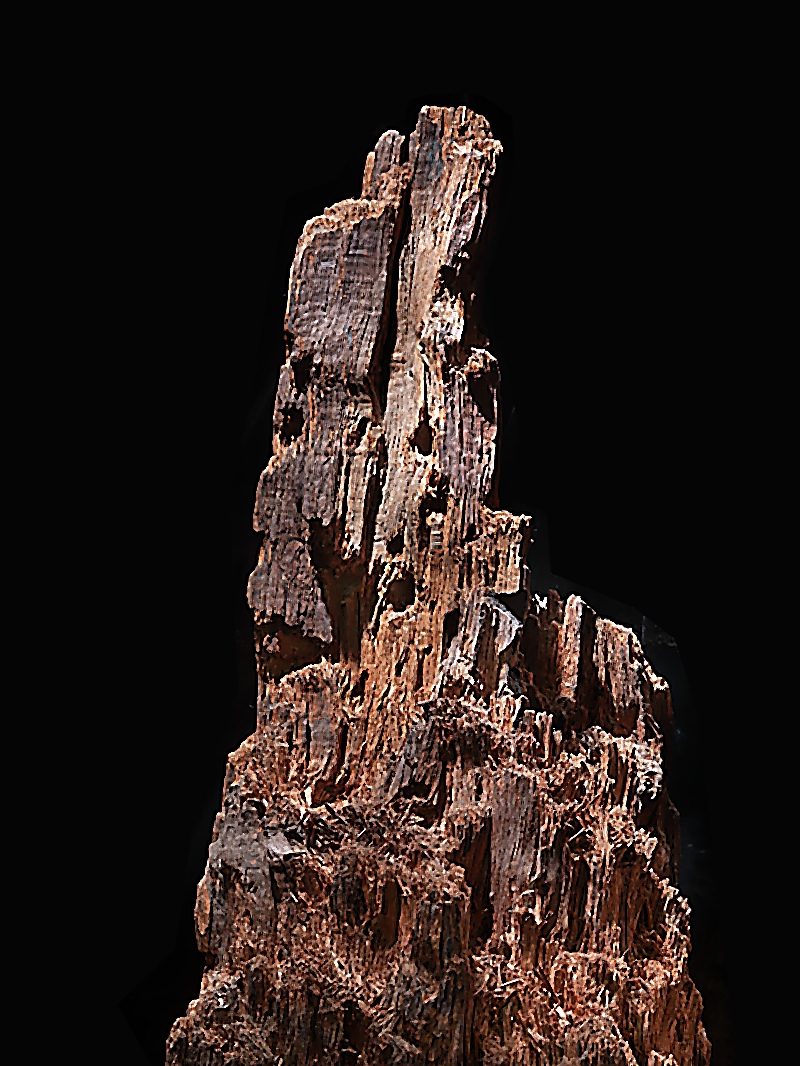 What remained of a twenty-two-inch oak, severed entirely by small-arms fire at the Bloody Angle. Now held by the Smithsonian's National Museum of American History.
May 12 alone had cost roughly seventeen thousand casualties combined between both armies, among the bloodiest single days of the entire war. The precise Union and Confederate split is harder to state with confidence than popular accounts often suggest, since Confederate record keeping from these days is incomplete. The ground fought over so viciously did not simply sit abandoned afterward. The Confederates held it long enough, at enormous cost, to finish the new line to their rear, then withdrew into that line in an organized retreat rather than a rout.
What the Dress Rehearsal Actually Shows
It would be simpler, and more dramatic, to say Grant watched a lesson on May 10 and ignored it on May 12. That is not quite what the record supports. Meade's plan for May 12 was larger and more coordinated than what backed up Upton two days earlier, built specifically to prevent the kind of unsupported breakthrough that had doomed the first attempt. What the record does support is a harder and more interesting question. Upton's small column proved a fortified line could be broken. It also proved, in miniature, how easily a breakthrough could be lost. Scaling that success up did not just make the attack bigger. It multiplied every problem that makes a battlefield breakthrough difficult to exploit: more men to coordinate in less space, more prisoners to manage, more terrain to cross inside a salient never designed to be crossed quickly, and less visibility to manage any of it in the fog and rain. The Confederate withdrawal of artillery the night before, a decision entirely outside Grant's control, only deepened the breach and added to the chaos that followed.
Grant did not stop after Spotsylvania. Unable to break Lee's line even after a failed follow up assault on May 18, he disengaged on May 21 and continued the pattern that had defined the campaign since the Wilderness, refusing to retreat, moving instead toward another position further south. At Cold Harbor three weeks later, Grant would confront a related but not identical version of the same larger dilemma: how to attack an entrenched enemy when the opportunities for maneuver kept narrowing and every frontal assault grew more costly than the last.